Why Does US Military Wants All The Existing Boeing 747-8?

Washington DC; May 2026: The Boeing 747 is one of the aviation history’s most successful widebody airliners, but the final 747-8 variant was anything but a black sheep. After spending $4 billion to modernise the 747’s systems, adding new engines, stretching the airframe, and reprofiling the wing, Boeing was able to sell 155 units, most of which were for the freighter 747-8F. The passenger 747-8i received just 36 orders from three airlines (along with some BBJ sales), and the final passenger 747 was delivered to Korean Air in 2017, while the last 747-8F was delivered to Atlas Air in 2023.
A decade and a half after the 747-8 entered service, a new customer has emerged for the 747-8i variant: the United States Air Force. After formally selecting the 747-8i as the platform for a future presidential transport aircraft, it’s now looking to buy up more examples of the type to support its operations. As the 747 is no longer in active production, parts supply may be limited in the future, which means that the only way to sustain the operations of the 747-8i in the distant future will be to take parts from existing aircraft. As such, the USAF is looking to get its hands on as many examples as it can.
Boeing had been considering the stretching of its 747 variants since the early 1990s, whereas the 747-8i was officially launched in 2005, mainly at the request of Lufthansa. The airline, which had already ordered the Airbus A380 in 2001, desired an improved version of the 747 that could hold more premium seats to serve a rotating selection of large business markets year-round with fewer economy seats than the A380. Finally, Lufthansa was the only passenger airline that inclined towards the 747-8i, ordering 19 aircrafts.
The 747-8i was projected as a competitor to the A380, specifying the plane with roughly 25% fewer seats than an A380. In real airline configurations, however, the 747-8i typically seated roughly 40% fewer passengers than an A380, since the buyers (operators) desired more business-class seats than the comparatively economy-heavy layouts. In addition, early 747-8s missed initial fuel burn projection. As such, the 747-8i seated 40% fewer passengers than the A380, but only burned 18% less fuel overall, making it to be an uncompetitive aircraft.
In addition to the A380, the 747-8i also faced stiff challenges from the 777-300ER variant, which was slightly smaller, just as capable, and far more fuel efficient, and these two factors killed any potential market for the stretched 747. The only other passenger 747-8 operators were Korean Air and Air China, but orders by Chinese airlines are primarily politically motivated. Meanwhile, Korean Air acquired the 747-8i in part to support local production of 747-8 components, and it also ordered the type after ordering the A380.
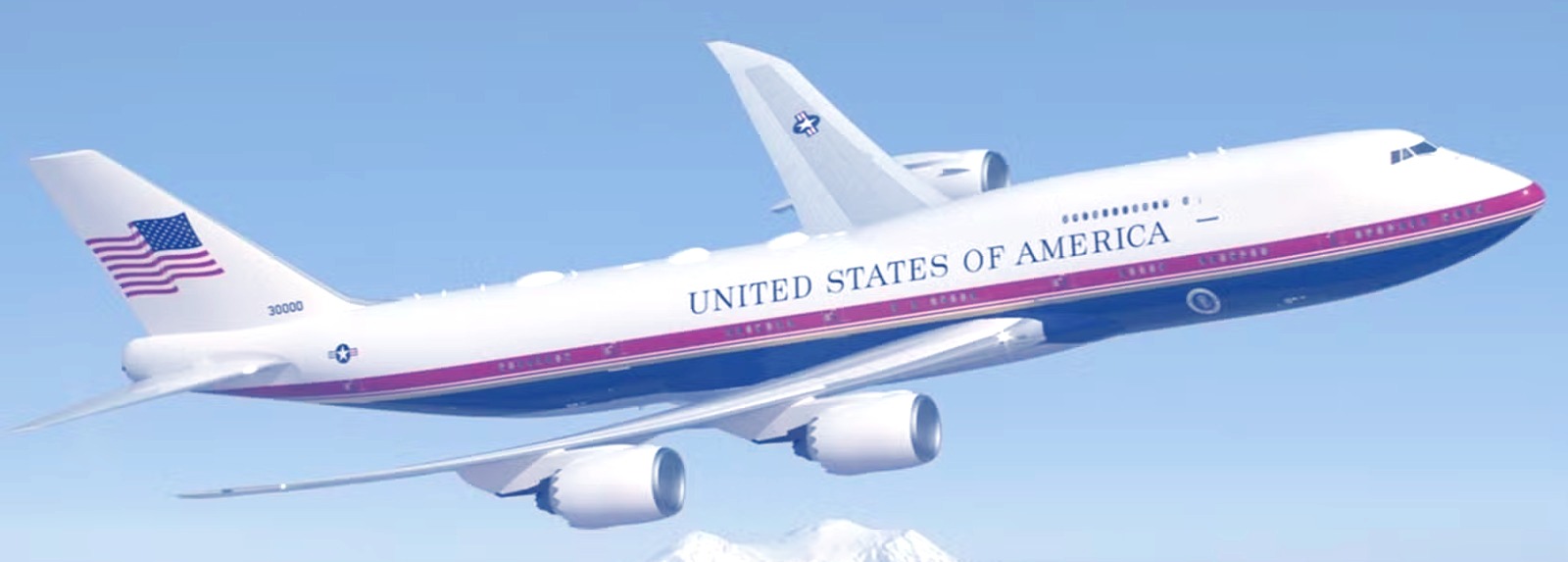
It was in 2015, the United States Air Force selected the 747-8i as the platform for the Boeing VC-25B, the replacement for the 02 VC-25As that had transported the United States President under the ‘Air Force One’ callsign. EADS, then the name of the parent company of Airbus, was invited to bid with the A380, but EADS declined to participate due to the poor economics of constructing 02 A380s in the US. As such, the 747-8i was the only participant, with the USAF selecting 02 747-8 white-tails, which were originally intended for defunct Russian airline Transaero, to be converted to VC-25B specifications.
In 2019, the USAF also began a separate program to replace its current fleet of Boeing E-4B Nightwatches, which dated back to the 1970s. Sierra Nevada Corporation was selected to develop the aircraft in 2024, dubbed the SNC E-4C, and it later acquired 05 used 747-8s from Korean Air the same year, at an average price of $135 million per aircraft. These aircraft began arriving in 2025, and SNC is currently targeting to complete the conversions for all aircraft in 2036.
| Boeing 747-8i Operators | Number Ordered | Number In Service |
| Air China | 07 | 07 |
| Korean Air | 10 | 05 |
| Lufthansa | 19 | 19 (02 to be transferred to USAF) |
| Total | 36 | 31 |
More recently, the USAF announced that it would acquire two used 747-8s from Lufthansa. This transaction caught some by surprise, given that Lufthansa has long been the most enthusiastic operator of the 747-8, but the sale rewarded Lufthansa with $400 million. This represents a significant jump in price for the aircraft, as the USAF paid $200 million per unit. The newly acquired aircraft will primarily be used for spare parts and training, rather than actively flying for the USAF.
The VC-25B is the successor to the VC-25A. The 02 VC-25As in service are typically used to transport the US President, although the ‘Air Force One’ callsign is assigned to any USAF aircraft carrying the president. The VC-25As were delivered in 1990 and 1991, making them among the oldest presidential transport aircraft in the world, and this has led to increases in maintenance costs as well as deteriorating reliability. In addition, they’re based on the Boeing 747-200B, an aircraft that debuted in the early 1970s.
Currently, the VC-25Bs are intended to enter service in 2028, after years of delays. The USAF desired a four-engine aircraft so that the VC-25B wouldn’t need to divert in case of an engine failure, and a large aircraft was also necessary due to how these planes would be configured. The current VC-25As include features like an onboard bedroom for the First Family, a medical annex, a full conference room, as well as a host of defensive and communications equipment. The VC-25B will incorporate updates to the current security measures found on the VC-25A, as well as many more classified features.
Although the current VC-25As were among the last 747-200Bs delivered, the 747 line as a whole remained in active production. However, the 747 line closed in 2023, with the final passenger 747-8i having been delivered several years earlier, and this means that parts are far harder to come by than in the VC-25A’s years of service. To sustain the two VC-25Bs, the USAF needed to obtain additional units to be used as parts donors, which it found in the form of the former Lufthansa 747s. When other passenger 747-8s inevitably come up for retirement, expect the USAF to snatch these up as well.
The VC-25A fleet is old, unreliable, and expensive to maintain, yet they remain in active service due to delays with the VC-25B. President Donald Trump has been vocal about his dissatisfaction with the delays, and his solution came in the form of N7478D. This was a Boeing 747-8 BBJ that was originally delivered to Qatar and would be donated as a ‘gift’ to the US in 2025. The transaction raised significant questions regarding legality and ethics, while there were doubts about the true practicality of hastily converting the aircraft, which was built as a private jet, to serve as Air Force One.
Still, the program moved on, with L3Harris being awarded the contract to convert the former private jet for official presidential use. It’s unclear the extent to which the new plane will be modified, as it’s targeted to enter service during the summer of 2026, roughly a year after it was donated. Reportedly, the aircraft will omit some of the VC-25’s typical features to expedite the conversion process. These omissions may result in restrictions on the missions that it can operate.
Team Maverick.








Trump Declares Strait of Hormuz Reopened Under US Protection, Imposes Full Blockade on Iranian Shipping
Washington, July 2026 : US President Donald Trump on Tuesday announced that the Strait of …

Trump Declares Strait of Hormuz Reopened Under US Protection, Imposes Full Blockade on Iranian Shipping
Washington, July 2026 : US President Donald Trump on Tuesday announced that the Strait …