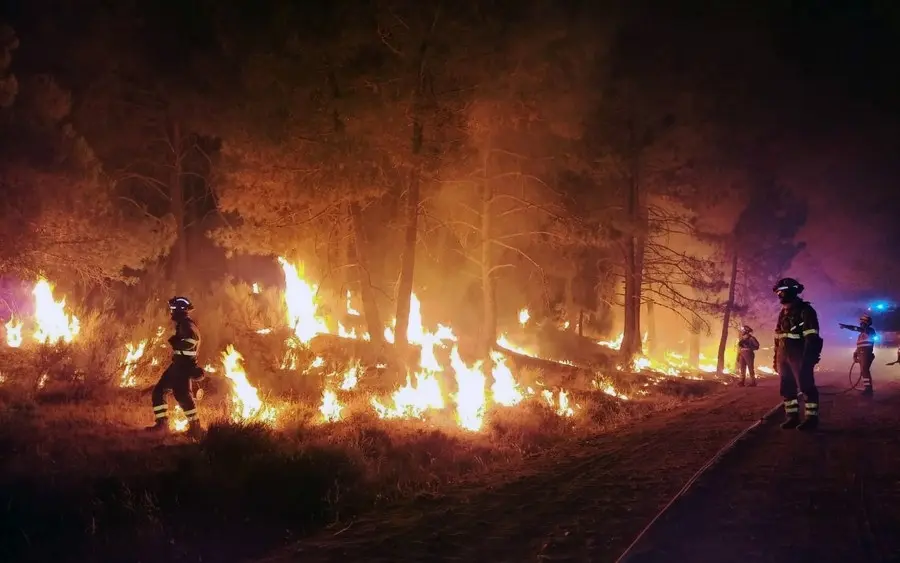
Spain Battles Devastating Wildfires as National Emergency Declared, Tens of Thousands Affected

Madrid, July 2026: Spain is grappling with one of its worst wildfire seasons in recent memory, as massive blazes continue to rage across central parts of the country, forcing widespread evacuations and prompting the government to declare a national emergency. The fires, which have swept through the Madrid region and neighbouring Avila province, have scorched vast areas of land, displaced thousands of residents, and triggered an extensive domestic and international emergency response.
Authorities said the wildfires continued to burn on Saturday despite cooler overnight temperatures, with strong winds and low humidity severely hampering firefighting operations. Emergency officials warned that weather conditions remain highly favourable for the rapid spread of flames, making containment efforts increasingly difficult.
Madrid Regional President Isabel Díaz Ayuso described the disaster as the “worst fire in the history of the region,” underscoring the scale of the crisis.
According to the latest official figures, nearly 91,000 people have either been evacuated from their homes or instructed to remain indoors across the Madrid region, Avila province and parts of neighbouring Toledo. The fires have already destroyed or damaged approximately 45,000 hectares of land in Madrid and Avila alone, devastating forests, agricultural areas and local infrastructure.
The fires in central Spain are part of a wider wave of wildfires affecting several parts of the country this summer. Major blazes are also burning in the eastern province of Castellón, while earlier this month deadly wildfires in Almeria claimed 13 lives. Data from the European Forest Fire Information System shows that nearly 130,000 hectares have been consumed by wildfires across Spain since the beginning of the year.
Thousands of emergency personnel, including firefighters, soldiers, police officers and civil protection teams, have been deployed to combat the fires. Spain’s Military Emergency Unit remains at the forefront of operations, helping regional authorities protect communities, critical infrastructure and evacuation routes.
Recognising the severity of the crisis, Spain has activated the European Union Civil Protection Mechanism, enabling assistance from several partner nations. Greece and Italy have each deployed two Canadair firefighting aircraft along with additional support planes. Italian aircraft were already participating in aerial firefighting missions over Madrid and Avila on Saturday.
International support has extended beyond aircraft. Greece has sent 33 emergency personnel, Italy has deployed 14 specialists, while neighbouring Portugal has dispatched 129 firefighters and emergency responders along with 41 emergency vehicles, including fire engines, bulldozers, ambulances and command vehicles.
Meteorologists have attributed the rapid spread of the fires to a dangerous combination of extreme weather conditions. Javier Armeteros, Madrid delegate of Spain’s State Meteorological Agency, said firefighters were confronting what is commonly known as the “30-30-30 rule”—temperatures above 30 degrees Celsius, relative humidity below 30 per cent and wind speeds exceeding 30 kilometres per hour.
In the affected areas, temperatures climbed beyond 32 degrees Celsius, humidity dropped below 30 per cent and wind gusts reached between 50 and 60 kilometres per hour, creating ideal conditions for explosive fire behaviour.
The extreme intensity of the fires has also forced emergency crews to alter their firefighting strategy. José María Bermúdez, spokesperson for Madrid’s Forest Rangers Corps, said firefighters could not directly attack the advancing fire front because it would amount to “going straight to death.” Instead, crews have focused on protecting populated areas, vital infrastructure and evacuation corridors whenever conditions permit.
Israel Naveso, spokesperson for Madrid’s firefighters’ union, described the unfolding disaster as the result of a “perfect storm.” He cited abundant vegetation following a wet winter, three intense heatwaves within six weeks and persistent strong winds as the factors that combined to create ideal conditions for multiple fast-moving wildfires.
Authorities have warned that the crisis is far from over. Spain’s latest national wildfire risk assessment indicates that large parts of eastern, southern and central Spain remain under high to extreme wildfire risk, raising fears that additional outbreaks could occur in the coming days unless weather conditions improve significantly. Emergency services remain on high alert as firefighters continue their battle to bring the devastating blazes under control.
(The content of this article is sourced from a news agency and has not been edited by the Mavericknews30 team.)






Pope The Holy Father IV Advocates For The Intentional Choice For Caring The Elders.
Vatican City; July 2026: The theme of this year’s ‘World Day for Grandparents and th…

Pope The Holy Father IV Advocates For The Intentional Choice For Caring The Elders.
Vatican City; July 2026: The theme of this year’s ‘World Day for Grandparents and …