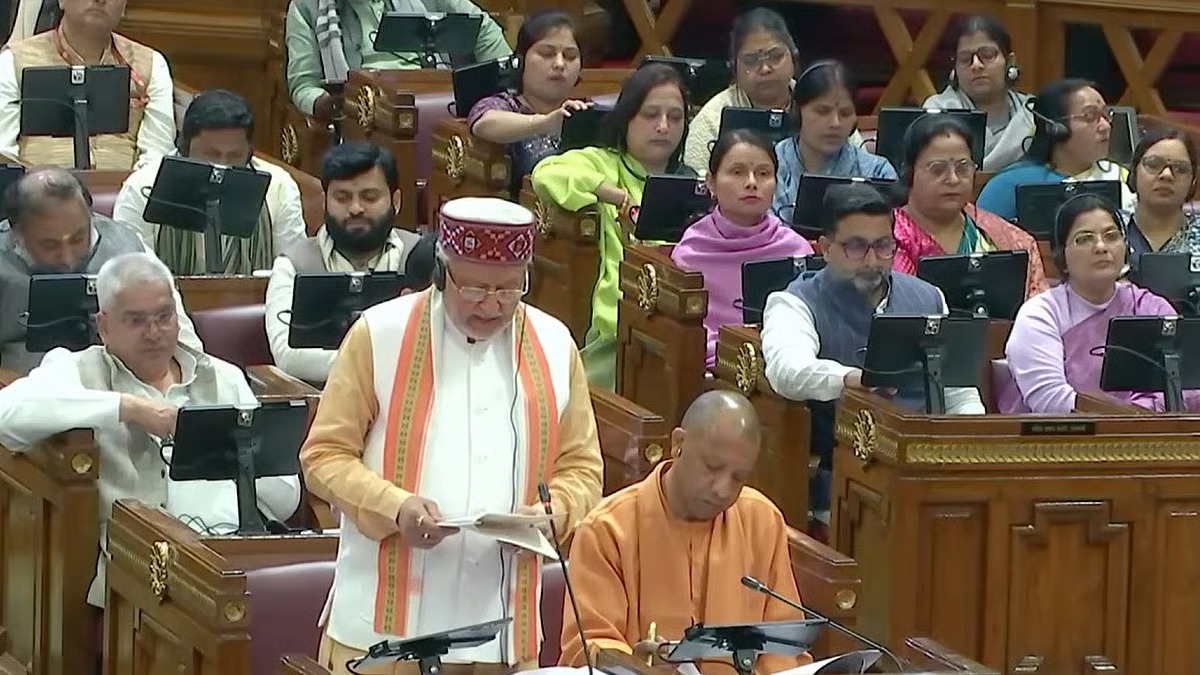
Finance Minister Suresh Khanna presented the Economic Review report in the Assembly, outlined a strong Law and Order framework

Lucknow, February 2026 : Finance Minister Suresh Khanna on Monday tabled the Economic Review Report of the Uttar Pradesh Government for the year 2025-26 in the Budget Session of the Legislative Assembly, which included a detailed description of the government’s achievements in the field of law and order and public security.
He stated, “The Uttar Pradesh Government has given top priority to strengthening law and order in the state by taking strict action against organized crime and mafia networks. This has had a positive impact, resulting in a remarkable decline in the crime rate, thereby increasing the confidence of both the general public and investors”.
Finance Minister Suresh Khanna informed, “According to the Economic Review, police reforms have been given a new direction by promoting technology-based modern policing. The use of CCTV, the Digital Case Management System, and strict action against criminals have enhanced police efficiency and accountability”.
He added, this has created an environment where people can lodge complaints without fear and has strengthened crime control. With regard to women’s safety, the state government has effectively implemented a Zero Tolerance Policy. Under the Safe City Project, the deployment of women police beats, CCTV networks, and Anti-Romeo Squads has ensured the safety of women at public places and workplaces. Additionally, through the Uttar Pradesh Factory Act (Amended) 2025, women have been provided equal opportunities in industrial work, especially in night shifts.
Under Mission Shakti, the integration of safety, health, and employment services has given new momentum to women’s self-reliance and social participation. At the same time, to strengthen judicial cooperation, Fast Track Courts and e-Courts have been established, accelerating the judicial process.
The Economic Review also mentions that through the Jan Vishwas Adhiniyam, the criminalization of minor procedural offenses has been eliminated, thereby reinforcing a transparency-based governance model.
Overall, the government’s initiatives in law and order, women’s safety, and judicial reforms have played a significant role in making Uttar Pradesh a safe and investment-friendly state.
Finance Minister Suresh Khanna tabled the Economic Review Report in the Assembly, presenting details of achievements in the health sector
Finance Minister Suresh Khanna on Monday tabled the Economic Survey Report for the year 2025-26 of the Uttar Pradesh government on the floor of the Assembly during the budget session. The report presented a detailed account of efforts and achievements made toward strengthening health services in the state.
According to the data in the Economic review, the state government is fully committed to strengthening medical infrastructure, expanding medical education and training, and providing quality healthcare services to the general public.
While presenting the Economic Review Report, Finance Minister Suresh Khanna said, “A total budget provision of ₹46,728.48 crore has been made for the medical and health sector in the financial year 2025-26. This is the highest allocation ever, clearly indicating that the state government has accorded top priority to medical health and family welfare. The budget ensures adequate funds for hospitals, health centres, medical education institutions, health infrastructure, and public welfare health programs”.
Citing the Reserve Bank of India’s report “State Finance: A Study of Budgets of 2025-26”, the Economic review states that Uttar Pradesh’s health budget in 2025-26 accounts for 6.1 percent of the total budget, which is higher than the national average. This fact shows that the state government is investing more in health services compared to other states.
According to national health accounts estimates and updated reports periodically published by the Ministry of Health and Family Welfare, Government of India, there has been a continuous increase in the share of government expenditure in the state’s total health spending. At the same time, a decline has been recorded in the out-of-pocket expenditure of the general public.
As per the Economic Review, this change indicates that increased government investment is reducing the financial burden of healthcare on citizens. Higher budget allocations have been made for improvements in hospitals, clinics, immunization, national health programs, and health infrastructure, leading to better access to services and improved quality.
The Economic Review also states that due to the reform-oriented efforts of the state government and the impact of schemes such as the Janani Suraksha Yojana and the Pradhan Mantri Surakshit Matritva Abhiyan, there has been a significant increase in institutional deliveries.
In rural areas, the active role of ASHA workers and ANMs has continuously encouraged pregnant women to opt for deliveries at hospitals and health centres. In 2021-22, a total of 34.74 lakh institutional deliveries took place in the state, which increased by 18.02 percent to reach 41 lakh in 2024-25.
In 2024-25, 96.12 percent of total deliveries in the state were institutional. In contrast, the number of non-institutional deliveries, which was 3.35 lakh in 2021-22, declined by 50.44 percent to 1.66 lakh in 2024-25. This achievement is considered a direct result of the government’s positive efforts and improved access to health services.
The state has also achieved a notable milestone in the field of immunization. According to the Economic Review, children aged 0 to 5 years in all districts of the state are being regularly provided free immunization against 12 life-threatening diseases like polio, tuberculosis, diphtheria, tetanus, whooping cough, Haemophilus influenzae type-B (Hib), hepatitis-B, pneumonia, Japanese encephalitis (JE), measles, rubella, and diarrhoea.
Pregnant women are also being vaccinated to protect against tetanus. Under the routine immunization program, as per HMIS data, 100 percent of children in the state were fully immunized in 2024-25. In 2025-26, up to September 2025, 28.62 lakh children (98 percent) have already been fully immunized. The Economic Review described this as a positive outcome of public awareness campaigns, improved service delivery, and strengthening of health services.
The Economic Review Report also mentions efforts being made to reduce neonatal, infant, and child mortality rates. Under the National Health Mission, important schemes such as Sick New-born Care Units (SNCU), Nutrition Rehabilitation Centres, Home-Based New-born Care (HBNC), and Kangaroo Mother Care (KMC) are being implemented in the state.
Through these programs, special care is being provided to vulnerable and malnourished children, leading to continuous improvement in child health indicators.





New Financial Year to Bring Tax, Labour and Travel Reforms from April 1
Mumbai, March 2026 : A host of major financial and regulatory changes will come into effec…

New Financial Year to Bring Tax, Labour and Travel Reforms from April 1
Mumbai, March 2026 : A host of major financial and regulatory changes will come …