Council Of The European Union Approves Flexibility For Austria To Increase Defence Spending.

Brussels; February 2026: The Council of the European Union today (17th February 2026) have activated the National Escape Clause (NEC) under the stability and growth pact (SGP) for Austria. The measure will help Austria transition to higher defence spending at national level without putting its debt sustainability at risk.
The clause covers a period of four years and a maximum of 1.5% of GDP in flexibility. The flexibility provided by the national escape clause will not have any effect on Austria’s ongoing commitment to address its ongoing excessive deficit, provided that the flexibility is used for increased defence spending.
For all other expenses, Austria remains bound by the budgetary rules and must remain committed to the implementation of the revised economic governance framework irrespective of the clause’s activation.
The National Escape Clause (NEC) allows a member state to temporarily deviate from budgetary requirements in response to exceptional circumstances outside their control, while ensuring debt sustainability. The EU has activated the national escape clause to respond effectively to heightened geopolitical tensions which pose a significant threat to European security. This threat creates a growing need to ramp up the European defence industry.
The reformed EU economic governance framework allows member states to make use of this flexibility by temporarily increasing public spending or running higher deficits without being considered in breach of the fiscal rules set out in the stability and growth pact.
16 other EU member states – Belgium, Bulgaria, Croatia, Czechia, Denmark, Estonia, Finland, Germany, Greece, Hungary, Latvia, Lithuania, Poland, Portugal, Slovakia and Slovenia, have also had their requests to activate the national escape clause approved.
Austria’s Pledge –
On 11th December 2025, Austria submitted a request to the Council and the Commission, to
activate the national escape clause. In its request, Austria sets out that, in a context of heightened geopolitical tensions, Russia’s continued war of aggression against Ukraine and its threat to European security constitutes an existential challenge for the Union, which requires a significant increase of defence spending.
This situation is an exceptional circumstance outside the control of each Member State. Specifically, Austria underlines the purchase of military equipment in 2025 given the deterioration of the geopolitical situation throughout the year. In light of this, Austria is requesting the activation of the national escape clause for the period from 2025 to 2028, in line with the other Member States for which the Council has already activated the national escape clause for defence.
In its request, Austria reports data on total defence expenditure until 2026 (Table 1). In addition, Austria intends to safeguard its long-term defence capabilities also after 2026. Therefore, the increase in defence expenditure has a major impact on the public finances of Austria.
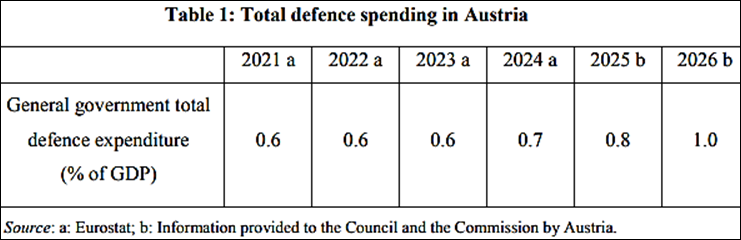
Austria estimates that the increase in total defence expenditure as a ratio to GDP from 2021 to 2025 has been in the order of 0.2 percentage points and therefore contributes to deteriorating the government balance and increasing government debt.
All else being equal, an increase in expenditure over the period covered by the national escape clause will lead to higher government debt and a higher deficit by the end of that period. Indicative projections run by the Commission and assuming, by 2028, a linear uptake of the full increase in government expenditure allowed by this recommendation suggest that the deficit-to-GDP ratio and debt-to-GDP ratio in 2028 would be 1.2 PPS. And 1.7 PPS. higher, respectively, than if net expenditure grew in line with the path set by Council Recommendation C/2025/3958.
**[[PPS – Purchasing Power Standard is an artificial currency unit. Theoretically, one PPS can buy the same amount of goods and services in each country. However, price differences across borders mean that different amounts of national currency units are needed for the same goods and services depending on the country. PPS are derived by dividing any economic aggregate of a country in national currency by its respective purchasing power parities.
PPS is the technical term used by Eurostat for the common currency in which national accounts aggregates are expressed when adjusted for price level differences using PPPs. Thus, PPPs can be interpreted as the exchange rate of the PPS against the euro]]**.
This would likely require an additional fiscal adjustment after the period of activation of the national escape clause in order to meet the requirements of the fiscal framework, including to ensure that the debt ratio is put or remains on a plausibly downward path, or stays at prudent levels below 60% of GDP over the medium term, and that the deficit stays or is brought below 3% of GDP and maintained
below the reference value over the medium term. Austria acknowledges that, going forward, structurally higher defence expenditure may require policies to preserve fiscal sustainability and compliance with the fiscal rules over the medium term. The limited projected increase in deficit and debt levels caused by the national escape clause, together with Austria’s commitment to implementing the necessary adjustment to fulfil all the requirements of the fiscal framework in the next plan, ensures that fiscal sustainability is preserved over the medium term.
General government defence expenditure data are compiled and released by the national statistical authorities and Eurostat according to the International Classification of the Functions of Government (COFOG) in the framework of the European System of National Accounts (ESA2010). These data are appropriate to assess the impact of defence spending on government deficit, debt and net expenditure, and related concepts. Eurostat, in close cooperation with the national statistical authorities, are establishing a data collection process. The data collection process needs to be aligned with reporting requirements established by Council Regulation (EU) No 479/200910
Moreover, for some of the contracts for military equipment signed during the period of activation of the national escape clause, delivery may occur at a later stage, therefore impacting public finances only after the period of activation of the clause. To cater for this eventuality, the flexibility granted under the national escape clause should also apply to defence expenditure linked to such later delivery, provided that the corresponding contracts were signed during the period of activation of the clause and that this delayed defence spending remains within the overall cap mentioned above.
The expenditure financed by loans provided under Council Regulation (EU) 2025/1106 of 27 May 2025 establishing the Security Action for Europe (SAFE) for the Reinforcement of European Defence Industry Instrument, would automatically benefit from the above flexibility. To this end, Member States would report to Eurostat all defence-related expenditures made under the SAFE Instrument under the categories ‘defence products’ and ‘other products for defence purpose’ as defined in Regulation (EU) 2025/1106.
This recommendation does not modify the definitions of government deficit, debt and net expenditure, and related concepts. Data based on these concepts are to be compiled and reported by Austria in accordance with Regulation (EU) 2024/1263, Council Regulation (EC) No 479/2009 and Regulation (EU) No 549/2013.
Council’s Recommendations –
During the period 2025–2028, Austria is allowed to deviate from and exceed the maximum growth rates of net expenditure as set by Council Recommendation C/2025/3958 to the extent that the net expenditure in excess of these maximum growth rates is not more than:
(i) the increase in defence expenditure in percent of GDP since 2021;
(ii) provided that the deviation in excess of the maximum growth rates of net expenditure does not exceed 1.5% of GDP.
In the years after 2028, Austria may still deviate from and exceed the maximum growth rates of net expenditure as set by a Council Recommendation in accordance with Articles 17, 19 or 20 of Regulation (EU) 2024/1263, to the extent that the net expenditure in excess of these maximum growth rates is related to deliveries of military equipment contracted before end-2028 and remains within the overall cap mentioned above.
In accordance with Article 22(7) of Regulation (EU) 2024/1263, the deviations from the maximum growth rates of net expenditure as set by the Council that are allowed by this Recommendation will not be recorded as debits in the control account of Austria.
In order to ensure correct recording of the additional expenditure Austria is to include actual and planned data on total defence expenditure (COFOG division 02), including on defence investment (COFOG division 02 P.51) and any expenditure to be financed by SAFE loans that are not covered in COFOG-02:
a) for years T-4, T-3, T-2 and T-1 (with year T being the current year, 2026) in the reporting to the Commission (Eurostat) in accordance with Council Regulation (EU) No 479/2009;
b) for years 2021 through year T (current year), in national medium-term fiscal structural plans and in annual progress reports in accordance with Articles 11(1) and 15, and 21(1) of Regulation (EU) 2024/1263;
c) for years T (current year) and T+1 in draft budgetary plans in accordance with Regulation (EU) No 472/2013 of the European Parliament and of the Council.
Team Maverick.


Thousands Welcome Egypt’s World Cup Heroes After Historic Campaign
Cairo, July 2026 : Thousands of jubilant football fans lined the streets and gathered at A…

Thousands Welcome Egypt’s World Cup Heroes After Historic Campaign
Cairo, July 2026 : Thousands of jubilant football fans lined the streets and gathered …