AI Offers an Opportunity to Strengthen Democracy: Minister Adv. Ashish Shelar

AI Impact Summit 2026; Confidence Expressed that Maharashtra Has Emerged as a Hub of Technological Revolution
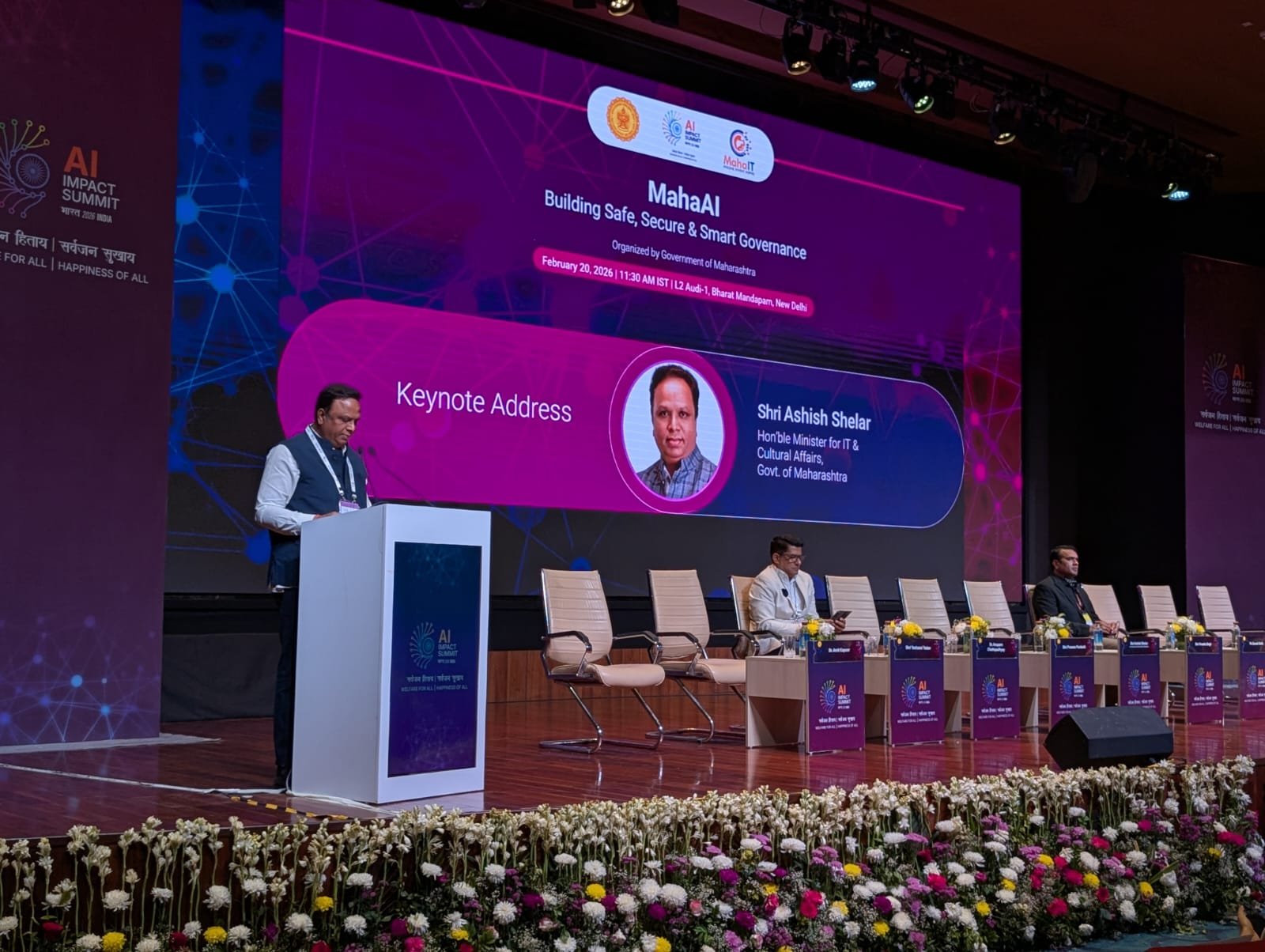
New Delhi, Feb 2026 : Artificial Intelligence is not merely a technological revolution but a powerful opportunity to strengthen democracy, said Maharashtra’s Minister for Information Technology and Cultural Affairs, Ashish Shelar. Emphasising the need for secure and smart governance, he stated that Maharashtra has effectively deployed AI in administration and has emerged as a leading centre of this technological transformation.
The minister was speaking at the AI Impact Summit 2026, organised at Bharat Mandapam, during a session titled “Maha AI: Building Safe, Secure and Smart Governance”, hosted on behalf of the Government of Maharashtra. Virendra Singh, Secretary, Information Technology, was also present on the dais.
Highlighting the digital journey of Maharashtra under the leadership of Chief Minister Devendra Fadnavis, Minister Shelar said the state has used technology not only to bring a human-centric approach to governance but also to make administration faster, more transparent, and more accountable. He explained that initiatives such as the ‘Maha Crime’ project, implemented in collaboration with Microsoft, have significantly strengthened crime prevention, accelerated investigations, and enhanced transparency in policing. He noted quoting that Microsoft CEO Satya Nadella has also praised the effectiveness of this system.
The minister further stated that MahaIT is developing an advanced “intelligent government infrastructure” in the state, built on a cloud-native and API-driven model. Through this platform, several AI-enabled initiatives are being rolled out, including smart recruitment processes, AI-based property mapping for urban local bodies, real-time civic dashboards, instant data analytics for traffic and flood management, weather monitoring systems, and citizen grievance redressal mechanisms.
Clarifying the state’s philosophy, Minister Shelar said AI is not being used to distance administration from citizens, but rather to make governance more sensitive, accurate, and responsive to public needs.
Referring to rising cyber threats, he compared digital security to public health, stating that just as good health is essential for the human body, digital health is vital for society. He asserted that the Maharashtra government is committed to building robust cyber security systems and hybrid verification mechanisms to counter misinformation and cyber attacks. He also appealed to more global technology institutions to partner with Maharashtra in strengthening its digital and AI ecosystem.
In the second part of the session, several experts shared their technical insights and experiences. Among them were Praveen Pardeshi, CEO of Mitra; Yashasvi Yadav, Additional Director General of Police, Maharashtra Cyber Cell; Anupam Chattopadhyay; Ranjit Goswami; Suresh Sethi; Amit Kapoor; Bina Sarkar; and Devrup Dhar.
Praveen Pardeshi highlighted the importance of solar energy adoption and workforce training. He noted that a specialised AI model called Maha GPT is being developed to simplify complex government regulations and assist citizens more effectively.
Yashasvi Yadav spoke about the emerging challenges posed by future technologies such as quantum computing, particularly in safeguarding banking and financial systems. He shared that by using AI-driven cyber security solutions, Maharashtra Cyber has prevented fraud amounting to nearly ₹1,000 crore and saved the lives of around 70 girls.
Dr. Anupam Chattopadhyay elaborated on the technical challenges involved in detecting deepfake videos and audio. He stressed the need to create datasets in local languages for effective deepfake detection and emphasised the importance of using AI while ensuring privacy protection of sensitive personal data.
From an administrative perspective, Suresh Sethi underlined the strength of India’s Digital Public Infrastructure. He said that by layering AI over platforms such as Aadhaar and UPI, India can move towards predictive governance. This would enable government benefits to reach beneficiaries even before formal demands are raised. However, he cautioned that such AI systems must remain transparent, explainable, and allow room for human intervention.
Ranjit Goswami reflected the philosophy of the Tata Group, stating that technology should not be used solely to enhance efficiency, but also for social welfare and human happiness. He advocated the use of integrated databases across government departments to deliver simpler and more citizen-friendly services.
On ethical considerations, Bina Sarkar emphasised the safety of women and children. She warned that devices such as smart glasses could violate privacy through unauthorised recording. She suggested that before introducing any new technology or hardware into the market, it should be mandatorily evaluated by the India Safety Institute to ensure that it does not increase insecurity for 50 per cent of the population, particularly women.
Concluding the session, Dr. Amit Kapoor drew attention to infrastructure gaps, noting that nearly 80 per cent of Maharashtra’s workforce still operates at a basic skill level, highlighting the urgent need for improvements in education and training. He also stressed that expanding AI adoption to Tier-2 and Tier-3 cities would require the rapid rollout of high-speed internet connectivity and a strong network of data centres.
The programme began with a welcome address by IT Secretary Virendra Singh, while the session was moderated by Devrup Dhar.


Deepti’s Five-Wicket Magic Powers India to Dominant Win Over Pakistan
Birmingham, June 2026 : India launched their ICC Women’s T20 World Cup 2026 campaign in co…

Deepti’s Five-Wicket Magic Powers India to Dominant Win Over Pakistan
Birmingham, June 2026 : India launched their ICC Women’s T20 World Cup 2026 campaign …