Uttar Pradesh rises from ‘Bottom-3 to Top-3 states’ in 9 years: CM Yogi

Yogi Adityanath praises the achievements of budget 2026-27 and financial discipline in Assembly
CM Yogi says the transformation over 9 years is the result of clear policy, clean intent and effective financial management
Chief Minister calls the budget historic; for the first time in the state’s history, a CM gets the opportunity to present the budget for the 10th time
Priority given to capital expenditure, one rupee invested in infrastructure yields 5 to 6 times return: CM
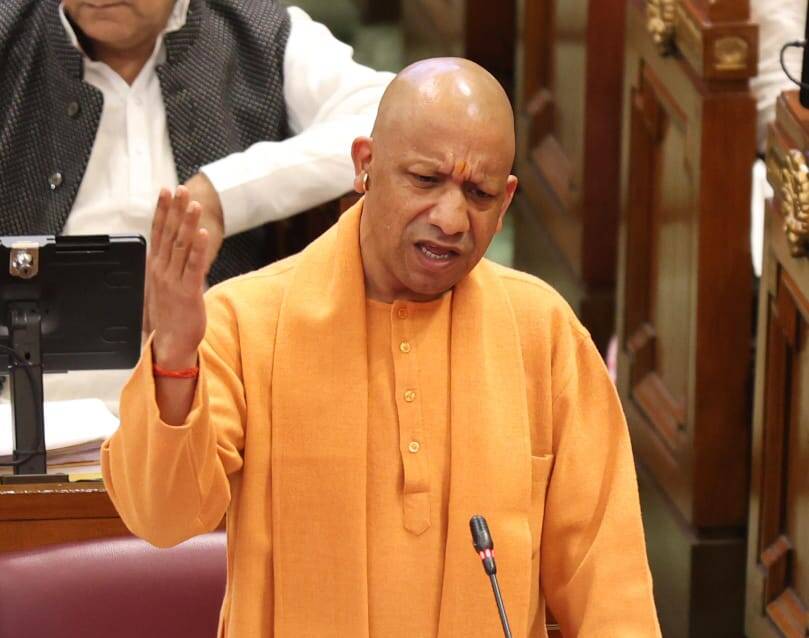
Lucknow: February 2026 : While participating in the discussion on budget for the financial year 2026-27 in the Assembly on Friday, Chief Minister Yogi Adityanath said, “Over the past 9 years, Uttar Pradesh has moved out of the category of the bottom three states and secured a place among the top three states in the country.” He said this transformation is the outcome of clear policies, clean intent and effective financial management.
Calling the ₹9,12,696 crore budget historic, the Chief Minister said, “For the first time in the history of Uttar Pradesh, a Chief Minister has received the opportunity to present the budget for the 10th time.” Responding to questions raised by the opposition regarding financial approvals, he clarified that approvals are issued on time and the expenditure process is completely transparent.
On fiscal discipline, CM countered the opposition by stating that in 2016-17, the fiscal deficit stood at 4.39% of the Gross State Domestic Product (GSDP), which is being reduced to 2.97% in 2025-26. Similarly, the debt burden has declined from nearly 30% to around 26%, with a target of bringing it down to 23% by 2026-27.
He further noted that in 2016-17, the per capita income was around ₹43,000, which has increased to more than ₹1,20,000 by the end of 2024-25. “This change reflects the growing economic strength and pace of development in Uttar Pradesh”, he said.
The Chief Minister added that in 2016-17, Uttar Pradesh ranked at the lower end among large states, but today the state has increased its GSDP from ₹13 lakh crore to ₹36 lakh crore, with a target of reaching ₹40 lakh crore in 2026-27.
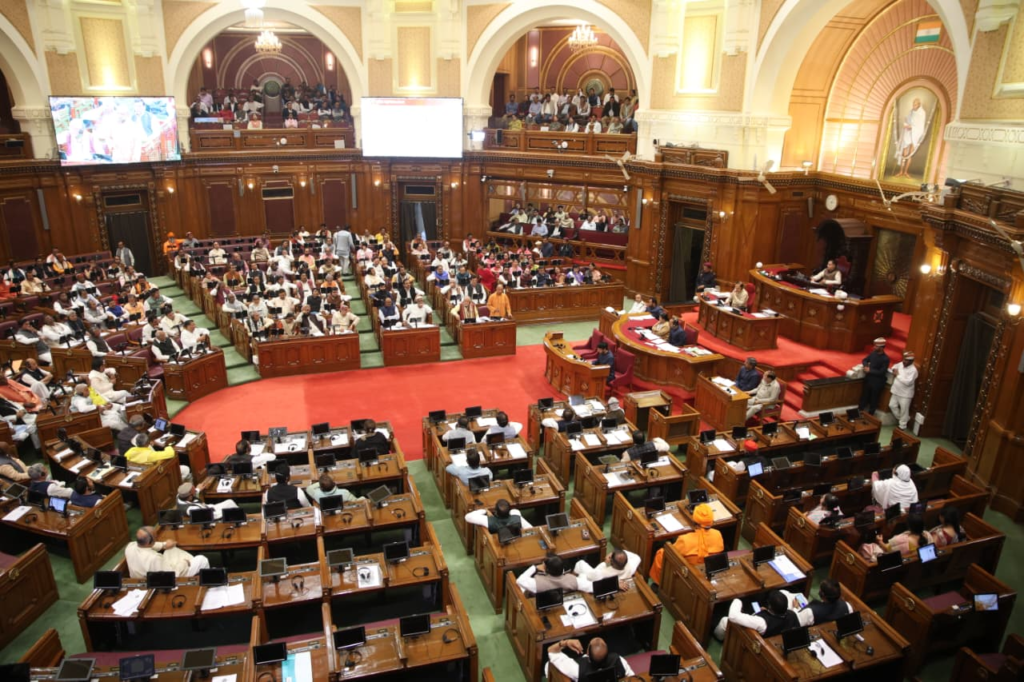
Chief Minister said, “The purpose of discussions on demands for grants is to guide departments so that they can begin work in a planned manner from the very start of the new financial year. All departments are moving forward with their respective action plans to ensure effective implementation of the budget.”
He emphasized that capital expenditure has been given priority in the state. In 2016-17, capital expenditure was around ₹71,000 crore, which has now increased to more than ₹1,77,000 crore. Investment in infrastructure, he said, accelerates employment generation and economic activity. Infrastructure spending not only creates physical assets but also promotes job creation, industrial expansion, and overall economic momentum. According to experts, one rupee invested in infrastructure generates returns of five to six times.
CM stated that the goal of making Uttar Pradesh a one-trillion-dollar economy is being advanced through this budget. He added that Uttar Pradesh will play a crucial role in realizing the vision of a Developed India, and this budget is a concrete step in that direction.
Earlier, CM thanked the Speaker for the smooth conduct of the House, noting that during the two-week budget session, from the Governor’s address to discussions under various rules and a detailed debate on the budget, meaningful deliberations took place on all issues. He said this reflects the dignity and responsibility of the Assembly as the highest democratic institution.
Chief Minister informed the House that the General Budget 2026-27 was presented by his colleague, Finance Minister Suresh Kumar Khanna. He said he listened carefully to the statements of Leader of the Opposition Mata Prasad Pandey and senior member Shivpal Singh Yadav and appreciated the suggestions given by all members.
He further shared that a total of 167 members participated in the budget discussion, including 109 from the ruling side and 58 from the opposition. There was also extensive discussion on demands for grants. Calling it an example of healthy parliamentary tradition, the Chief Minister said that dialogue is indeed the path to solutions.
Leakages were plugged, corruption curbed and financial discipline strengthened: Chief Minister
Participating in the discussion on the Budget for the financial year 2026-27 in the Uttar Pradesh Legislative Assembly, Chief Minister Yogi Adityanath said that his government plugged leakages, effectively curbed corruption and strengthened financial discipline. As a result, Uttar Pradesh’s economy has gained new momentum, and the state has emerged among the leading states of the country.
Chief Minister said, “In recent years, there has been a significant change in the perception of Uttar Pradesh both nationally and internationally.” Today, the state’s citizens are viewed with respect. This transformation is the result of a clear policy, transparent working style and pure intent.
Chief Minister said that when the decision to waive loans of small and marginal farmers was taken in 2017, questions were raised about where the resources would come from. Without taking loans from any bank or financial institution, the government waived loans of up to ₹1 lakh for 86 lakh farmers through budgetary resources. This, he said, is an example of financial discipline and efficient resource management.
He further stated that the government reformed the PLA (Personal Ledger Account) system and curbed the tendency of unnecessary parking of funds. Funds are now released strictly as per requirement for schemes, ensuring financial transparency and accountability. He added that the guidelines of the Reserve Bank of India are being followed in letter and spirit. Financial discipline has led to balanced fiscal management and accelerated development projects.
Chief Minister Yogi Adityanath stated, “In 2016-17, the state’s Credit-Deposit (CD) ratio was around 43-44 percent, which has now increased to 61-62 percent.” This means that a larger share of the money deposited by the people of Uttar Pradesh in banks is now being invested within the state itself. As a result, opportunities for industry, trade and self-employment have increased at the local level.
Chief Minister added that the government has set ambitious targets and is working diligently to achieve them. Financial discipline, transparency and a strategy focused on capital investment have given a new direction to the state’s development journey.
Uttar Pradesh is no longer a BIMARU state, but a Front Runner State: Chief Minister Yogi Adityanath
During the discussion on the Budget for the financial year 2026–27 in the Uttar Pradesh Legislative Assembly, Chief Minister Yogi Adityanath said that the MSME sector is the largest source of employment generation in the state, and the government has taken comprehensive steps to strengthen it. He said, “A state with a strong MSME network, affordable and skilled human resources is best positioned to attract large industrial investments.”
The Chief Minister stated that before 2017, there were opportunities, but no conducive investment environment. MSME units were neglected, and traditional industries were in a state of despair. Over the past nine years, significant efforts have been made to revive them.
He said, “In the ‘Fiscal Health Index 2025’ report of NITI Aayog, Uttar Pradesh has been placed in the ‘Front Runner’ category. On parameters such as quality of expenditure, capital investment, debt sustainability and fiscal discipline, the state has been described as balanced and robust.”
He added that the Comptroller and Auditor General of India has also appreciated Uttar Pradesh’s strong revenue position and balanced financial management. This, he said, reflects the current status of the state.
The Chief Minister said, “Moradabad’s brass industry, Firozabad’s glass industry, Azamgarh’s black pottery, Gorakhpur’s terracotta and Bhadohi’s carpets are centuries-old traditions. The government conducted surveys and mapping to assess where support was needed in design, technology, finance, packaging, marketing and training.” He informed that in 2018, the ‘One District One Product’ scheme was launched, through which these traditional products received a new identity and markets.
The Chief Minister said, “Uttar Pradesh now has the highest number of MSME units in the country, approximately 96 lakh. More than three crore people are employed in these units, gaining employment and self-employment opportunities.” He added that a registration system has been introduced for every MSME unit, and registered units are being provided insurance cover of up to Rs 5 lakh by the state government.
The Chief Minister said, “Under the earlier concept of Gram Swaraj, villages used to be self-reliant, but over time this system weakened. To revive it, the ‘Vishwakarma Shram Samman Yojana’ was implemented in 2019. Under this scheme, artisans are provided with toolkits, training and access to loans at affordable rates.”
The Chief Minister said, “To link youth with self-employment, the ‘Mukhyamantri Yuva Yojana’ has been implemented. Under this scheme, collateral-free and interest-free loans of Rs 5 lakh, Rs 7.5 lakh and Rs 10 lakh are being provided in three phases.”
He informed that so far, more than 1,10,000 youth have been assisted in securing bank loans under this scheme. He urged public representatives to play an active role in training and mentoring youth so that they can establish successful enterprises.
For the first time Uttar Pradesh presents its Economic Survey Report: Chief Minister
While participating in the discussion on the Budget 2026-27, Chief Minister Yogi Adityanath said, “For the first time, Uttar Pradesh has also presented its Economic Survey Report inside the Assembly.”
He said that work on this had been going on for a long time and that he had told the Finance Minister that if work has been done, the data should be placed before everyone. He further added, “Uttar Pradesh, is the first state to present an Economic Survey.”
CM stated, “As a result of the government’s continuous efforts, Uttar Pradesh has successfully established itself as a state with strong law and order, moving from risk-prone to stable and emerging as a dream destination for investment.”
This, he said, has become the new identity of Uttar Pradesh. Today, at every level, the state is witnessing the impact of the ‘Triple T’ – Technology, Trust and Transformation.’
CM Yogi said, “Industry 4.0 has strengthened India’s progress through automation, the Internet of Things, big data and artificial intelligence. Under the leadership of Prime Minister Narendra Modi, India is hosting an AI Impact Summit in Delhi for the first time. Heads of state from more than 20 countries and representatives from over 100 countries are participating in it, reflecting India’s emergence as a new leader in this field.”
Drawing the attention of the House, the Chief Minister also spoke about Industry 5.0, stating that it represents a new technology-driven model that is human-centric and based on values and he elaborated on the evolving role of artificial intelligence.
CM further said that the entire country and the world are looking towards India. On one hand, under Prime Minister Modi’s leadership, India has established itself as a major global power; on the other hand, the youth organization of the Indian National Congress attempted to carry out a shameful act at Bharat Mandapam. He said that there was an attempt to tarnish India’s image before the world, which deserves strong condemnation.
CM Yogi added, “While allegations and counter-allegations are part of politics, creating chaos and indulging in unruly behavior at an event where participants from more than 100 countries are present amounts to playing with the nation’s image. Every Indian, he said, should condemn such actions. He asserted that the strictest possible action must be taken against those who seek to damage India’s global reputation.
Data is the foundation of the new economy, and AI will become the ‘New Oil’: Chief Minister
Participating in the discussion on Budget 2026–27, Chief Minister Yogi Adityanath stated that the budget includes significant announcements regarding the establishment of Data Centers and the formation of a State Data Center Authority. In the current global scenario, data has become the foundation of the new economy, and Artificial Intelligence is set to play the role of the ‘New Oil’ in the future. In this context, understanding the utility of data and its scientific management has become extremely important.
The Chief Minister said, “There was a time when the concept of an ‘Oil Economy’ dominated the world, meaning that countries with oil resources wielded influence over the global economy. Later, emerging technologies gained importance, and nations that established dominance in these technologies strengthened their global standing. Today, the world acknowledges that AI is poised to become the most powerful force of the future, and its foremost requirement is robust data infrastructure.”
He added, “With this vision, the state government has advanced its program to establish Data Centers and develop Data Center clusters. Before 2017, there were no Data Centers in Uttar Pradesh. However, since then, the government has taken concrete steps in this direction. Several Data Centers have already been established in the state, and many more are proposed. The government aims to develop these Data Centers in cluster form to make them more effective and efficient.”
The primary function of a Data Center is to securely store digital data, process it, and ensure its systematic management. These three processes play a crucial role in enhancing governance efficiency. With this objective, the process of forming the State Data Center Authority is being taken forward.
The Chief Minister stated that until now, it was often observed that different departments presented varying data on the same subject at different times. This created difficulties in policymaking and strategy formulation. In the absence of an integrated and authenticated data system at the departmental level, confusion frequently arose. Without accurate and verified data, action plans could not be prepared effectively.
Until now, governance largely followed a “problem-to-solution” approach. This limited the ability to build long-term and comprehensive strategies based on data-driven forecasting. Instead of an individual approach, there is now a need to adopt a universal approach so that policies are implemented uniformly and serve the broader public interest. Data will play a significant role in realizing the spirit of “Sabka Saath, Sabka Vikas.”
The government intends to move beyond a reactive model toward a predictive and proactive model. Instead of finding solutions after problems arise, strategies will now be prepared in advance by assessing potential challenges through data analysis.
The Chief Minister said, “The State Data Center Authority will be developed as the supreme regulator and architect for the state. The Authority will collect data from various departments, integrate it, analyze it, and ensure its effective use in policymaking.”
He emphasized that “critical thinking” in linking and meaningfully utilizing data will be the true game changer. Data-driven administration will strengthen transparency, efficiency, and future-oriented policymaking. The formation of Data Center clusters and the State Data Center Authority will elevate Uttar Pradesh to new heights in digital governance and an AI-driven economy.
Chief Minister Yogi Adityanath said, “Before 2017, children affected by encephalitis in eastern Uttar Pradesh often did not receive proper treatment, and no concrete efforts were made toward its eradication. When the government assumed office in 2017, Prime Minister Narendra Modi directed that all necessary resources be provided for treatment and that hospitals be strengthened, along with taking effective steps toward the eradication of the disease.”
He added, “Earlier, the focus was only on treating patients after they fell ill. No effort was made to reach the root cause of the disease. After 2017, the government initiated a large-scale data collection process. By bringing together various departments, organizations, and expert teams, a detailed analysis was conducted to identify the regions from which the highest number of patients were coming and to understand the underlying causes.”
The CM added, “Uttar Pradesh has nine climatic zones, and different types of diseases emerge at different times depending on the climate of each zone. Diseases such as dengue, malaria, kala-azar, chikungunya, or cancer do not occur uniformly across the state, nor was encephalitis evenly spread throughout the region. The nature of diseases varies according to the bio-ecology and climatic conditions of a particular area. Based on this understanding, the government adopted a scientific approach and conducted in-depth studies.”
The Chief Minister said that after data analysis, the government concluded that most deaths due to encephalitis were occurring in areas where there was a lack of clean drinking water and where people were compelled to defecate in the open. Following this, while strengthening treatment facilities, work was carried out on two major fronts: the supply of clean drinking water and the construction of toilets in every household. This was the government’s proactive and universal approach.
He added, “Earlier, every year 1,200 to 1,500 children used to die due to encephalitis alone. A large number of these children belonged to the Scheduled Castes, Extremely Backward Classes, minority communities, and poor families. The Samajwadi Party formed the government in the state four times, yet during those years, such a large number of children continued to lose their lives annually. Until 2017, the disease remained a serious challenge”.
After coming to power, we consolidated all available data, coordinated various departments, and initiated focused action. As a result, after 2019, conditions were created for the eradication of encephalitis, and today the disease has been effectively eliminated. Now, in eastern Uttar Pradesh, children no longer die due to encephalitis.
The government did not view this campaign through the lens of caste or class. Government facilities are the right of every citizen and must reach each individual equally. The government’s policies are not caste-based but are founded on an inclusive approach.
Chief Minister Yogi Adityanath said, “Governance should not practice any form of discrimination, and under the law, the benefits of government schemes must reach everyone equally. It is the government’s responsibility to ensure that welfare schemes reach the person standing at the last rung of society, without discrimination based on caste, class, or any other factor.”
During his address, the Chief Minister quoted lines of national poet Ramdhari Singh Dinkar:“Mool Janna Bada Kathin Hai Nadiyo Ka Veero Ka. Dhanush Chorkar Aur Gotra Kya Hota Hai Randheero Ka. Paate Hain Samman Tapobal Se Bhutal Par Shoor Aur Jatiya Jatiya Ka Shor Machate Keval Kayar Kroor”
He said, “Politics based on caste divisions caused long-term damage to the state. Previous governments engaged only in caste-based political calculations, but did not think about the Dalit or Extremely Backward Class child who succumbed to a disease like encephalitis.”
He added that when the son of a poor family rises to become a minister, some people object, because they prefer him to remain merely a supporter rather than emerge as a leader.
The Chief Minister said, “Siddharthnagar was once considered the epicenter of encephalitis. The highest number of patients came from Siddharthnagar and were treated at BRD Medical College in Gorakhpur. Many children lost their lives. In areas under the Devipatan division, the disease was often presented as an ‘Unknown Illness.””
Referring to an incident from 2007, he said that when he was a Member of Parliament, he read a news report about the death of 10 children due to an “unknown illness” at the district hospital in Balrampur. He personally visited the hospital and observed clear symptoms of encephalitis among the children. When he questioned the Chief Medical Officer, he was told that due to inadequate treatment facilities, the disease had to be described as unknown. The government at that time did not show the will to resolve this serious issue.
He said, “After 2017, the government took concrete steps in this direction. Hospital infrastructure was strengthened, treatment facilities were expanded, and a comprehensive campaign was launched for the eradication of encephalitis. As a result, today the number of deaths due to encephalitis has come down to zero.”
The Chief Minister said, “Making grand announcements does not produce results. Real evaluation should be based on the changes visible on the ground.” He added that his government has prioritized result-oriented politics. Ensuring that the benefits of governance schemes reach everyone without discrimination remains the government’s firm commitment.


India and Japan Adopt Rules of Implementation for Joint Crediting Mechanism Under Article 6.2 of Paris Agreement
The Government of the Republic of India and the Government of Japan have adopted the ‘Rule…

India and Japan Adopt Rules of Implementation for Joint Crediting Mechanism Under Article 6.2 of Paris Agreement
The Government of the Republic of India and the Government of Japan have adopted …