Maharashtra will become the world’s 13th largest economy in the coming years – Chief Minister Devendra Fadnavis

Chief Minister’s reply to the Governor’s Address
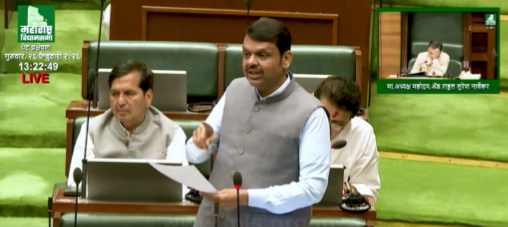
Mumbai, Feb 2026: Chief Minister Devendra Fadnavis, while replying to the issues raised by members on the Governor’s Address, expressed the resolve to achieve the target of making Maharashtra a trillion-dollar economy, creating 10 lakh jobs every year, attracting investments worth USD 13–14 billion, and bringing the fiscal deficit below 2.5 per cent.
Replying in detail to the points raised by members on the Governor’s Address, Chief Minister Fadnavis said at the very beginning of his speech that we all know the Maharashtra Dharma shown to us by Chhatrapati Shivaji Maharaj – to unite all Marathas, to expand Maharashtra Dharma, to preserve what exists, to add more, and to establish the Maharashtra state everywhere. In this manner, efforts are being made to take Maharashtra forward in all fields.
The Chief Minister said that Maharashtra has maintained the best level in the country in terms of debt compared to GDP. The state’s share in the national GDP stood at 13.8 per cent in 2024–25 and, as per preliminary estimates, it will now move closer to 14 per cent. The aim is not to make the state budget trillion-dollar, but to make the state’s economy trillion-dollar. Currently, the state’s economy is around ₹51 lakh crore, whereas in 2012–13 it was ₹13 lakh crore. In just ten years, it has grown threefold. Maharashtra, with a USD 660-billion economy, is the only such state in the country. Claiming that no other state’s economy matches Maharashtra’s, he said that if drought-like conditions do not arise in the next four to five years, Maharashtra will become a trillion-dollar economy and the world’s 13th largest economy. At present, Maharashtra’s economy is comparable to that of Belgium.
Developed Maharashtra: Not just a document, but an action plan
‘Developed Maharashtra’ is not merely a book; extensive work has been done on it. A ‘Vision Management Unit’ has been established for efficient planning of resources. Development has been planned according to milestones of the state’s Amrit Mahotsav year 2029, 2034 and 2047. A roadmap has been prepared to steer the economy in that direction. While preparing this roadmap, 3.80 lakh citizens participated and over 7 lakh citizens gave suggestions. Keeping all sectors in view, a picture of Developed Maharashtra has been created. The four objectives for Developed Maharashtra are progressiveness, sustainability, inclusiveness and good governance.
Davos agreements: Leading even in implementation
Davos is where the global economy comes together, and therefore agreements there carry special importance. Maharashtra’s significance has increased there. Even if foreign companies do not come directly, foreign capital is invested in Indian companies, and agreements are signed with such companies, the Chief Minister clarified.
In the investment cycle, it takes two to seven years from agreement to production. Of the agreements signed, 98 per cent in 2022, 80 per cent in 2023, 70 per cent in 2024 and 88 per cent in 2025 are at various stages of implementation. Agreements worth ₹31 lakh crore have been signed for 2026, of which 67 per cent are from the Industries Department and some from MMRDA. In addition, agreements worth ₹10 lakh crore are in process and decisions will be taken soon. These agreements involve companies from 18 countries, with 83 per cent foreign investment. Investments have come to all parts of the state, including Nandurbar district and all districts of North Maharashtra. Maharashtra ranks first in the country in foreign direct investment, with 39 per cent of the country’s FDI coming to the state. These are not merely intentions but actual investments as per RBI data. In Chhatrapati Sambhajinagar, agreements signed at Davos regarding JSW’s electric vehicle manufacturing project are being implemented rapidly and work will begin in June. Investments have come in sectors such as artificial intelligence, data centres, circular economy, sustainable development, agricultural technology and green energy. Global companies such as Microsoft and Google will also invest.
Unemployment rate reduced; milestone of 1.5 lakh government appointments
Clarifying that the state’s unemployment rate has never exceeded 11 per cent, the Chief Minister said it stood at 4 per cent in 2021–22, 3.3 per cent in 2022–23 and declined to 3.1 per cent in 2023–24. After the Mahayuti government came to power, 1,20,449 people have been given government jobs, and in the next two months this figure will reach 1.5 lakh. A target of creating 10 lakh jobs every year has been fixed.
The state has approved startup, entrepreneurship and innovation policies for job creation, and more than 146 initiatives have been promoted.
Gadchiroli moving towards becoming a ‘Steel City’
Investments in Gadchiroli will generate 70,895 jobs. While developing on the principles of ‘water, forest and land’, plantation of 5 crore trees has been undertaken. Priority is being given to employment for local tribal youth. He cited the example of a tribal girl earning ₹53,000 by driving a truck. Forty tribal students are receiving mining training at world-class Curtin University in Australia, and work to make Gadchiroli a ‘Steel City’ has begun.
Maharashtra is the startup capital of the country
Twenty per cent of registered startups in the country are from Maharashtra. Of the country’s 119 unicorns, 28 are in Maharashtra, accounting for 25 per cent of India’s unicorns. Hence, the state has emerged as a startup hub and gained the identity of ‘Startup Capital’.
Kumbh Mela: A confluence of faith and sustainable development
The Kumbh Mela is an ‘intangible faith’. Maharashtra is the land of saints, where people of different sects, castes and religions come together. The Kumbh Mela helped brand Uttar Pradesh globally. Similarly, Maharashtra aims to brand itself globally through the Nashik Kumbh Mela. Citing the example of Prayagraj receiving returns higher than investments, works such as complete cleaning of the Godavari, preventing sewage from entering the river, airport construction and road expansion have been undertaken. The Kumbh Mela will boost religious tourism and help transform the state’s economy. This is not limited to the Kumbh alone but is aimed at sustainable city development and global branding of the state.
Priority to Marathi language
Regarding the issue of compulsory Hindi, he said an 18-member expert committee headed by Dr. Raghunath Mashelkar was appointed earlier. Its 101-page report submitted on September 14, 2021 recommended implementing English and Hindi as second languages from Class I, which was approved by the Cabinet on January 30, 2022. However, Marathi will remain the compulsory language in the state, and no other language will be compulsory. Being multilingual is not wrong, he added. He also said that Prime Minister Narendra Modi has made it possible to pursue education from engineering to medical studies in the mother tongue.
Scholarships, youth training and employment initiatives
Scholarship amounts have been distributed to 95.58 per cent of students who applied for higher education scholarships. Under the Punjabrao Deshmukh Hostel Maintenance Allowance Scheme and Rajarshi Shahu Maharaj Tuition Fee Scheme, 98 per cent of students benefited in 2023–24 and 96 per cent in 2024–25.
The Youth Training Scheme was designed purely to provide experience. Under this scheme, about one lakh youth were given opportunities to work in various departments for 11 months and awarded certificates, giving them official administrative experience. There is no provision for backdoor permanent jobs through this scheme.
In 2024–25, 767 Deendayal Employment Fairs were organised with participation of 7,273 entrepreneurs. Of 1,27,357 candidates, 38,512 were selected. In 2025–26 so far, 372 employment fairs have been held, with 20,069 entrepreneurs participating and 24,101 candidates selected from 1,29,657 applicants.
Mental health of students, border dispute, farmers’ support and reforms
On student mental health, he said a report has been prepared under the ‘Maharashtra Student Protection and Mental Well-being Policy 2025’, and a special task force has been formed to review steps taken by universities.
On the border dispute, the state’s stand is unified, all committee recommendations have been implemented, appropriate advocates appointed, and directions given to pursue early hearings.
The state deposited ₹15,472 crore directly into farmers’ accounts via DBT during last year’s crisis. Crop insurance reforms were undertaken, loan waiver promises will be fulfilled at the appropriate time, and assistance will be provided through Agristack with digital land records linked to Aadhaar.
Under the ‘Magel Tyala Krushi Pump’ scheme, 85 per cent of applicants received agricultural pumps, with 10.63 lakh pumps installed between 2022 and 2025, including a Guinness record of installing 50,000 pumps in one month. ₹23,000 crore has been spent on electricity bill concessions, and Maharashtra received the award for best state in irrigation and water use.
A three-tier cancer treatment system has been launched, and through Mahacare Foundation, cancer treatment facilities will be developed.
₹400 crore has been allocated this year for the Dr. Babasaheb Ambedkar memorial at Indu Mill. Structural work is 100 per cent complete and entry building work 96 per cent complete.
On administrative reforms, service rules have been updated, e-HRMS introduced, service books and departmental inquiries digitised, and governance simplified.
Concluding his speech, the Chief Minister quoted the lines, “Khud se jeetne ki zid hai meri, mujhe khud ko hi harana hai… Main bheed nahin hoon duniya ki, mere andar bhi zamana hai…” and affirmed that the government will move forward taking everyone along.
NCC Holds Cyclothon 2026 to Mark 79th Independence Anniversary
The National Cadet Corps (NCC) organised Cyclothon 2026 on August 02, 2026 in New Delhi to…
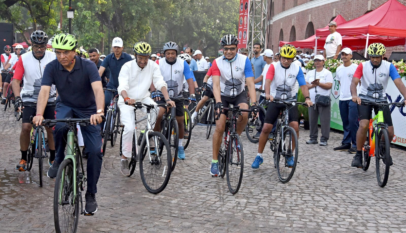
NCC Holds Cyclothon 2026 to Mark 79th Independence Anniversary
The National Cadet Corps (NCC) organised Cyclothon 2026 on August 02, 2026 in New …