Pakistan–Afghanistan Border Crisis Escalates Into Open Conflict After Airstrikes on Kabul and Eastern Provinces

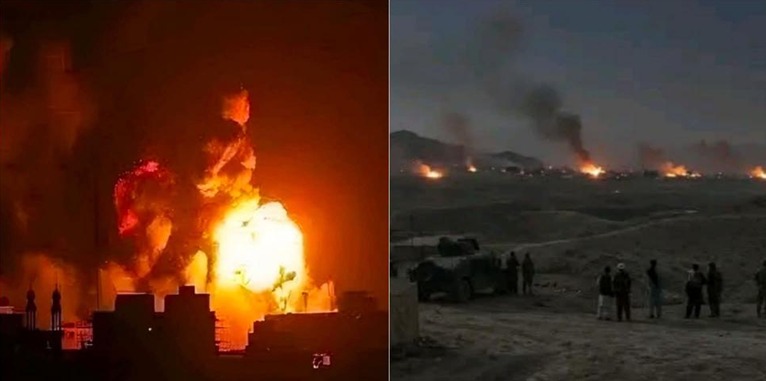
Kabul, Feb 2026 : Tensions between South Asia’s neighbouring countries Pakistan and Afghanistan have sharply escalated into what now resembles an open military confrontation, following a series of cross-border attacks and retaliatory airstrikes. In the early hours of Friday, fighter jets of the Pakistan Air Force carried out intense aerial bombardments on multiple locations inside Afghanistan, including the capital Kabul, as well as Kandahar and Paktia. Pakistan has named the operation Operation Ghazab lil-Haq and claimed that it inflicted heavy losses on Afghan Taliban forces.
According to Pakistani officials, the operation began around 1:50 a.m., when residents of Kabul reported the roar of jet engines followed by at least eight powerful explosions that shook residential neighbourhoods. Witnesses said the blasts were so intense that windows rattled and buildings trembled across parts of the city. Pakistan’s Information Minister Ataullah Tarar confirmed that the airstrikes targeted Taliban defence installations, ammunition depots and logistical supply centres.
Islamabad has claimed that the strikes resulted in the deaths of 133 Afghan Taliban fighters, with more than 200 others injured. It further stated that two Taliban corps headquarters, three brigade headquarters and at least 27 border outposts were destroyed. Pakistan also claimed the destruction of more than 80 tanks, artillery pieces and armoured vehicles, and said it had seized control of nine Taliban border checkpoints along the frontier.
Origins of the Escalation
The latest escalation followed intense fighting that began late Thursday night, when Afghan Taliban forces reportedly launched large-scale retaliatory attacks in response to earlier Pakistani air operations. Kabul claimed that its forces captured more than 15 Pakistani military posts along the disputed Durand Line and killed at least 55 Pakistani soldiers. Pakistan dismissed these claims as exaggerated and provocative, describing the Taliban’s actions as deliberate attempts to inflame tensions.
Defence Minister Khawaja Asif described Pakistan’s response as “crushing and decisive,” asserting that the country would go to any length to defend its territorial integrity. “Pakistan will not tolerate repeated provocations or violations of its borders,” he said.
Following Taliban counterattacks, Pakistan intensified its air campaign, striking what it described as Taliban military infrastructure across multiple Afghan cities. Taliban officials accused Pakistan of launching unprovoked airstrikes on Kabul, Kandahar and Paktia, alleging that civilian areas had also been affected. Taliban spokesperson Zabihullah Mujahid claimed that, despite the intensity of the strikes, there were no confirmed casualties, and accused Pakistan of “cowardly aggression.” In a post on X, Mujahid warned that Afghanistan would respond decisively.
Competing Claims and Counterclaims
Afghanistan, in turn, claimed it carried out retaliatory cross-border attacks, capturing more than a dozen Pakistani army posts. Mujahid said large-scale operations were launched against Pakistani military bases and installations along the Durand Line, describing them as retaliation for repeated Pakistani “rebellion and aggression.”
Earlier in the week, the Taliban had also claimed to have captured 17 Pakistani posts, killing 55 soldiers, recovering 23 bodies and capturing several others. Pakistan strongly rejected these figures, stating that only two of its soldiers were killed and three injured, while at least 36 Afghan fighters were eliminated.
Pakistan’s Information Minister Ataullah Tarar said the country had responded firmly to Taliban fire and successfully defended its territory. Prime Minister’s spokesperson Musharraf Ali Zaidi denied reports that Pakistani soldiers had been captured, citing the absence of verifiable evidence and conflicting casualty figures from both sides.
The Durand Line Flashpoint
At the heart of the conflict lies the Durand Line, the long-disputed border between Pakistan and Afghanistan that Kabul has never formally recognised. The boundary has remained a persistent flashpoint, with frequent skirmishes, mutual accusations of infiltration, and competing territorial claims. Analysts note that the lack of a mutually accepted border framework has made the region particularly vulnerable to escalation.
Both Pakistan and Afghanistan have placed their security forces on high alert as cross-border attacks and counterattacks intensify. Neither side has provided independently verifiable information, and both continue to accuse the other of launching unprovoked assaults.
Taliban Claims of Civilian Casualties
Afghanistan’s defence ministry alleged that Pakistani airstrikes on February 26 killed women and children inside Afghan territory. According to the ministry, Afghan forces responded by targeting Pakistani military posts near the eastern and southeastern provinces of Paktika, Paktia, Khost, Nangarhar, Kunar and Nuristan. The Taliban claimed that during a four-hour operation, two Pakistani military bases and 19 posts were captured, while four others were abandoned by retreating troops. The ministry also claimed the destruction of a Pakistani tank and the seizure of a large military transport vehicle.
In response, Pakistan launched Operation Ghazab lil-Haq, with state-linked media outlets such as ARY News and Geo News reporting extensive Taliban losses and the destruction of multiple checkpoints. Pakistani security forces reportedly conducted operations in border regions including Chitral, Khyber, Mohmand, Kurram and Bajaur.
Regional and International Alarm
As the fighting intensified, concerns grew within the international community. Jet engine noise and gunfire echoed across Kabul, with journalists from Agence France-Presse reporting explosions and heavy aerial activity in real time. Similar sounds were reported in Kandahar, a stronghold of the Taliban and the base of its supreme leader Hibatullah Akhundzada.
The growing hostilities have raised fears that a fragile, Qatar-mediated ceasefire could collapse entirely, pushing the region closer to a wider conflict. The situation has also drawn the attention of the United Nations. UN Secretary-General Antonio Guterres expressed deep concern over the escalating violence, warning that continued military confrontation could destabilise the broader region.
Guterres urged both Pakistan and Afghanistan to exercise restraint and resolve their differences through dialogue rather than force. “Further escalation risks serious consequences for regional peace and security,” he said, calling for immediate efforts to de-escalate tensions.
Uncertain Road Ahead
With both sides vowing retaliation and accusing each other of aggression, the Pakistan–Afghanistan conflict appears to be entering its most dangerous phase in years. Analysts warn that miscalculations or misinformation could quickly spiral into a prolonged military standoff, with far-reaching implications for South Asia and beyond.
As international observers watch closely, the immediate priority remains preventing further loss of life and restoring channels of communication. Whether diplomacy can still rein in the violence remains uncertain, as both Islamabad and Kabul continue to trade claims, counterclaims and warnings of further action.
(The content of this article is sourced from a news agency and has not been edited by the Mavericknews30 team.)






Lower Global Crude Prices Won’t Immediately Reduce Fuel Rates in India: Suresh Gopi
New Delhi, June 2026 : A fall in international crude oil prices does not automatically res…

Lower Global Crude Prices Won’t Immediately Reduce Fuel Rates in India: Suresh Gopi
New Delhi, June 2026 : A fall in international crude oil prices does not …