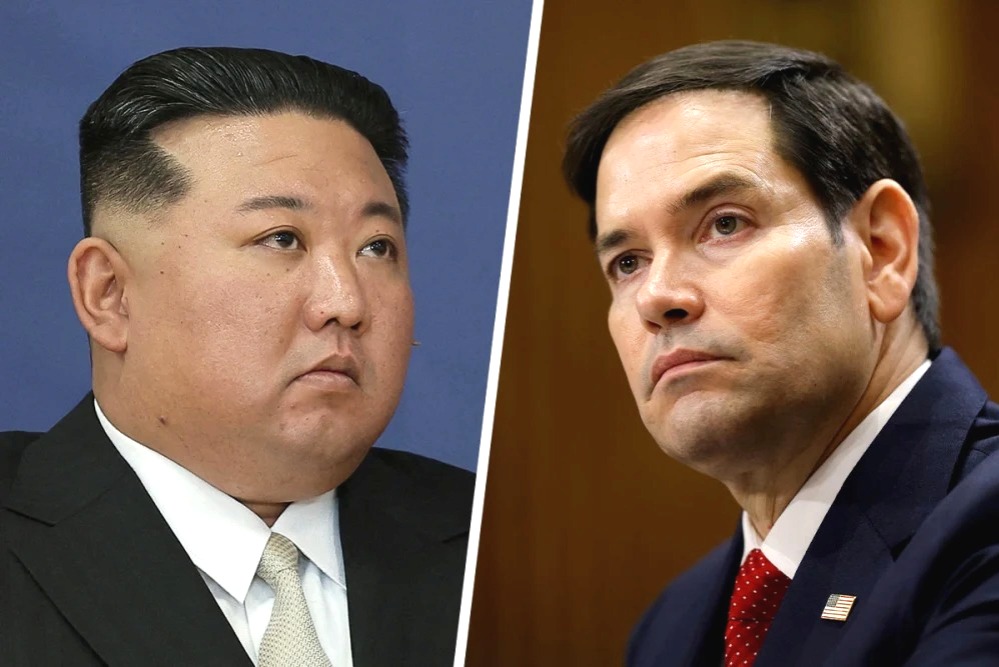
North Korea’s Kim Jong Un Agress To Negotiate With The US, If US Agrees Korea’s Nuclear Status.

Pyongyang; March 2026: Worker’s Party of Korea’s General Secretary Kim Jong Un suggested that he would negotiate with the United States if the United States accepted Pyongyang’s nuclear status.
Meanwhile, the United States have stated that it is “open” to dialogue with North Korea but is unlikely to change its stance on denuclearisation. Kim criticised US President Donald Trump’s “America First” policies for causing chaos and promoting US hegemony and said that North Korea will continue to treat the United States and South Korea as its “enemies” during a speech at the 09th Party Congress.
North Korean state media had reported on February 26th that Pyongyang was prepared for “peaceful coexistence or eternal confrontation” with Washington. Kim’s statements suggested that engagement with Washington could be possible if it abandoned its “hostile policies”, a term that typically refers to US sanctions on North Korea and calls for denuclearisation.
US Secretary of State Marco Rubio said that the United States remained open to dialogue with North Korea on February 26th. The Trump administration has not shifted its policies on denuclearisation or sanctions, however, making US-North Korean dialogue unlikely given Kim’s stated conditions. North Korea likely seeks US acknowledgement of its nuclear status and aims to keep Seoul from any future dialogue. North Korea likely sees no advantage in opening dialogue with the United States or South Korea currently, given its strengthened relations with Russia and the People’s Republic of China (PRC) and increased confidence in Pyongyang due to stabilising economic conditions.
North Korea is likely aiming to establish another leg of the nuclear triad under the “New National Defence Development Five-Year Plan”. Kim Jong Un also emphasised the development of emerging military technologies to enhance North Korea’s conventional forces. Kim said during his work summary report delivered on February 20 and 21 that North Korea aims to expand the delivery means and operational scope of its nuclear deterrent.
Kim Jong Un have also emphasised the development of expanded land and sea-based intercontinental ballistic missile (ICBM) complexes and operational-tactical missile complexes. Kim also expressed North Korea’s intention to use nuclear-capable ballistic missile submarines (SSBNs) to extend the range of North Korea’s nuclear deterrent. This was the first time that Kim had mentioned the use of surface vessels to achieve nuclear dispersal during a party congress speech, likely referring to North Korea’s two Choe Hyon-class guided missile destroyers (DDGs) launched in 2025.
Adding surface vessels to North Korea’s nuclear deterrent would further disperse its nuclear arsenal and allow North Korea to deploy nuclear-capable cruise missiles that could form a “middle-rung” on the deterrence ladder between tactical nuclear weapons and ICBMs. North Korea may seek assistance from Russia or the PRC to leverage their large arsenals of vertical launch system (VLS)-equipped surface ships and SSBNs to develop its own sea-based nuclear deterrent.
Kim’s comments on North Korea’s conventional defence priorities revealed a greater emphasis on integrating artificial intelligence (AI), electronic warfare (EW), and anti-satellite weapons into the Korean People’s Army (KPA).
Kim however did not mention any of these technologies during the last party congress. North Korea may be orienting its conventional weapons development toward systems and capabilities designed to target an opponent’s operational system and situational awareness. Kim’s emphasis on AI-assisted drone technology and EW systems may stem from the experience of North Korean troops on the frontline in Ukraine, where unmanned systems and EW have become essential to modern combat.
Kim may also aim to leverage Russia’s experience with such systems to improve North Korea’s own capabilities in these areas.
Kim’s emphasis on long-range strategic nuclear weapons and short-range tactical nuclear weapons with enhanced conventional strike capabilities likely reflects North Korea’s diverging efforts to deter the United States and South Korea, respectively. North Korea is likely to task the tactical systems, such as the 600mm MLRS and surface-launched cruise missiles, with overwhelming South Korea’s integrated air and missile defence (IAMD) network with conventional or nuclear armaments.[12] North Korea could use the ICBMs, including those launched from a future SSBN, to deter or strike the United States from long range.
Team Maverick.





President Of India Reviews Passing Out Parade at Indian Military Academy, Dehradun.
Dehradun; June 2026: The Supreme Commander of the Armed Forces and President of India, Dro…

President Of India Reviews Passing Out Parade at Indian Military Academy, Dehradun.
Dehradun; June 2026: The Supreme Commander of the Armed Forces and President of India, …