India Set to Lead 6G Era Under PM Modi: Scindia

India aspires to have 10% share in global 6G patents; Secures international acceptance for Ubiquitous Connectivity proposal: Union Minister Shri Scindia
Bharat 6G Alliance expands six-fold (from 14 to 85 institutions), emerging as key driver of India’s 6G ambitions
Anusandhan National Research Foundation (ANRF) to drive Innovation with historic funding support
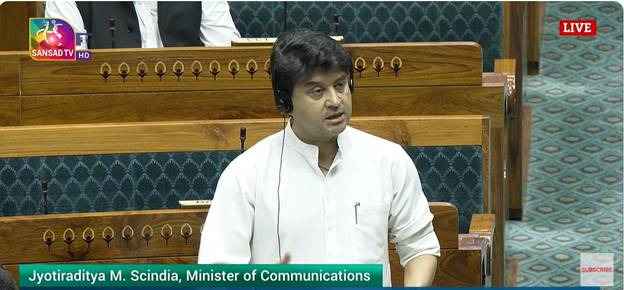
Union Minister of Communications and Development of North Eastern Region, Shri Jyotiraditya M. Scindia, informed the Lok Sabha on Wednesday of significant progress made in the growth of the Bharat 6G Alliance and the strengthening of India’s research ecosystem through the Anusandhan National Research Foundation.
Responding to a query, the Union Minister stated that the Anusandhan National Research Foundation (ANRF) was established under the leadership of the Prime Minister Shri Narendra Modi and became operational in February 2024 with the objective of imparting fresh momentum to innovation and research in the country. He informed that the Foundation functions through a Governing Council and an Executive Council to ensure effective and transparent decision-making. ANRF aims to receive funds amounting to Rs. 50,000 crore during 2023-28 in the form of ANRF Fund, Innovation Fund, Science and Engineering Research Fund, Special Purpose Funds. A budgetary provision of Rs. 14,000 crore is made from the Central Government and remaining amount will be sourced through donations from any other source, including from public sector enterprises, the private sector, philanthropist organizations, foundations or international bodies.
Elaborating further, Shri Scindia highlighted that this budgetary provision has been announced to support key programmes aimed at advancing cutting-edge research which include the Mission for Advancement in High Impact Areas, EV Mission, 2D Innovation Hub, MedTech Mission, AI for Science and Engineering, and the CRM Research Programme. In addition, several grant initiatives such as the Advanced Research Grant, Prime Minister Early Career Research Grant, and Inclusivity Research Grant have been introduced to broaden participation in research and innovation.
The Union Minister also informed that multiple institutional mechanisms have been established to strengthen the innovation ecosystem. These include Centres of Excellence Convergence, a Centre of Excellence for Science, Technology, Innovation Indicators and Analysis, the Partnership for Accelerated Innovation and Research, and the ANRF Transnational Research Innovation Hub. He added that several fellowships have been awarded, and an allocation of approximately ₹300 crore has been made to support these initiatives.
Turning to the progress of 6G, Shri Scindia underlined that the Bharat 6G Alliance, established under the guidance of the Prime Minister, has witnessed substantial growth. From an initial 14 institutions, the Alliance has expanded to include 85 institutions. Seven working groups have been constituted focusing on spectrum, devices, technology and components, alliances, green and sustainability, outreach, and 6G use cases. He noted that “quarterly analysis of all seven working groups is undertaken by the Ministry to ensure steady progress.”
Minister Shri Scindia further informed that India aims to contribute nearly 10 per cent of global 6G patents, with around 4,000 patents already contributed. India’s proposal on ubiquitous connectivity has also been accepted by international bodies such as the 3rd Generation Partnership Project (3GPP) and the International Telecommunication Union (ITU).
Concluding his statement, Shri Scindia reaffirmed the Government’s commitment to technological leadership, stating that the Ministry remains confident that India will emerge as a global leader in 6G technology.
Additionally, the Union Minister also gave details about the progress of the Bharat 6 G Alliance, as follows:
The Bharat 6G Alliance (B6GA), an industry and academia-led society, has 85 members as of 15th March 2026. These members represent a broad and diverse ecosystem comprising telecom service providers, telecom equipment manufacturers, startups, research and development institutions, academia and other stakeholders from the telecom sector. The Alliance serves as a collaborative platform for various stakeholders to work together towards innovation, standardisation and development of indigenous 6G technologies, in alignment with the Bharat 6G Vision announced by the Government of India.
The Government has announced the ₹1.0 lakh crore Research, Development and Innovation (RDI) Scheme to provide long-term financial support for undertaking research and innovation in critical and emerging technology areas vital for national development and global competitiveness. The Department of Science and Technology is the nodal department for implementation of RDI Scheme. The scheme aims to catalyse private sector investment in research and development and support innovation in key domains such as —
-
- energy security and energy transition and climate action;
- deep technologies, including quantum computing, robotics and space technologies;
- artificial intelligence and advanced digital technologies;
- biotechnology and medical devices; and
- digital economy, including areas such as digital agriculture.
One of the seven working groups on ‘spectrum’ constituted by the Bharat 6G Alliance has published a report titled “Spectrum Roadmap For 6G in India”. Further, the Department of Telecommunications, after consultation with stakeholders including the Bharat 6G Alliance, has released Spectrum Roadmap for 6G services, which can be accessed online at https://www.dot.gov.in/static/uploads/2026/02/092d793d6ea912a5dd79bf0c26ea1a84.pdf.
A project for the establishment of a 6G terahertz testbed at Society for Applied Microwave Electronics Engineering and Research (SAMEER), Kolkata, an autonomous research and development body under the Ministry of Electronics and Information Technology by a consortium consisting of SAMEER and three other members, namely, Indian Institute of Technology (IIT) Madras, IIT Guwahati and IIT Patna, has been approved from the Telecom Technology Development Fund under Digital Bharat Nidhi. Under this project, a high data-rate line-of-sight link was demonstrated in the India Mobile Congress 2025, achieving a data rate of 6,400 megabytes per second over a 270 gigahertz wireless link.
The Anusandhan National Research Foundation (ANRF) has been established through an Act of Parliament, under the Department of Science and Technology, to provide high-level strategic direction for research, innovation and entrepreneurship across diverse fields of science and engineering. It is designed to support research institutions and innovation ecosystems through funding programmes, innovation grants and incubation support, with the objective of promoting development of advanced technologies.




“Lights, Camera, Delhi!” — Grand Inauguration of International Film Festival Delhi (IFFD) 2026 in the Capital
Chief Minister reiterates commitment to making Delhi a global film hub at the inauguration…

“Lights, Camera, Delhi!” — Grand Inauguration of International Film Festival Delhi (IFFD) 2026 in the Capital
Chief Minister reiterates commitment to making Delhi a global film hub at the inauguration …