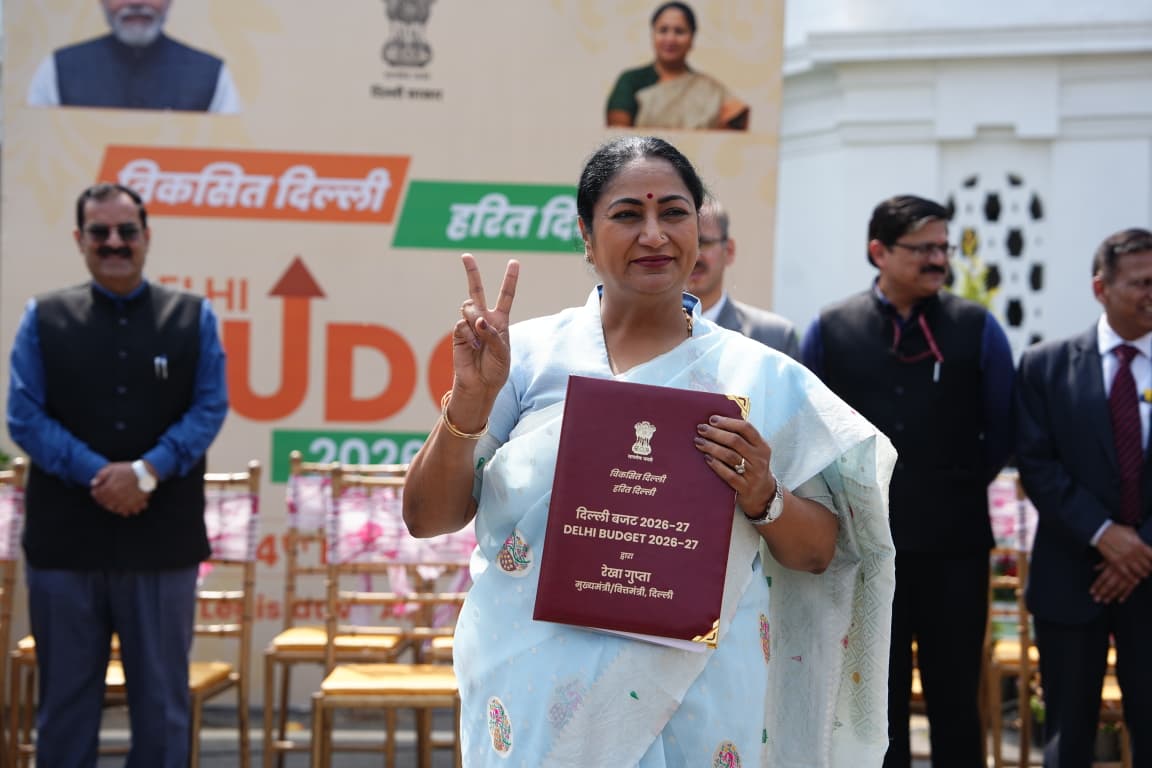
Chief Minister Rekha Gupta Presents Delhi’s First ‘Green Budget’ Worth ₹1,03,700 Crore

Education Department Allocated ₹19,148 Crore; Free Bicycles for Female Students and Laptops for Meritorious Students
₹12,645 Crore Earmarked for Health Department; 750 New ‘Ayushman Arogya Mandirs’ and the ‘Anmol’ Scheme to be Launched
Revamping of 750 km of Roads and a Target of 12,000 E-Buses: CM Rekha Gupta
Mini Secretariats in 13 Districts and ‘Bhu-Aadhaar’ to Transform Delhi: Chief Minister Rekha Gupta
New Delhi, March 2026 : Delhi Chief Minister Smt. Rekha Gupta on Tuesday presented her government’s second Budget in the Assembly, laying out an ambitious roadmap to transform the capital into a modern, inclusive, safe and environmentally sustainable city. The Budget for 2026-27 has been pegged at ₹1,03,700 crore, marking an increase of ₹3,700 crore over the previous year—an annual growth of 3.7 per cent. Notably, this is the first time Delhi has presented a dedicated ‘Green Budget’, with 21.44 per cent of the total outlay ₹22,236 crore earmarked for environmental protection and sustainable development.
Where the money will go
The Chief Minister stated that the largest share of the budget ₹19,326 crore (18.64%) has been allocated to the education sector. This is followed by an expenditure of ₹13,034 crore (12.57%) on the medical and public health sectors. Allocations of ₹12,613 crore (12.16%) have been earmarked for the transport, roads, and bridges sector, and ₹11,572 crore (11.16%) for the housing and urban development sector. A provision of ₹10,537 crore (10.16%) has been made for the social security and welfare sector, and ₹9,000 crore (8.68%) for the water supply and sanitation sector. Furthermore, ₹4,254 crore (4.10%) has been set aside for public debt, ₹3,938 crore (3.80%) for the energy sector, and ₹2,734 crore (2.64%) for interest payments. An amount of ₹1,777 crore (1.71%) has been designated for agriculture, rural development, irrigation, and flood control, while a provision of ₹14,915 crore (14.38%) has been made for other heads.
Infrastructure push: Roads, flyovers and urban upgrades
The government has placed infrastructure at the centre of its development agenda. The Municipal Corporation of Delhi (MCD) has been allocated Rs 11,266 crore, while NDMC and DCB together will receive Rs 146 crore. The PWD gets Rs 5,921 crore and the urban development and housing department Rs 7,887 crore.
An outlay of Rs 300 crore has been earmarked for the Trans Yamuna Development Board, Rs 800 crore for improving basic amenities in unauthorised colonies, and Rs 787 crore for rural development through the Delhi Gram Vikas Board.
Of the 1,400 km of PWD roads, 400 km have already been redeveloped. In 2026-27, 750 km of roads will undergo end-to-end recarpeting and redevelopment at a cost of Rs 1,392 crore. MCD roads will see investments of around Rs 1,000 crore, while Rs 160 crore has been set aside for roads and drainage in notified and non-conforming industrial areas.
The Barapullah corridor will be completed with an allocation of Rs 210 crore, while new foot-over bridges worth Rs 25 crore will be constructed. Major mobility projects include the extension of the Modi Mill flyover up to Kalkaji and a new flyover at Savitri Cinema junction, with a total project cost of Rs 371 crore (Rs 150 crore allocated this year). An underpass near Gagan Cinema on Mangolpuri Marg will be built at a cost of Rs 99.37 crore.
Roads will also be constructed along both sides of the 54-km Najafgarh drain at a cost of Rs 453.95 crore. The MLA Local Area Development (LAD) scheme has been allocated Rs 350 crore. Modern fruit, vegetable and flower markets will be developed at Tikri, Khanpur and Ghazipur. A centralised fund of Rs 90 crore has been proposed for maintenance of government buildings.
Other initiatives include a cycle track along the Yamuna, installation of solar panels over drains, five new modern parking facilities, and Rs 200 crore to underground high and low tension power lines. Solar energy will be promoted through the PM Surya Ghar Muft Bijli Yojana. The Fire Department’s budget has been increased from Rs 530 crore to Rs 674 crore, including new fire stations, 26 quick response vehicles and modern equipment.
Water and sanitation: Expanding supply, cutting losses
The Delhi Jal Board has been allocated Rs 9,000 crore. The plan includes 12.7 km of transmission lines, 172 km of distribution pipelines, and an additional 10 MGD water supply, with a long-term target of 36 MGD. The government aims to reduce non-revenue water losses from 45 per cent to 15 per cent. The Chandrawal water treatment plant expansion will receive Rs 475 crore, while the Wazirabad project will also be implemented.
Sewage treatment capacity has been increased from 707 MGD to 814 MGD, with a target of 1,500 MGD. A drainage project on MB Road (total cost Rs 387 crore) has been approved, with Rs 50 crore allocated this year. Drain redevelopment will be taken up in areas such as Taimur Nagar, Kailash Nagar, Kirari and Bawana. The irrigation and flood control department has been allocated Rs 610 crore.
Healthcare: Expanding access and infrastructure
The health sector gets Rs 12,645 crore. Completing pending hospital projects remains a top priority. Hospitals in Madipur, Siraspur, Hastsal and Jwalapuri will be completed with an investment of Rs 515 crore. Infrastructure will be strengthened at Rao Tula Ram Memorial Hospital, Baba Saheb Ambedkar Hospital and Lal Bahadur Shastri Hospital under the SASCI scheme. Construction of LNJP Hospital and Raja Harish Chandra Hospital will also be completed.
An allocation of Rs 150 crore has been made for ICU facilities, while Rs 787 crore has been set aside for procurement of medicines and equipment through the Central Procurement Agency. Under the Ayushman Bharat scheme, coverage has been expanded to 7.5 lakh beneficiaries, including ASHA workers, Anganwadi workers, widows, pensioners and now transgender persons. The scheme has been allocated Rs 202 crore.
Over 750 new Ayushman Arogya Mandirs will be set up with an outlay of Rs 1,500 crore. The government will also establish 11 integrated public health laboratories and nine critical care blocks. A trauma centre costing Rs 200 crore will be built at GTB Hospital with central assistance. Medical education will be expanded, with UG seats increasing from 595 to 820 and PG seats from 553 to 762. New hostels will be built at Maulana Azad Medical College (Rs 50 crore).
The ‘Anmol’ scheme will be launched with Rs 25 crore to provide free screening of 56 conditions in newborns using a single drop of blood. A real-time ventilator bed availability monitoring system will also be introduced across public and private hospitals.
Education: Focus on infrastructure, access and technology
The education sector has been allocated Rs 19,148 crore. This includes Rs 200 crore for new school buildings and Rs 275 crore for expansion of existing schools. All government schools will have medical rooms. Around 1.3 lakh Class 9 girls will receive free bicycles (Rs 90 crore), while meritorious Class 10 students will be given laptops (Rs 10 crore).
After installing smart boards in about 7,000 classrooms in 2025-26, the government plans to add 8,777 smart classrooms this year, with a long-term target of 21,000 (Rs 150 crore). Sports infrastructure, including hostels, playgrounds and swimming pools, will receive Rs 50 crore. Programmes in AI, data analytics, exchange initiatives and exposure visits have been allocated Rs 18.5 crore.
Technical education gets Rs 720 crore, including expansion of ITIs in Shahdara, Pusa and Jail Road, and construction of new buildings for GB Pant Engineering College and polytechnics (Rs 100 crore). Centres of Excellence will be set up in multiple ITIs. The government will also develop an ‘Educity’ in Narela, expand Ambedkar University, and build a permanent campus for the sports university in Mundka.
A Talent Hunt Scheme (Rs 10 crore) will engage youth across all 70 Assembly constituencies. A Sainik School will be established, along with a private play school policy, common library infrastructure and a digital library system. Rehabilitation centres will be set up in government stadiums, and a private sports academy policy will be introduced.
Social welfare: Focus on women, youth and vulnerable groups
The Budget allocates Rs 2,392 crore for social welfare and Rs 227 crore for SC/ST/OBC welfare. An amount of Rs 80 crore has been earmarked for improving SC colonies, and Rs 35 crore for housing for persons with mental disabilities. The ‘Vayo Anand’ scheme (Rs 25 crore) will provide recreational platforms for senior citizens. DUSIB will receive Rs 634 crore for JJ colonies, Atal canteens and community infrastructure.
The Women and Child Development Department gets Rs 7,406 crore, including Rs 5,110 crore for the Mahila Samriddhi Yojana. Free LPG cylinders during Holi and Diwali will be provided at a cost of Rs 260 crore, while Rs 450 crore has been allocated for free bus travel for women and transgender persons. Under the ‘Delhi Lakhpati Bitiya’ scheme, financial support of Rs 61,000 will be provided from birth to graduation, growing to Rs 1.2 lakh at maturity (Rs 128 crore allocation).
Other measures include women’s markets (Rs 10 crore), model Anganwadi centres in every district (Rs 33 crore), installation of 50,000 additional CCTV cameras (Rs 225 crore), and LED street lighting (Rs 50 crore). Eleven new One Stop Centres (Rs 16 crore) will support women in distress. Under the ‘DURGA’ scheme, 1,000 women and 100 transgender persons will be assisted in obtaining e-auto permits.
The ‘Samarthya Palna’ scheme (Rs 10 crore) will strengthen 611 childcare centres. An integrated complex for children in correctional homes will be built in Alipur (Rs 18 crore), along with an aftercare fund (Rs 3.5 crore). Sanitary pad vending machines will be installed in government schools. Welfare boards will be set up for gig workers, transgender persons and auto-taxi drivers. Veterinary hospitals will be modernised with an allocation of Rs 62.6 crore.
Transport: Electrification and connectivity
The transport sector has been allocated Rs 8,374 crore. Under the PM e-Drive scheme, 6,130 new electric buses will be introduced. The government aims to have 7,500 buses by March 2027, including 5,800 electric buses, and 12,000 e-buses by 2029. An allocation of Rs 2,885 crore has been made for DMRC Phase IV and V projects. Two new NaMo Bharat corridors—Delhi-SNB and Delhi-Panipat-Sonepat—have been approved, which are expected to cut travel time by up to 60 per cent. Rs 568 crore has been allocated for RRTS.
The Delhi EV Policy 2.0 gets Rs 200 crore. Five new automated testing stations will be set up at DTC depots (Rs 50 crore), and Rs 320 crore has been earmarked for electrification of depots and charging infrastructure. A feasibility study for new flyovers, elevated roads and a parallel Ring Road has been allocated Rs 10 crore.
Governance reforms: Digitisation and decentralisation
To improve governance, 13 mini secretariats will be set up (Rs 100 crore), offering integrated public services. All properties will be assigned a unique ID (‘Bhu-Aadhaar’) and land records digitised via the NGDRS portal.
A new think tank—DITI—will be established on the lines of NITI Aayog. District magistrates will be given Rs 59 crore under the district development fund. A modern, paperless and faceless registration system will be introduced. A state-of-the-art Emergency Operations Centre will be set up (Rs 10 crore).
Judicial infrastructure will be strengthened with new court complexes in Shastri Park, Karkardooma, Rohini and Rouse Avenue, along with a family court in Rohini (Rs 230 crore). A forensic science lab will be built in Sheikh Sarai (Rs 2 crore). A high-security jail will be constructed in Narela to reduce overcrowding. The Centre has also approved separation of Delhi’s public account from the Union government’s account.
Industry, tourism and green transition
To boost industry, Rs 48 crore has been allocated for MSME common facility centres and Rs 10 crore for a new warehousing policy. Under the RAMP scheme, 32,000 MSMEs will be trained and 15,000 businesses linked to digital platforms like GeM and ONDC. New semiconductor and drone policies will be introduced to position Delhi as a hub for advanced technology and manufacturing.
Tourism allocation has been increased from Rs 121 crore to Rs 412 crore. Art, culture and language get Rs 173 crore. The ‘Branding Delhi’ initiative (Rs 50 crore) will support a tourism master plan and digital promotion. Delhi will host its first International Film Festival. About 1,000 modern toilets will be built, major junctions beautified, and 13 grand entry gates constructed (Rs 300 crore). A ‘Delhi Sadan’ will be built (Rs 10 crore), and the Institute of Hotel Management will be redeveloped. A new film policy (Rs 5 crore) and an AVGC policy will boost creative industries. Town Hall will be developed into a global heritage centre.
Green Budget: A push for sustainability
The Green Budget totals Rs 22,236 crore (21.44 per cent of the total outlay). The environment budget has been increased from Rs 505 crore to Rs 822 crore. A Rs 300 crore pollution control and emergency response plan includes mechanical sweepers, anti-smog guns and water sprinklers. MCD will receive Rs 204 crore for pollution control, and Rs 2 crore has been allocated for monitoring systems including ICCC, war rooms and real-time tracking.
The government will collaborate with the World Bank on advanced environmental solutions. Urban forests, parks and green spaces will be expanded. Waste processing capacity will be increased from 7,000 to 15,000 metric tonnes per day, with expansion of waste-to-energy plants at Narela, Okhla, Ghazipur and Tehkhand. About 1,500 tonnes of daily cow dung waste will be converted into energy. A carbon credit monetisation scheme will also be implemented through a robust MRV system.
Chief Minister Smt. Rekha Gupta stated that this budget is a historic step towards transforming Delhi into a modern, clean, safe, inclusive, and eco-friendly global capital.
Exchequer to be funded through taxes, grants and borrowings
Chief Minister Rekha Gupta said that of the total Budget, Rs 62,550 crore has been earmarked for schemes, programmes and projects, while Rs 41,150 crore has been allocated towards establishment expenditure. The revenue Budget stands at Rs 72,900.28 crore, and the capital Budget at Rs 30,799.72 crore.
She said the government expects to mobilise Rs 74,000 crore through its own tax revenues. The largest share will come from GST at Rs 43,500 crore. This will be followed by Rs 8,500 crore from VAT, Rs 11,000 crore from stamp duty and registration fees, Rs 7,200 crore from state excise, and Rs 3,800 crore from motor vehicle tax.
In addition, the government will receive funds from other sources. Non-tax revenue is estimated at Rs 900 crore. A sum of Rs 3,931.16 crore will come from centrally sponsored schemes, while Rs 968.01 crore is expected as central assistance and grants. Further inflows include Rs 591 crore from the Central Road Fund, Rs 1,500 crore under the National Mission for Clean Ganga, Rs 100 crore from the National Disaster Management Authority, and Rs 1.90 crore for the Delhi Assembly project.
On the capital receipts side, the Chief Minister said the government will raise funds from multiple channels. The largest component—Rs 16,700 crore—will come through market borrowings routed via the Reserve Bank of India. Additionally, Rs 2,500 crore will be received as interest-free loans under the SASCI scheme. External aid for projects, including the Chandrawal drainage project, is expected to bring in Rs 380 crore. Recoveries of loans and advances will contribute Rs 487.93 crore. Apart from these, the government will also have an opening balance of Rs 1,640 crore available at the start of the financial year.

Viren Rasquinha Questions India Hockey Team’s New Saffron Jersey
New Delhi, July 2026 : Former India hockey captain Viren Rasquinha has criticised Hockey I…

Viren Rasquinha Questions India Hockey Team’s New Saffron Jersey
New Delhi, July 2026 : Former India hockey captain Viren Rasquinha has criticised Hockey …