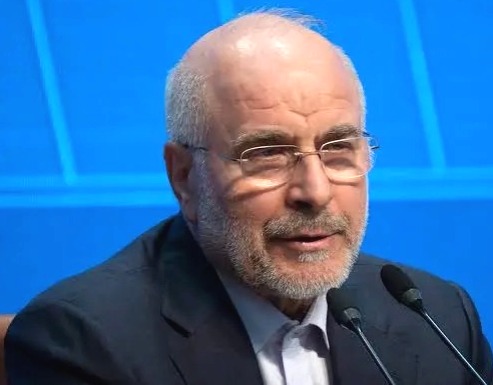
Iranian Parliament Speaker Mohammad Bagher Ghalibaf: Americans Will Soon Be Nostalgic For Gasoline Prices Of $4 To $5 Per Gallon.

Tehran; April 2026: Mohammad Bagher Ghalibaf, who had led Iran’s delegation in talks to end the war, said US delegation have failed to gain the trust of the Iranian delegation. The senior Iranian authority have said that the United States needs to do more if an agreement is to be made to end the war as they urge their supporters to maintain control of the streets.
The fact that the Iranian delegation did not accede to Washington’s core demands of eliminating nuclear enrichment on Iranian soil and ending Iranian control over the Strait of Hormuz was adulated by Iranian authorities yesterday late evening (IST) as they projected defiance.
Judiciary chief Gholam-Hossein Mohseni-Ejei has congratulated the delegation that went to Islamabad and said they “guarded the rights” of the supporters of Iran’s government, including paramilitary forces converging on main squares, streets and mosques in Tehran and other cities every night for more than six weeks.
When the delegations were engaged in the talks on Saturday night, a member of the aerospace division of the Islamic Revolutionary Guard Corps (IRGC) was shown by state television telling flag-waving supporters in downtown Tehran not to be concerned. “If the enemy does not understand, we will make them understand”, the man who was wearing military attire and a black mask to conceal his identity said to cheers from the crowd, some of whom demanded more missile and drone attacks from the IRGC.
The Ministry of Foreign Affairs said it did not expect to reach an agreement after only one day of negotiations, alongside several lawmakers in the hardliner-dominated parliament said they were happy that the talks did not yield results because they believed Iran had the upper hand in the war.
Hamidreza Haji-Babaei, the deputy parliament speaker, said the only thing acceptable to the establishment supporters who are on the streets is a United Nations Security Council resolution that would signal “surrender” for the US and lead to the lifting of sanctions against Iran and its leaders.
Amir Hossein Sabeti, a Tehran lawmaker affiliated with the Paydari faction of hardliners, said he was thankful to the negotiating team for “not backing away from red lines” and “there is no way left but to show resistance in the field against these evildoers and demons”.
This comes after some pro-state voices said they were disheartened by the abrupt announcement overnight into Wednesday of a two-week ceasefire and direct negotiations on ending the war with the US. To assuage internal concerns, the Iranian delegation to Islamabad had 91 members, including dozens of representatives from state-affiliated media and analysts close to different factions.
In addition to Ghalibaf, a former IRGC commander who advanced Iran’s missile programme, senior members of the team included Foreign Minister Abbas Araghchi, hardline diplomat Ali Bagheri Kani, Defence Council head and former security chief Ali Akbar Ahmadian and moderate central bank chief Abdolnasser Hemmati.
The talks on Saturday established that a diplomatic breakthrough was not close and that more escalation was likely, even if there is no immediate return to full-fledged fighting. “What Trump has been saying after the negotiations is just excessive talk. He is saying his wishes out loud”, Ebrahim Azizi, the head of the national security commission of Iran’s parliament, told state television on Sunday afternoon about Trump’s announced naval blockade and new threats.
The IRGC has threatened that it will respond to any passage of military vessels through the Strait of Hormuz with full force. It also rejected the US military’s announcement during the talks that two US warships had passed through the strait in preparation for an operation to clear naval mines blocking the strategic waterway.
However, in a sharp contrast to what the Trump led American government is thinking about the future course of actions against Iran, the Democrats are continuing their criticisms against Donald Trump. Senator Tim Kaine said Trump should never have exited the Iranian nuclear deal, negotiated under President Obama. Tim Kaine further went on to say: “Vance says Iran won’t agree to what they agreed to 10 years ago. I’m sure Iran wonders: if we agree to it, will the United States tear it up again, bomb our civilian infrastructure, kill schoolchildren, and engage in an assassination campaign against our leadership? This is not going to be an easy negotiation, because the last negotiation that led to control of Iran’s nuclear programme, the US made the decision to tear it up and walk away. I think that decision by President Trump will go down in history as one of the worst decisions in the foreign policy space ever made by an American president. If you make diplomacy impossible, you tend to make war inevitable”.
Meanwhile, Republican Senator Ron Johnson said he agreed with Trump’s decisions on this war, but acknowledged it would be ‘a long-term project going forward’.
Lawmakers on both sides said they were hopeful there is still room for further negotiations before the ceasefire ends in about 10 days. But there is a definite acknowledgement, even from Trump’s own party, that this remains an open-ended conflict.
Suvro Sanyal – Team Maverick.



PM congratulates Major Abhilasha Barak on being conferred the UN Military Gender Advocate of the Year Award
Prime Minister Shri Narendra Modi today congratulated Major Abhilasha Barak on being confe…

PM congratulates Major Abhilasha Barak on being conferred the UN Military Gender Advocate of the Year Award
Prime Minister Shri Narendra Modi today congratulated Major Abhilasha Barak on being conferred the …