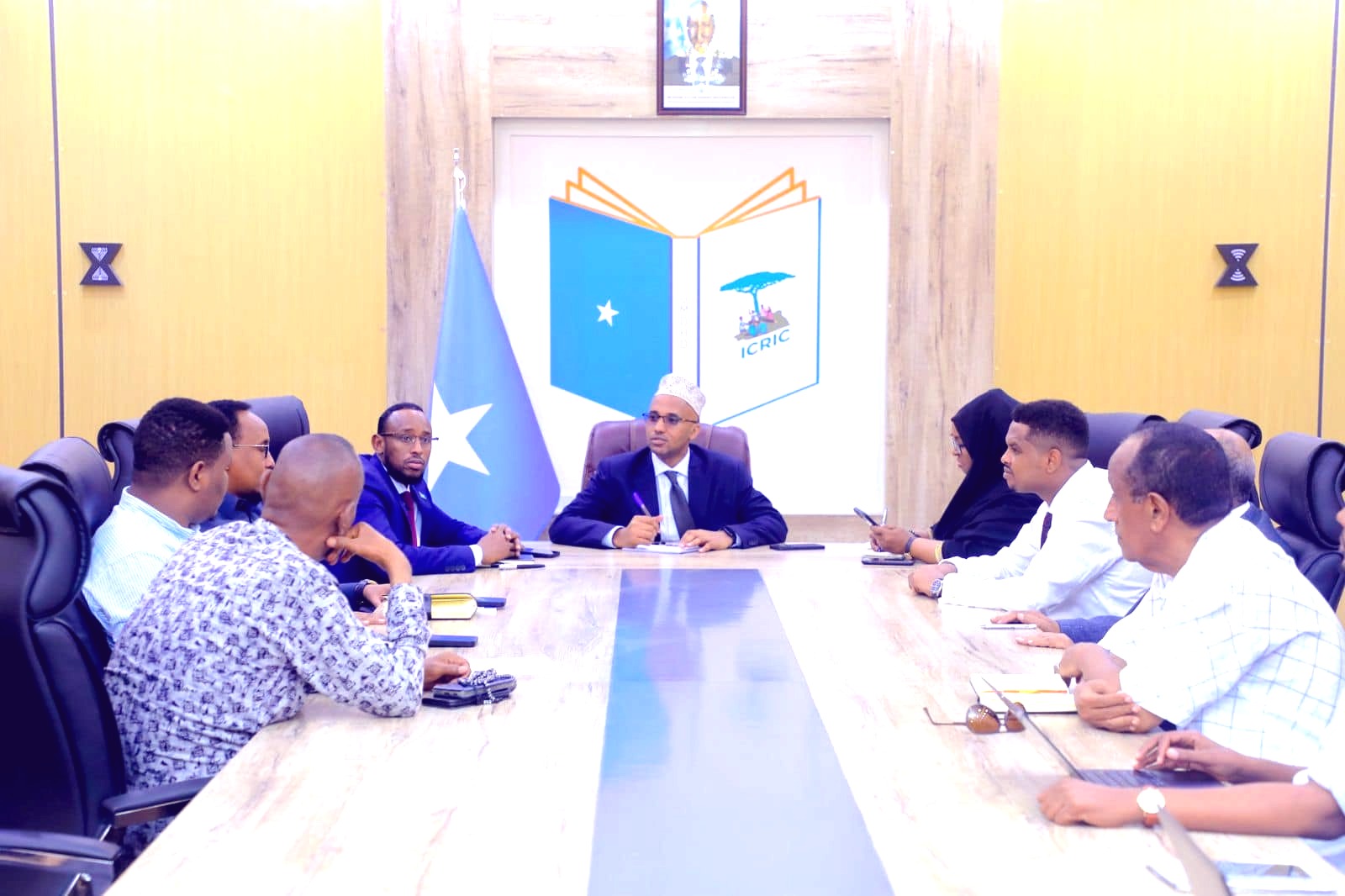
Somalia Plunges Into Uncertainty As President Declines Stepping Down.

Mogadishu; May 2026: When Somalia’s President Hassan Sheikh Mohamud denied the end of his term on 15 May, the opposition announced they no longer recognised his legitimacy and warned that Somalia had entered a dangerous phase. Mohamud insisted that constitutional amendments approved by Parliament had extended his term from four to five years.
The African Union, Intergovernmental Authority on Development and United Nations have urged the resumption of transition talks that stalled on 15 May, mediated by the United States and Britain. Only a gradual consensus-based process can reconcile Somalia’s competing political systems and avert repeated election crises.
Elections should have been held before Mohamud’s term expired, but preparations were delayed due to political disagreements among the elite, ongoing insecurity and funding limitations. These would have been Somalia’s fourth elections since the Federal Government’s establishment in 2012 – although the country’s unique leader selection process differs from democratic elections.
For two decades, Somalia has struggled to shift from a clan-based indirect electoral system to nationwide direct elections based on universal suffrage. Efforts in 2017 and 2022 to dismantle or bypass the system broke down due to disagreements among political leaders over the transition process, delaying the change of government. This raised the risk of violence between the federal government and opposition and hindered improvements in service delivery, counter-terrorism and governance.
Somalia has long planned to conduct direct elections as part of its democratisation process. But the federal government is trying to shift too abruptly from clan-based power-sharing to full democratic elections without reconciling these competing political systems. The country needs a gradual transition that ensures inclusion through representation and stability through legitimacy.
Somalia’s current electoral model relies on clan delegates to choose parliamentarians, who then elect the president
Divisions between the federal government and opposition groups, including Puntland and Jubaland federal member state leaders and the opposition Somali Salvation Forum coalition led by former President Sharif Sheikh Ahmed all have undermined election preparations.
The opposition has rejected the unilateral push for reforms to enable direct elections since March 2024, when the federal government amended the provisional constitution to extend Mohamud’s and Parliament’s mandates by a year. The Somali Salvation Forum was formed in October 2025 to oppose the federal government’s approach, fragmenting the political landscape and creating parallel processes.
None of this is new to Somalia’s political scene. The same issues arose among the same actors during the election that brought Mohamud to power in 2022. Then-president Mohamed Abdullahi Mohamed (known as Farmaajo) had planned nationwide direct elections, but disagreements led to a 15-month delay in the polls and conflict between opposing sides.
At the heart of Somalia’s recurrent election crisis is tension between the clan-based power-sharing system and direct elections. This is hard to resolve because the distribution of power between the federal government and its member states is not clearly demarcated in the provisional constitution.
Somalia’s current electoral model is often referred to as a ‘selection’ rather than an election. The 4.5 clan-based framework provides equal political representation to the four major clan families and a half share to minority groups. It relies on clan delegates to choose parliamentarians, who in turn elect the president.
Although it allocates power among major clan families and minority groups, the system doesn’t adequately reflect evolving dynamics among clans and sub-clans, or accommodate demands for merit-based or population-based proportional representation. It has therefore become both a tool for inclusion and a source of grievance.
The power distribution between the federal government and states isn’t clear in the provisional constitution
A central limitation is the disconnect between formal representation and actual power. Certain sub-clans that have significant influence through economic resources and military capacity are underrepresented in the 4.5 structure. This incentivises them to operate as political ‘kingmakers’, exerting influence informally and often pushing institutions into deadlock when their interests are not accommodated.
At the same time, groups that are formally better represented – particularly smaller clans and minority communities – often lack the financial and organisational capacity to sustain political influence. They align with more powerful actors in exchange for support, effectively becoming proxies rather than autonomous representatives.
These limitations undermine the inclusivity the system was designed to ensure, as representation is mediated through patronage networks rather than grounded in genuine constituency interests.
Transitioning to direct elections also presents political and structural challenges. Such a system could shift political authority away from clan elders towards individual citizens, fundamentally altering Somalia’s political economy. Unless their roles are carefully redefined, that could marginalise traditional power brokers.
There are also entrenched institutional interests at stake. Members of Parliament, who currently derive their authority from the indirect system, could lose their ability to choose the president. The indirect system also enables member states to exert significant influence over national politics, often beyond what the provisional constitution allows. Regional actors will resist reforms that strengthen the federal authority at their expense.
A phased approach could gradually expand direct local elections to regional, then national, universal suffrage
Moreover, voter registration, constituency delimitation and election security for national elections remain only partially developed. State authority is uneven, with al-Shabaab controlling southern and central Somalia, where institutional capacity is limited.
A direct election could also produce a geographically imbalanced and politically irregular outcome. Regions allied with Mogadishu and having better security and administrative infrastructure would likely dominate. More fragile or contested areas, or those that distance themselves from the federal government, such as Puntland and Jubaland, could be effectively excluded. This would undermine any claim to national representation and legitimacy.
These dynamics create winners and losers who want to protect or oppose the transition to a federal government-led democratic electoral system that remains tied to a clan-based political settlement.
Because the two systems are hard to reconcile, careful sequencing and reconciliation are needed to align incentives, build trust and gradually expand inclusion. For example, blending clan quotas with geographic constituencies, or creating a bicameral balance in which one chamber reflects clan equity and the other the popular vote.
A phased approach could gradually expand direct local elections (as piloted in the December 2025 Mogadishu poll) to regional and then national universal suffrage. Without a calibrated approach, Somalia will remain trapped in a cycle in which each election becomes a trigger for conflict rather than a means to resolve tensions.
Team Maverick.




U.S. Ambassador Sergio Gor calls on Dr Jitendra Singh, discusses expanding bilateral collaborations across domains
India, U.S. explore trusted technology cooperation in biotech, quantum and space Nuclear r…

U.S. Ambassador Sergio Gor calls on Dr Jitendra Singh, discusses expanding bilateral collaborations across domains
India, U.S. explore trusted technology cooperation in biotech, quantum and space Nuclear research has …