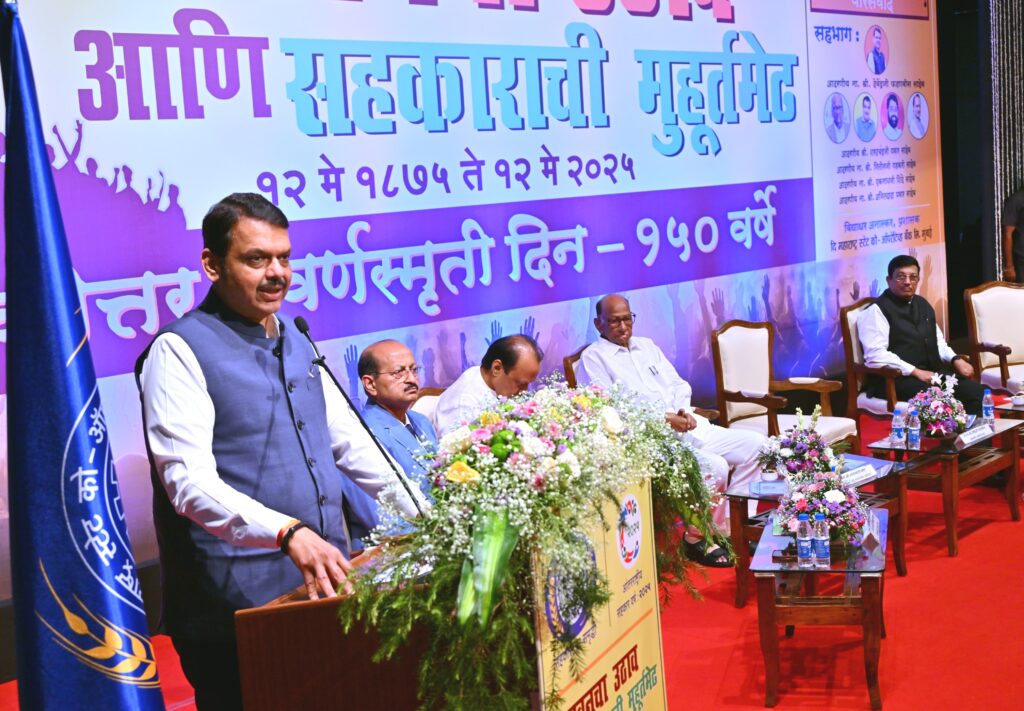
A committee will be formed to make necessary amendments to the Cooperative Law – Chief Minister Devendra Fadnavis

Seminar on the topic “Empowerment of Cooperation and State Government’s Policy”
Mumbai : Every stakeholder associated with the cooperative sector must get justice through the cooperative law. For that, new ‘chapters’ related to each sector will have to be included in the law. The currently prevailing cooperative law needs to be amended in line with the changing times. For this purpose, a committee is being established to make the necessary amendments in the cooperative law, announced Chief Minister Devendra Fadnavis today.
At Yashwantrao Chavan Pratishthan Auditorium, on the occasion of “Dakkhancha Uthav ani Sahakarachi Muhurtmeedh,” commemorating the 150th post-centenary golden memorial day and the International Year of Cooperatives 2025, a seminar was organized on the topic “Empowerment of Cooperation and the State Government’s Policy.” Chief Minister was addressing the audience during the event. Deputy Chief Minister Eknath Shinde, Deputy Chief Minister Ajit Pawar, Union Minister for Road Transport and Highways Nitin Gadkari, MP Sharad Pawar, Bank Administrator Vidhyadhar Anaskar, and Dilip Dighe were present.
Chief Minister Devendra Fadnavis said that cooperative banks have adopted modern technology and brought about a radical change in the banking sector. Cooperative banks have adopted a modern tech-based banking system with core banking. All customer-friendly services are being provided by cooperative banks. Because of this, cooperative banks have survived even during the period of fiscal consolidation. They have performed well during this time. The movement against moneylenders at Supa in Pune district on May 12, 1875, marked the beginning of the cooperative movement. This historic event has now completed 150 years.
Prime Minister Narendra Modi has for the first time set up an independent Ministry of Cooperation at the central level. Through this ministry, the cooperative movement across the country is being empowered. Cooperative institutions are being strengthened through the central government, which is giving a boost to the rural economy. With the help of the World Bank, cooperative institutions in 10,000 villages are being trained and provided business models. The World Bank has expressed satisfaction with this initiative, and a new beginning has been made in agri-business, said CM Fadnavis.
Cooperative sugar factories are producing by-products along with sugar. This helps them survive in global competition. The central government has made continuous changes in the Minimum Support Price (MSP) and ethanol policies. The state government’s stand is that sugar factories of farmers should remain with the farmers. Hence, sugar factories should also focus on by-product manufacturing. Power tariffs for cooperative spinning mills have been a hurdle in staying competitive in the global market. The government also provides subsidies on electricity. Therefore, all spinning mills are being shifted to solar power. This will resolve the major electricity issue for spinning mills, Fadnavis said.
The Chief Minister said that the cooperative sector should also assist in setting up processing industries. Among all cooperative institutions, 50 percent are cooperative housing societies. Amendments have been made to the cooperative law and a separate chapter has been included for housing societies. This is helping to set up a systematic structure for cooperative housing societies. A new scheme has been introduced for self-redevelopment of these societies. The state government is providing 17 types of various concessions. Strengthening cooperative housing societies is helping citizens in Mumbai to own homes. A committee under the chairmanship of MLA Pravin Darekar has also been set up on self-redevelopment of cooperative housing societies.
The Chief Minister also said that a study will be conducted to ensure that the state government’s transactions are done significantly through cooperative banks, and a positive decision will be taken on it.
Cooperation has a major role in India’s journey to becoming a superpower
– Deputy Chief Minister Eknath Shinde
India is rapidly moving towards becoming the third superpower. It currently holds the position of the fifth-largest economy in the world. The cooperative sector will have a significant role in this journey, stated Deputy CM Eknath Shinde.
He said that after the establishment of the Ministry of Cooperation at the center, major reforms have taken place in the cooperative sector. With the help of NABARD, rural marts are being established in rural areas. Due to Kisan Credit Cards and micro ATMs, the cooperative movement has become stronger. This has significantly boosted the rural economy. The Maharashtra Co-operative Bank, with a business volume of ₹62,000 crores, is one of the most financially strong cooperative banks in the country. Shinde expressed confidence that this seminar’s brainstorming session will generate ideas highlighting the importance of the cooperative sector in empowering common people economically.
Maharashtra State Cooperative Bank should prepare a report on the history of the cooperative movement so far
– Deputy Chief Minister Ajit Pawar
A movement against moneylenders took place in Supa, Pune district, 150 years ago. This movement marked the beginning of the cooperative sector. Today, the cooperative movement has made great progress. However, to face future crises and challenges, the movement must be further strengthened. The Maharashtra State Cooperative Bank should prepare a report on the history of the cooperative movement till now, instructed Deputy CM Ajit Pawar.
He said that the Maharashtra State Cooperative Bank is the only bank in the cooperative sector that has made a profit of more than ₹600 crores consecutively. This year, the bank earned a profit of ₹651 crores. There should be a provision to share part of the profit with board members when the bank earns a profit, and also provisions to act against the board when the bank is in trouble. Cooperative institutions should be given management training. The government is firmly standing behind the cooperative movement, he assured.
Bring a new law by balancing the Company Law and the existing Cooperative Law
– Union Minister Nitin Gadkari
A strong movement against moneylenders took place at Supa in Pune district. This movement laid the foundation of the cooperative sector. Currently, the cooperative movement exists only in Maharashtra, Gujarat, Karnataka, Kerala, and a few other states. To spread this movement across the country, the central government is working through the newly created Ministry of Cooperation. A new law should be brought by balancing the currently applicable Company Law and the cooperative law, appealed Union Minister for Road Transport and Highways Nitin Gadkari.
Through the cooperative movement, a positive transformation has taken place in the lives of many hardworking, poor, and economically weaker sections. The cooperative sector has played a major role in bringing the underprivileged into the mainstream. The Maharashtra State Cooperative Bank should study the social and economic impacts of this. The cooperative sector should work to make the laborious life of common people easier. The dairy sector has greatly benefited from the cooperative movement, leading to financial prosperity for farmers, Gadkari said.
The cooperative movement was born as an alternative to the moneylending system – Sharad Pawar
On May 12, 1875, a movement against moneylenders was held at Supa in Pune district. This uprising became the birth of the cooperative movement as an alternative to the moneylending system. At that time, farmers and the poor were suffering due to exploitation by moneylenders. To free them from such exploitation, a major movement was launched. This movement led to the beginning of the cooperative movement, said former Chief Minister and MP Sharad Pawar.
The schemes started by the State Cooperative Bank at that time are still in operation. Through the State Cooperative Bank, efforts are being continuously made to bring prosperity into the lives of common people. The bank’s financial empowerment is discussed across the country. Currently, cooperative institutions need revitalization. Necessary efforts must be made in that direction, Pawar said.
The introduction was given by Administrator Vidhyadhar Anaskar, and the vote of thanks was proposed by Dilip Dighe. During the program, a booklet on the financial balance sheet of the bank was released. Eminent personalities from the cooperative sector were present at the event.




Portugal Part Ways with Roberto Martinez After World Cup Exit, Begin Search for New Head Coach
Lisbon, July 2026 : The Portuguese Football Federation (FPF) has officially confirmed the …

Portugal Part Ways with Roberto Martinez After World Cup Exit, Begin Search for New Head Coach
Lisbon, July 2026 : The Portuguese Football Federation (FPF) has officially confirmed the departure …