US Air Force Executes First Coding Sprint for Enhanced C2 Operations

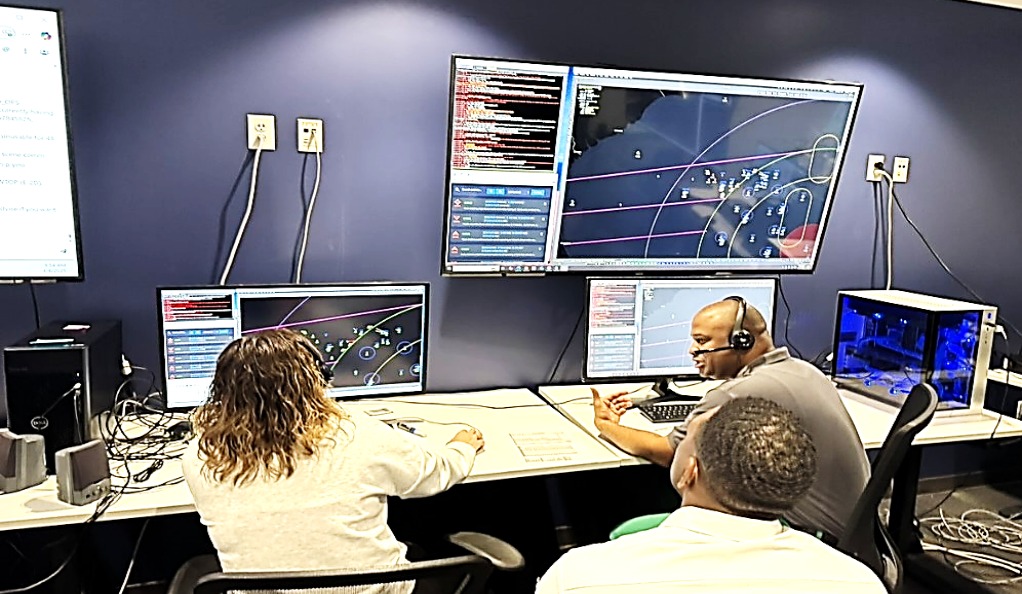
The US Air Force has completed its inaugural coding experiment in support to advancing command and control (C2) capabilities at the Howard Hughes Operations Center in Las Vegas, Nevada. Popularly known as the Decision Advantage Sprint for Human-Machine Teaming (DASH), this two-week event involved software prototyping that aligns with the military’s objective to adopt “transformational” decision-support tools for fast-paced battle management. It required the development of software to output “Battle Effects,” which are recommended C2 data constrained by rules of engagement and time.
Demonstrations were divided into two phases, with the first using legacy tools to establish a baseline and the second using the new prototypes. Each stage had speed and accuracy benchmarks to assess a software impact. During the experiment, personnel who had minimal training were able to process data while feedback loops between developers and war fighters allowed real-time refinement.
The codes used were flexible in design, allowing experts to apply various methods to provide quality decision-making information. Meanwhile, scenarios consisted of unclassified components to promote coordination between the military and civilian participants
Decision Advantage –
805th Combat Training Squadron Commander Lieutenant Colonnel Shawn Finney, who is among the experiment’s supervisors, explained how DASH could affect the strategies of war fighters.
“Our C2 systems are still putting the burden of complex decision-making entirely on the human; this sprint starts to change that by giving our Airmen digital teammates that help them perceive, decide and act faster”, Finney said.
It has concluded with the exercise validating a “repeatable, scalable” method for C2 software development, according to the air force. “The DASH experiment gave us a chance to immerse software developers in the reality our war fighters face, so the tools they build are operational from day one. Decision advantage is the capability gap that underwrites all others. With DASH, we’re not just closing that gap, we’re coding directly into it”, Finney stated.
Two DASH events will be facilitated later this year to refine software functions and inform future investments. This first experiment was made possible in partnership with the 711th Human Performance Wing, the Air Force Research Laboratory, the Integrated Capabilities Command, and the Royal Canadian Air Force air battle managers.
Team Maverick


RSS Chief Mohan Bhagwat Urges Dialogue with Youth, Says Today’s Generation Seeks Answers, Not Blind Obedience
New Delhi, July 2026 : Amid nationwide protests over examination paper leaks and alleged i…

RSS Chief Mohan Bhagwat Urges Dialogue with Youth, Says Today’s Generation Seeks Answers, Not Blind Obedience
New Delhi, July 2026 : Amid nationwide protests over examination paper leaks and alleged …