Oil Palm Cultivation to Provide Farmers with a Stable Source of Income

Horticulture Department’s technical assistance giving a new direction to oil palm farming in the state
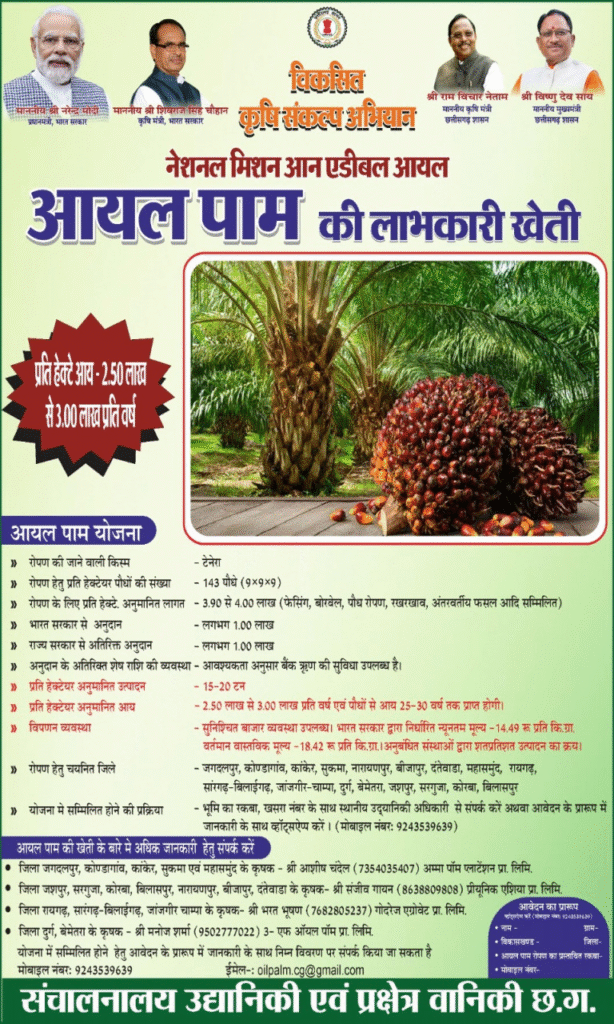
Annual earnings of ₹2.5–3 lakh per hectare
One-time planting, production for 30 consecutive years starting from the third year
₹1 lakh subsidy each from Central and State governments
Raipur, Aug 2025 – Oil palm cultivation is becoming a permanent source of income for farmers in the state. The state government is promoting oil palm and other horticultural crops to provide farmers with additional sources of revenue. Considering the demand and productivity of palm oil, farmers are being encouraged to cultivate it. For this purpose, the Central and State governments have launched a joint initiative under the National Mission on Oilseeds and Oil Palm. So far, more than 2,682 hectares have been planted with oil palm saplings.

Palm oil is the most widely used vegetable oil in the world. It is used in biscuits, chocolates, instant noodles, snacks, and non-food products like soaps, creams, detergents, and biofuels. To promote palm cultivation, both the Central and State governments provide a subsidy of ₹1 lakh each to farmers, along with free training.
3.5 lakh hectares under palm cultivation across India
The Central Government, aiming to reduce dependence on edible oil imports and increase farmers’ income, has boosted palm oil production through the National Mission on Edible Oils. Under the National Mission on Oilseeds and Palm Oil, palm cultivation has reached 3.5 lakh hectares nationwide. According to the Union Agriculture Ministry, domestic palm oil production rose by 15% in 2024–25. The government aims to increase production to 2.8 million tonnes by 2029–30. Special focus is being given to tribal-dominated areas like Bastar and Dantewada in Chhattisgarh, as well as Telangana, Assam, Mizoram, Odisha, and Andhra Pradesh, to create new avenues for employment and income.
Oil palm farming in 17 districts of Chhattisgarh
Under the leadership of Chief Minister Vishnudev Sai and the guidance of Agriculture Minister Ramvichar Netam, the state is encouraging farmers to grow horticultural crops. Efforts have been made to promote oil palm cultivation in 17 districts, including Bastar (Jagdalpur), Kondagaon, Kanker, Sukma, Narayanpur, Bijapur, Dantewada, Mahasamund, Raigarh, Sarangarh-Bilaigarh, Janjgir-Champa, Durg, Bemetara, Jashpur, Surguja, Korba, and Bilaspur.
In the past four years, around 1,150 farmers have planted oil palm over 1,600 hectares. This year alone, 802 farmers have planted oil palm over 1,089 hectares.
For instance, in Chakradharpur village of Raigarh block, farmer Rajendra Meher planted 570 oil palm saplings on his 10-acre land with the assistance of the Horticulture Department. His land had been lying idle for a long time, and though he had considered horticulture before, lack of technical knowledge delayed the decision. After connecting with the department, he received not only guidance but also detailed information on the benefits of palm farming, which motivated him to proceed. In Mahasamund district, oil palm is being cultivated over 611 hectares.
Production starts from the third year
According to Horticulture Department officials, under the Oil Palm Scheme, 143 saplings worth ₹29,000 per hectare are given free of cost. The total cost of planting, fencing, irrigation, maintenance, and intercrops is about ₹4 lakh per hectare. The Government of India and the State Government each provide a subsidy of ₹1 lakh, with the remaining cost covered through bank loans.
Additionally, subsidies are available for orchard maintenance, drip irrigation, intercrops, borewells, pump sets, water harvesting systems, vermicompost units, palm cutters, wire mesh, motorized chisels, chaff cutters, and tractor trolleys. Oil palm production begins in the third year and continues for 25–30 years, with yields increasing as plants mature. Each hectare can produce 15–20 tonnes annually, potentially generating an income of ₹2.5–3 lakh per year for farmers.
Assured procurement at support price
Since oil palm plants are spaced apart, farmers can grow vegetables or other intercrops in between, with additional government subsidies available. For plantations over 2 hectares, an extra subsidy of up to ₹50,000 is provided for borewell drilling. To ensure sales, the Government of India has arranged contracts with companies to purchase the produce directly from farmers’ fields at the minimum support price (MSP). Payments are made directly to farmers’ bank accounts.




Punjab Kings Beat Gujarat Titans by 3 Wickets in Last-Over Thriller
Delhi, March 2026 : In an exciting match of the Indian Premier League 2026, Punjab Kings d…

Punjab Kings Beat Gujarat Titans by 3 Wickets in Last-Over Thriller
Delhi, March 2026 : In an exciting match of the Indian Premier League 2026, …