
Organ Donation: A Social Cause

Aug 2025 : To encourage organ donation, state-level programs are being undertaken to create public awareness. Currently, across the state, an “Organ Donation Fortnight” is being organized effectively and purposefully from August 3 to August 15, 2025. Also, every year on August 13, World Organ Donation Day is celebrated. If one thinks, “Let’s bring new life to someone after our death!” then thousands of citizens will voluntarily participate in this organ donation campaign and fill out the organ donation pledge form. As part of this effort, this article aims to highlight the importance of organ donation.
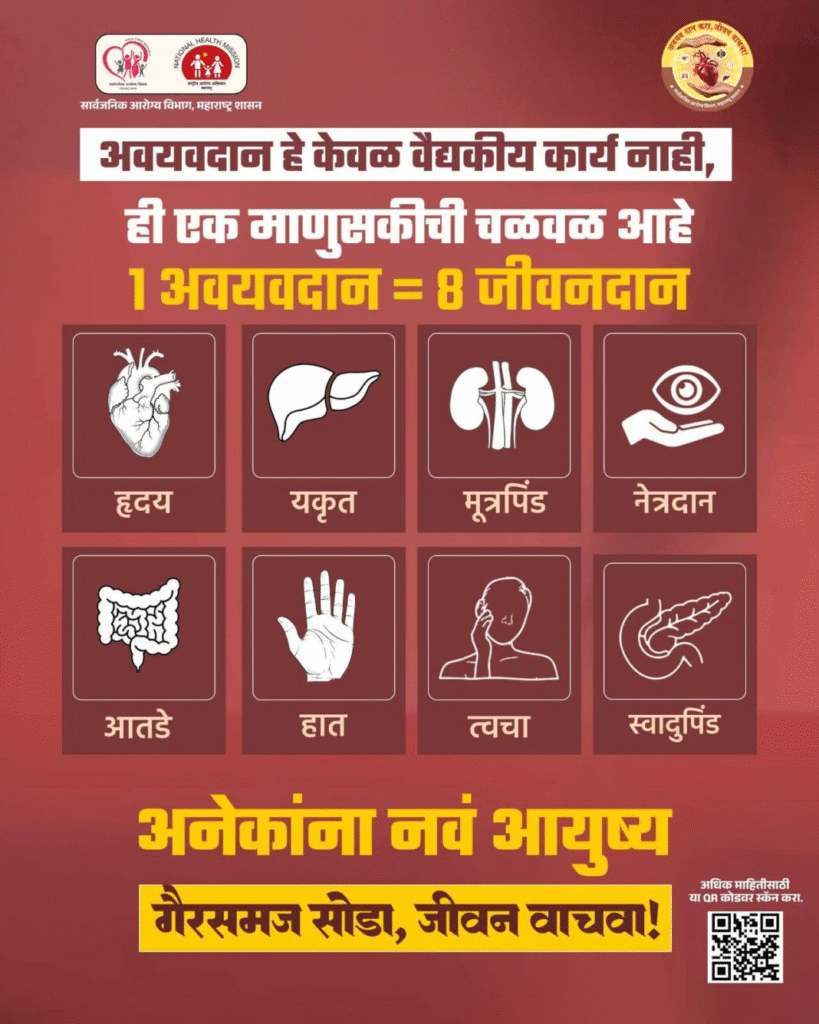
There is great curiosity among citizens about organ transplantation. People often wonder — if a good person donates a kidney or liver to a close relative, will it affect their own health? Can the organ regenerate? In fact, medical science has made tremendous progress, and transplantation procedures are performed with utmost care. We frequently read in the media about successful transplants of kidneys, hearts, lungs, livers, and eyes. Therefore, there is no reason for people to be afraid.
In the past, incidents occurred where organs were forcibly taken from hospitalized patients, kidnapped orphans, beggars, or poor individuals — sometimes lured by money. Certain doctors and organ traffickers were involved in such illegal acts, leading to people becoming disabled or even dying. To benefit genuine patients, reduce risks, and prevent the commercial sale of organs, the Central Government enacted the Transplantation of Human Organs Act (THOA) of 1994. After its implementation, the number of legal transplants steadily increased. According to reports, in the year 2024 alone, 13,476 kidney transplants, 4,901 liver transplants, 253 heart transplants, 228 lung transplants, and 44 pancreas transplants were performed, giving patients a new lease on life. At present, there are millions of patients across the country suffering from kidney, liver, and heart diseases who are waiting for donors — and the actual number is even higher, increasing every day.
Under this law, any registered doctor must inform the patient and their relatives about the outcomes and risks before removing or transplanting an organ. Surgeries can only be performed in registered hospitals. In addition, the organ donor and recipient must be close relatives; if not, permission from the transplant committee is required. The committee conducts thorough verification before approving the procedure. It is also mandatory for the treating doctors to provide full details of the patient to the transplant authorization committee.
To coordinate organ donation across the state, the Zonal Transplant Coordination Center (ZTCC) was established in Mumbai, with branches in Chhatrapati Sambhajinagar, Pune, and Nagpur. These centers maintain up-to-date records of patients in need, donors available, and match organs to recipients efficiently.
Specific rules apply to each type of transplant. For example, in kidney donation, the donor may be put on dialysis for a month. Spouses or blood relatives can donate kidneys to each other. Full written information about the importance of the organ and possible effects of removal must be given to the donor. Documents like ID cards, Aadhaar, PAN, ration cards, birth certificates, or marriage certificates are verified before surgery. Hospital coordinators check these before presenting them to the authorization committee for final approval.
The process must remain transparent. The authorization committee keeps a waiting list of patients, and organs are allocated only to those on the list. Violations can result in heavy fines for doctors and hospitals, and imprisonment if guilty. Currently, about 35 hospitals in Mumbai — including municipal, government, and some private — are registered for organ transplantation. Globally, Spain ranks first in organ donation, with England, the USA, Hong Kong, and Japan also having high rates (50 donors per 100,000 deaths). In comparison, India’s rate is extremely low — only 0.65 donors per million population according to the National Health Portal.
Medical science is rapidly advancing, and patients are getting better facilities. Awareness about surgeries and treatments is growing. Just as people now willingly donate blood and eyes — which was rare before — interest in organ donation is also increasing worldwide. Some even donate their entire bodies for medical research, setting a noble example.
Organ donation means giving away organs like kidneys, hearts, livers, eyes, lungs, pancreas, or skin when a person dies or is declared brain dead. Sometimes, individuals explicitly tell their families to donate their body or organs after death. Through this, patients receive life-changing transplants — someone gets kidneys, someone eyes, and many regain a healthy life.
Healthy individuals may die in accidents, heart attacks, or from brain-related issues. Instead of burying or cremating the body and wasting healthy organs, donating them can save lives. With modern technology, live organ donations of kidneys and livers are also possible. According to the National Health Portal, around 500,000 people in India die every year due to the unavailability of organs, including 200,000 who die waiting for a liver. One donor can save up to eight lives.
Thousands of registered patients in the state are waiting for organs. Organs have no religion or caste — donors and recipients can be from any background. There are many inspiring examples of people donating purely out of humanity.
Organ donation is becoming a movement. With lifestyle changes, environmental impacts, unhealthy diets, lack of exercise, and rising cases of diabetes, blood pressure, heart, kidney, and liver diseases — organ failure is becoming common, even in young people. Sometimes, late diagnosis or lack of facilities leads to death, but timely transplantation can save and extend life.
Anyone can donate organs. There are many stories — a son giving his kidney to his father, a sister to her brother, a son donating part of his liver, or a heart from Francis saving Hariprasad’s life. Organ donation is above caste and religion. The process is simple: if someone has filled an organ donor form, in the event of death or brain death, relatives can donate organs within six hours. Donation is possible for individuals from the age of three and above.
Thanks to the law, organ donation is now safer, and commercial trading of human organs is prohibited. Your donated organ can transform not just one life but many, bringing joy to families. On this World Organ Donation Day (August 13), let us work together to spread awareness and give many people a new life. If we truly think about giving life after death, thousands will join this noble cause and pledge to donate their organs.







Trump Says US, Iran Near Broad Peace Understanding After Talks With Regional Leaders
Washington, May 2026 : US President Donald Trump has claimed that the United States and Ir…

Trump Says US, Iran Near Broad Peace Understanding After Talks With Regional Leaders
Washington, May 2026 : US President Donald Trump has claimed that the United States …