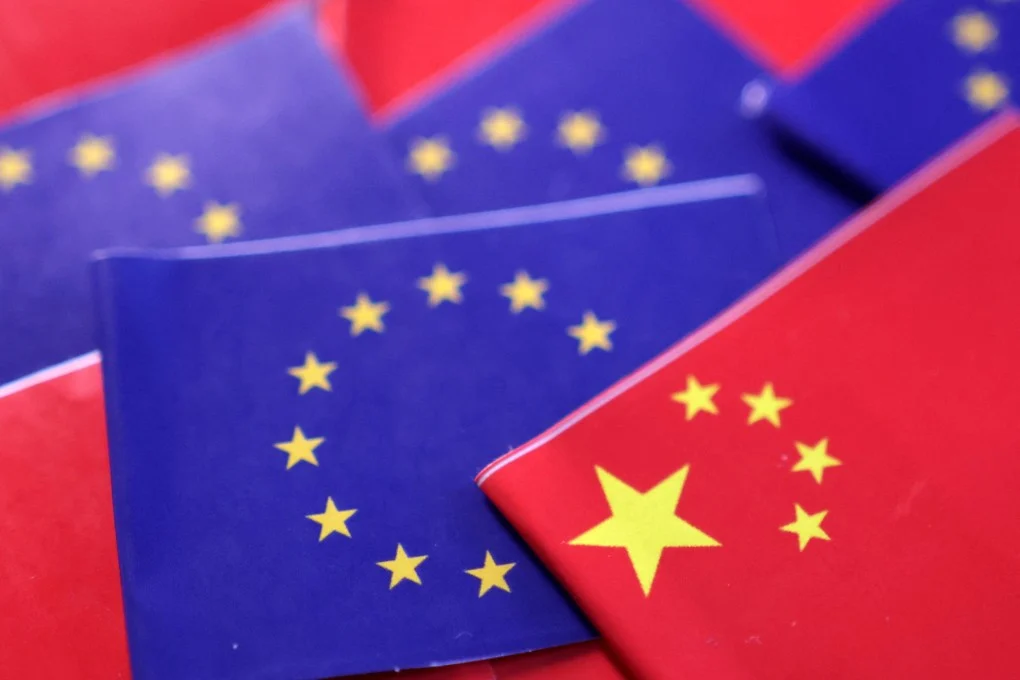
China Bans dealing with two European Union Banks.

Aug 2025 : The Chinese Ministry of Commerce has imposed a ban on UAB Urbo Bankas and AB Mano Bankas, from doing business as a countermeasure against previous financial sanctions from the 27 member bloc.
The two banks are from Lithuania, a country that has been one of Beijing’s most vociferous critics in Europe. The Baltic state saw its relations with Beijing downgraded and diplomats expelled in 2021, after allowing Taiwan to open a controversially named “Taiwanese Representative Office” in its capital.
The measure, taking effect immediately, will prohibit Chinese entities and individuals from engaging in any transactions, cooperation, or other activities with the two banks, the ministry said.
Last month, in its latest package of measures designed to hobble Russia’s war machine, the EU had announced sanctions on two small Chinese banks from cities close to China’s border with Russia: Suifenhe Rural Commercial Bank and Heihe Rural Commercial Bank. The measure prohibiting the EU operators from making transactions with the two banks went into effect on August 9. The Chinese banks have been accused of facilitating the exchange of digital assets that are “significantly frustrating” EU sanctions. Beijing responded by calling on the bloc to immediately cease its wrong practice.
China’s countermeasure on Wednesday is designed to resolutely safeguard its sovereignty, security and development interests, and in accordance with the country’s Anti-Foreign Sanctions Law and other relevant legal provisions, the commerce ministry said in a separate statement. China have urged the EU to cherish the long-standing and sound economic, trade, and financial cooperation between China and the EU and its member states, rectify its wrongdoings, and immediately cease actions that harm China’s interests and undermine China-EU collaboration.
Beijing had lobbied intensely behind the scenes to get its two banks removed from the EU’s sanctions list. During a meeting last month with the EU’s top diplomat, Kaja Kallas, Chinese Foreign Minister Wang Yi warned her “three or four times” that there would be a response to the banks’ inclusion, according to sources familiar with the exchange. While Beijing has failed in ameliorating the banks from being blacklisted, it appears to have been successful in watering down the terms.
According to two diplomatic sources, there was a commitment from the European Commission to review the lenders’ listings in six months. Should the banks prove that they have stopped enabling support for the Russian military, they could be taken off the list. Olof Gill, a spokesperson for the European Commission, told the Press on Wednesday that “the EU has already been engaging constructively with China on the issue of the sanctioned Chinese entities. The EU is open in identifying a mutually acceptable solution that could ultimately lead to the delisting of the [Chinese and European] banks”, he said. Beijing while communicating with the bloc on Tuesday reaffirmed its intention in imposing countermeasures, Gill said. The EU will study these measures in detail once formally received before deciding on any additional next steps, he added.
In separate statements, each of the Lithuanian banks said they had no business in China, so their operations would not be affected. “Our bank does not carry out any financial transactions in China and has no business ties with individuals or organisations in that country”, said Marius Arlauskas, head of administration at Urbo Bankas.
The relationship between China and the EU has been fraught in recent years, despite continuous dialogue as both sides seek to avoid a full-blown trade war being waged by US President Donald Trump. The ongoing Russia-Ukraine war continues to be a major sticking point for Brussels, with Beijing perceived as enabling the continuation of the conflict in European policymaking circles.
Meanwhile, the EU has accused China of exporting industrial overcapacity, deliberately flooding its markets with subsidised products, especially in tent-pole sectors like electric vehicles, and Brussels says this action distorts trade and threatens local businesses.
Little has been seen in the way of improvement, even as top leaders from both sides met in Beijing last month, holding a summit to commemorate the 50th anniversary of the establishment of diplomatic relations. Wang Yiwei, a professor at Renmin University’s School of International Studies, said China -EU relations remain far from normalised, still complicated by several lingering disputes, including Ukraine.
The countermeasures issued on Wednesday adhere to the principle of reciprocity, while the choice of target also serves as a political warning, Wang said, as Lithuania has “persistently challenged” the one-China principle. “It is a warning against other EU countries that may also violate the one-China principle or attempt to drag China into the Ukraine issue as a scapegoat. These measures are intended to deter and counteract such provocations”.
Team Maverick






Bank Locker Insurance Fixed at 100 Times Annual Rent, No Change Proposed: Sitharaman
New Delhi, March 2026 : Finance Minister Nirmala Sitharaman on Monday informed the Lok Sab…
Bank Locker Insurance Fixed at 100 Times Annual Rent, No Change Proposed: Sitharaman
New Delhi, March 2026 : Finance Minister Nirmala Sitharaman on Monday informed the Lok …