South Asias missile race is heating up while China remains in cross chairs.

Aug 2025 : On the 20th. August, 2025 India had announced that it had successfully test-fired Agni-V, its intermediate-range ballistic missile, from a test range in Odisha on its eastern Bay of Bengal coast.
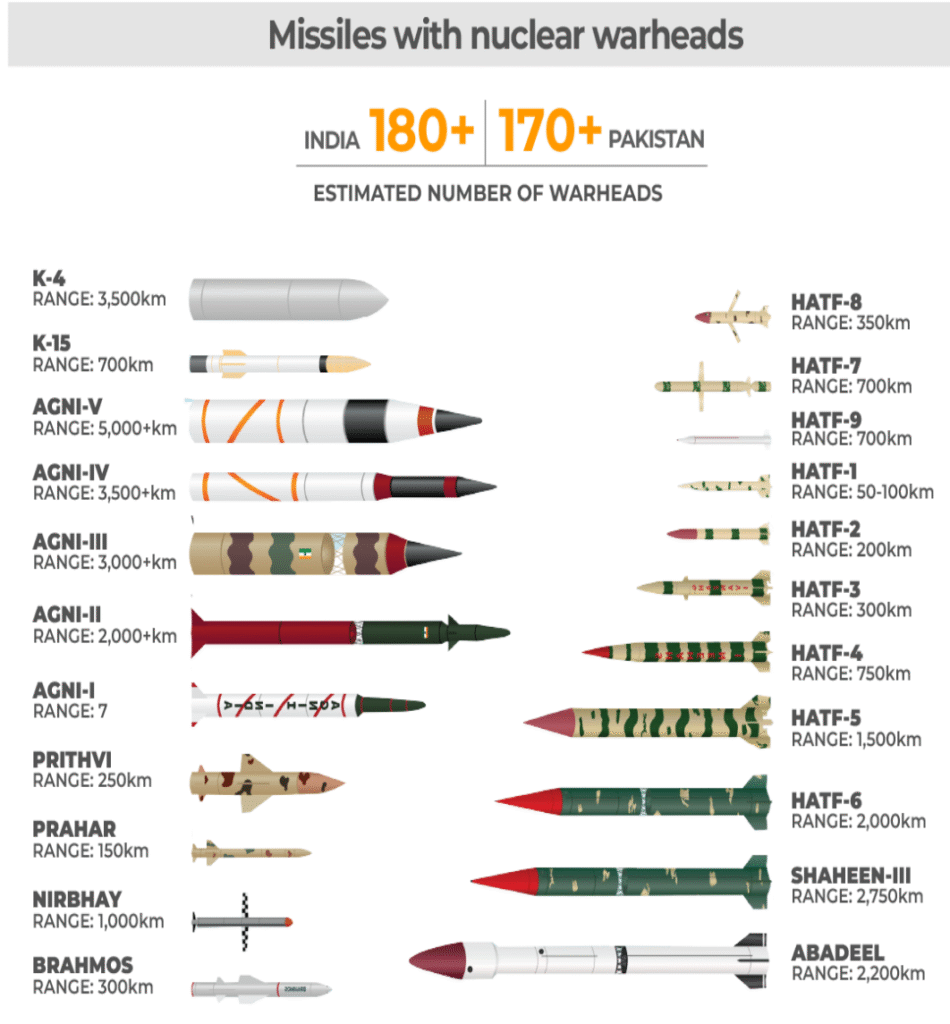
The Agni-V, meaning “fire” in Sanskrit, is 17.5 metres long, weighs 50,000kg, and can carry more than 1,000kg of nuclear or conventional payload. Capable of travelling more than 5,000km at hypersonic speeds of nearly 30,000km per hour, it is among the fastest ballistic missiles in the world.
The Agni test came exactly a week after Pakistan announced the formation of a new Army Rocket Force Command (ARFC), aimed, say experts, at plugging holes in its defensive posture exposed by India during the four-day conflict between the nuclear-armed neighbours in May. But experts say the latest Indian test might be a message less for Pakistan and more for another neighbour that New Delhi is cautiously warming up to again: China.
The Agni’s range puts most of Asia, including China’s northern regions, and parts of Europe within reach. This was the missile’s 10th test since 2012 and its first since March last year, but its timing, say analysts, was significant. It came just ahead of Indian Prime Minister Narendra Modi’s trip to China for the Shanghai Cooperation Organisation (SCO) summit, amid a thaw in ties, after years of tension over their disputed border – that has been accelerated by United States President Donald Trump’s tariff war against India. On Wednesday, the US tariffs on Indian goods doubled to 50% amid tensions over New Delhi’s oil purchases from Russia. Although a member country of the BRICS, India continues to view China as its primary threat in the neighbourhood, say experts, underscoring the complex relationship between the world’s two most populous nations. And it’s at China that India’s development of medium and long-range missiles is primarily aimed, they say.
Although India has acknowledged losing an unspecified number of fighter jets during the May skirmish with Pakistan, it also inflicted significant damage on Pakistani military bases, particularly with its supersonic BrahMos cruise missiles. The BrahMos, capable of carrying nuclear or conventional payloads of up to 300kg, has a range of about 500km. Its low altitude, terrain-hugging trajectory and blistering speed make it difficult to intercept, allowing it to penetrate Pakistani territory with relative ease.
The Agni-V test is not directly linked to Pakistan’s announcement of the ARFC. Instead, the test was likely a signal to China, since the Indian and Chinese troops were in an eyeball-to-eyeball standoff along their disputed Himalayan border for four years after a deadly clash in 2020, before Modi met Chinese President Xi Jinping in Russia in October 2024 to begin a process of detente.
Modi’s visit to China for the SCO summit on Sunday will be his first to that country since 2018. In the past, India has often felt betrayed by overtures to China, which, it claims, have frequently been followed by aggression from Beijing along their border.
As affirmed by a defence expert, “India’s requirement for a long-range, but not intercontinental, missile is dictated by its threat perception of China. Agni-V is a nuclear-capable ballistic missile of 5,000km range, which India has been developing as part of its nuclear deterrence capability against China. It has no relevance to Pakistan”. The same has been vetted by Christopher Clary, assistant professor of political science at the University at Albany.
“While the Agni-V might be usable against Pakistan, its primary mission would involve strikes on China. Its east coast, where its most economically and politically important cities are situated, is hard to reach from India and requires long-range missiles”, said Clary.
India and Pakistan have been steadily expanding their missile arsenals in recent years, unveiling new systems with increasing reach. Before announcing the ARFC, Pakistan showcased the Fatah-4, a cruise missile with a 750km range and the capability to carry both conventional and nuclear warheads.
India, meanwhile, is working on Agni-VI, which is expected to have a range exceeding 10,000km and carry multiple independently targetable re-entry vehicles (MIRVs), a capability already present in Agni-V. While, MIRV-enabled missiles can carry several nuclear warheads, each capable of striking a separate target, significantly boosting their destructive potential.
Pakistan, by contrast, does not possess long-range missiles or nuclear submarines. Its longest-range operational ballistic missile, the Shaheen-III, has a range of 2,750km. Pakistan also has South Asia’s first MIRV-enabled ballistic missile called Ababeel, which can strike up to 2,200km range, but it is the shortest-ranged MIRV-enabled system deployed by any nuclear-armed state.
Tughral Yamin, a former Pakistani army brigadier and nuclear policy scholar, said the countries’ missile ambitions reflect divergent priorities. “Pakistan’s programme is entirely Indian-specific and defensive in nature, while India’s ambitions extend beyond the subcontinent. Its long-range systems are designed for global power projection, particularly vis-a-vis China, and to establish itself as a great power with credible deterrence against major states”, said Yamin, author of The Evolution of Nuclear Deterrence in South Asia. But some experts say Pakistan’s missile development programme isn’t only about India.
Ashley J Tellis, the Tata Chair for Strategic Affairs at the Carnegie Endowment for International Peace (CEIP), said that while “India wants to be able to range China and Pakistan”, but Islamabad is building the capability to keep Israel – and even the US – in its range, in addition to India.
“The conventional missile force in both countries is designed to strike critical targets without putting manned strike aircraft at risk”, Tellis told media.
The United States has raised concerns over Pakistan’s ambitions, along with quietly accepted India’s rise. Pakistan’s missile programme came under intense spotlight in December last year when a senior White House official warned of Islamabad’s growing ambitions.
Jon Finer, serving in the then-Biden administration, described Pakistan’s pursuit of advanced missile technology as an “emerging threat” to the United States. “If the trend continues, Pakistan will have the capability to strike targets well beyond South Asia, including in the United States”, Finer said during an event at the CEIP. In a sharp contrast, India’s growing arsenal is not viewed as destabilising by Washington or its allies. “Pakistan’s capabilities in contrast are viewed as unsettling because the early history of its nuclear programme had anti-Western overtones, sentiments that have taken on a specific anti-US colouration after 9/11 and the Abbottabad raid”, Tellis explained, referring to the US capture of Osama bin Laden inside Pakistan in 2011.
The US and European powers have viewed and encouraged India to act as a net security provider. The India-US civil nuclear deal and the Nuclear Suppliers Group (NSG) waiver effectively gave India de facto nuclear weapons status without signing the Non-Proliferation Treaty (NPT). The NPT is a Cold War-era treaty aimed at preventing the spread of nuclear weapons, promoting the peaceful use of nuclear energy and advancing the goal of nuclear disarmament. It formally recognises only the United States, Russia, China, France and Britain as nuclear weapons states.
But the 2008 waiver from the NSG, a club of 48 nations that sell nuclear material and technology – allowed India to engage in global nuclear trade despite not being an NPT signatory, a unique status that elevated its global standing.
Christopher Clary from the University of Albany, however, pointed out that unlike the Biden administration, the current Trump White House has not expressed any concerns about Pakistan’s missile programme – or about India’s Agni-V test. “For now, so long as Pakistan keeps its missile tests limited to ranges already demonstrated by the Shaheen-III and Ababeel, I don’t expect Western governments to concern themselves overly with South Asia’s missile developments. There are more than enough other problems to keep them busy”.
Team Maverick





Prime Minister Modi Gives Maharashtra’s Development a New Direction: Chief Minister Devendra Fadnavis
Maharashtra Congratulates PM on Historic Longest Continuous Service New Delhi, June 2026: …
Prime Minister Modi Gives Maharashtra’s Development a New Direction: Chief Minister Devendra Fadnavis
Maharashtra Congratulates PM on Historic Longest Continuous Service New Delhi, June 2026: Maharashtra Chief …