Eastern Afghanistan Earthquake Kills 812, Thousands Injured as Rescue Efforts Struggle Amid Ruins

Kabul, Sept 2025 : A devastating 6.0-magnitude earthquake struck eastern Afghanistan on Sunday night, killing at least 812 people and injuring 2,817, officials said on Monday. The death toll is expected to rise further as emergency teams dig through collapsed homes and landslide-hit villages in remote mountainous areas.
According to interim government spokesman Zabihullah Mujahid, the worst devastation occurred in Kunar province, where nearly 800 people were killed and more than 2,500 injured across the districts of Nurgal, Suki, Watpur, and Chapa Dara. Neighboring Nangarhar province reported 12 deaths and 255 injuries, while Laghman recorded 58 injured and Nuristan four casualties.
“The scale of destruction is overwhelming, and many areas remain inaccessible due to damaged roads and rugged terrain,” Mujahid said. Relief convoys and emergency teams have been deployed, but rescue efforts are slowed by continuous aftershocks and landslides.
International Condolences and Indian Assistance
Prime Minister Narendra Modi expressed his sorrow, saying: “Deeply saddened by the loss of lives in the earthquake in Afghanistan. Our thoughts and prayers are with the bereaved families, and we pray for the speedy recovery of the injured. India stands ready to provide all possible humanitarian assistance.”
External Affairs Minister S. Jaishankar said he had spoken to Afghan Foreign Minister Maulvi Amir Khan Muttaqi and assured support. “India has delivered tents for 1,000 families in Kabul. Fifteen tonnes of food items are also being transported to Kunar, with more relief material to follow,” Jaishankar confirmed.
Scenes of Destruction
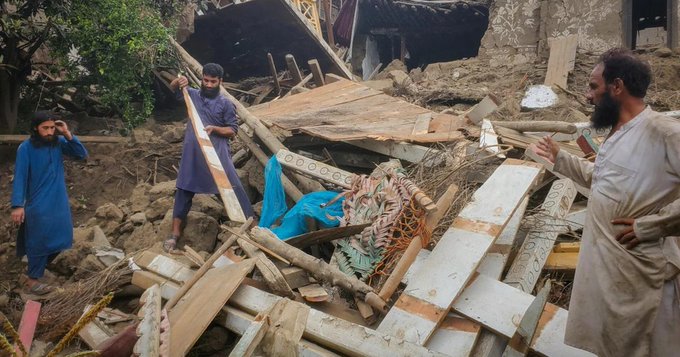
In Wadir, a village of about 1,000 homes in Kunar province—half belonging to Afghans recently expelled from Pakistan—the devastation was near total. No household was spared loss. Survivors described waking in terror as their homes collapsed around them in the dead of night.
Aftershocks rattled the region throughout Monday, adding to the fear. Amid the ruins, rescuers searched desperately for children trapped beneath mud-brick homes. “We pulled out their mother alive. She was injured, but she kept calling out for her children,” a rescue worker told AFP.
The earthquake also claimed countless animals, their remains sticking out from the rubble of flattened homes and broken beams.
Strained Relief Operations
Taliban security forces and emergency workers ferried the injured by helicopter to Jalalabad, the capital of Nangarhar province, about 40 kilometers away. Helicopters shuttled supplies—bread, water, tents—into villages and returned with stretchers carrying the severely injured.
Doctors and nurses struggled to cope with the constant flow of patients in overcrowded hospitals. “Nine out of ten people here are either dead or injured,” said Fazel Rabih, a local doctor administering first aid in Wadir.
Roads leading into the affected valleys, already difficult to navigate, were blocked by landslides, leaving entire communities cut off. Aid workers warned that survivors had little shelter as rain clouds gathered, raising fears of worsening conditions for those still trapped or displaced.
Human Tragedy in Numbers
The earthquake is one of the deadliest disasters in recent Afghan history. Already one of the poorest nations in the world, Afghanistan has been repeatedly battered by natural disasters—many of which experts warn are intensifying under the effects of climate change.
Hospitals across eastern Afghanistan were overflowing by Monday morning. Families sat outside with the injured, awaiting treatment. Stretchers lined hallways as staff worked frantically, overwhelmed by the scale of casualties.
For residents like 20-year-old Mohammad Jawad of Wadir, the quake is etched in memory as a moment of horror. “When the earthquake happened, it was so strong I ran out of the house. It collapsed right behind me,” he said. Of his 10 family members, one was killed and most others injured.
Long History of Quakes
Eastern Afghanistan has long been vulnerable to seismic activity, having suffered at least 12 earthquakes of magnitude seven or greater since 1900. But locals said Sunday night’s tremor felt different—stronger and more destructive than anything in living memory.
As villagers picked through the ruins of their lives, many feared the worst was yet to come. “If anyone is still alive under the rubble, they may not survive,” said Irfan Ulhaq, the local mullah in Wadir.
For now, eastern Afghanistan mourns its dead, prays for survivors, and braces for aftershocks, while a nation already scarred by conflict and poverty struggles to absorb yet another calamity.
Team Maverick.







Panic Buying Triggers Fuel Chaos Across Hyderabad Amid Rumour-Driven Shortage Fears
Hyderabad, March 2026 : Widespread panic gripped fuel stations across Hyderabad on Wednesd…
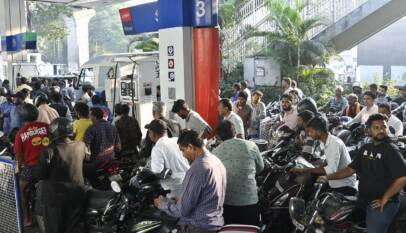
Panic Buying Triggers Fuel Chaos Across Hyderabad Amid Rumour-Driven Shortage Fears
Hyderabad, March 2026 : Widespread panic gripped fuel stations across Hyderabad on Wednesday as …