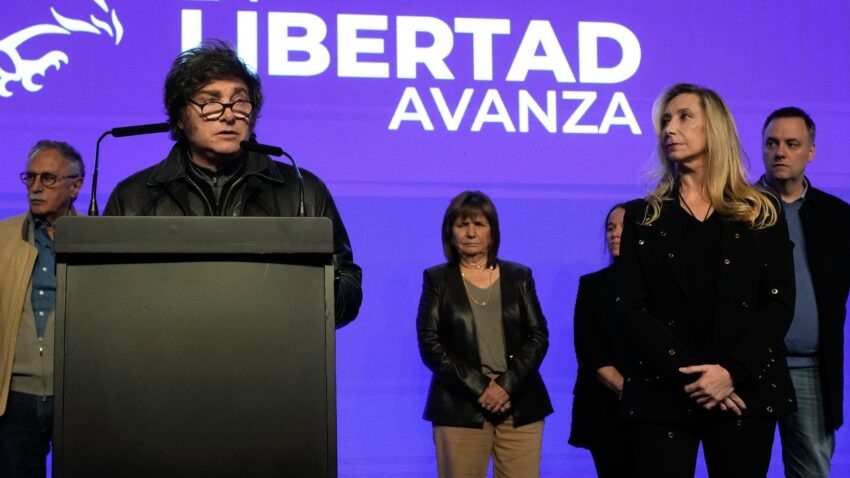
Argentinian President Milei is gradually loosing his credibility amongst the citizens.

Sept 2025 : When Milei won Argentina’s presidency in late 2023, a large part of his appeal was his self-portrayal as a populist outsider fighting against the country’s corrupt political “caste”. The image stuck in part because Milei who is an economist by training is a libertarian with fairly fringe economic views as well as some personal eccentricities. For example, he considers his cloned dogs, with which he claims to psychically communicate, to be among his political advisers.
Argentine voters were willing to take a chance on such an unconventional candidate to obtain change because of Argentina’s desperate economic straits. At the time of Milei’s election, Argentina was in a recession, with annual inflation running at over 200%, the peso having lost more than 50% of its value on the black market in that year alone and the fiscal deficit widening to about 4.4% of GDP. In fact, for some voters, Milei’s eccentricities were signs of authenticity and proof that he was not just another typical politician. Moreover, if Milei represented the clearest option for change in 2023, it was in large part because he promised such a different way of doing politics. As a result, he was able to defeat the ruling coalition’s candidate, the moderate Peronist Sergio Massa, as well as the centre-right opposition’s standard-bearer, the law-and-order hawk Patricia Bullrich, who went on to become Milei’s minister of security.
But, in late August 2025, Argentine media outlets published audio recordings of Diego Spagnuolo, the then-head of the country’s National Disability Agency, discussing alleged kickbacks related to contracts from pharmaceutical companies. President Javier Milei fired him immediately. While that would usually be enough to stop a story like this in its tracks, it did not tame the scandal, which has overtaken the political narrative in Argentina and now looms over Milei’s government ahead of crucial midterm elections in late October. The reason the recordings are so damning is that Spagnuolo was not just a random government official caught in a low-level corruption scheme. Before being named to run a government agency, Spagnuolo was Milei’s longtime personal lawyer. As a close ally, he was instrumental in Milei’s meteoric political rise to the Casa Rosada, as Argentina’s presidential office is known.
Worse still, in the audio recordings, Spagnuolo talks about making payments to Karina Milei, the president’s sister, chief of staff and closest confidant through another close adviser, Eduardo “Lule” Menem. Since Milei’s election, some media outlets have taken to portraying Karina Milei as Argentina’s de facto first lady, given that the president is unmarried. Though that may misrepresent her political power and influence within the government, Karina’s presence is a key part of Milei’s political identity, and firing her would be at the very least awkward, given their personal relationship.
Prior to the revelations of alleged bribery in the recently released recordings, Milei had already caused a scandal earlier this year when he used his social media feed to hawk a cryptocurrency that ended up being a scam: Many people lost their investments, amounting to hundreds of millions of dollars when the coin’s creators predictably sold their holdings at peak value, after which the price of the coin crashed. However, after a short time on the hot seat, Milei was able to brush the controversy aside and eventually bury the investigation into it. Milei’s furious opponents in Congress vowed to push on with the inquiry, but they struggled to find ways to make the scandal relevant to voters. If anything, the cryptocurrency story played into Milei’s image among voters as a weird and unconventional, rather than a corrupt, politician.
By contrast, the current scandal seems exactly like the sort of political corruption that voters elected Milei to root out. A top lawyer for the president accepting an 08% kickback on a contract, with 03% earmarked for the president’s sister, is a corruption scandal that the average person can understand more easily than a cryptocurrency pump-and-dump scheme. Voters can also easily understand how that sort of alleged corruption hurts not just Argentina’s economy but also them, with an impact they can feel on a personal level due to the significant cuts Milei has made to Argentina’s health care system, as well as other public services like pensions and education.
The corruption scandal’s political impact was immediately felt in provincial elections held on 07th. September in Buenos Aires, the country’s largest electoral district. Milei’s La Libertad Avanza party —Liberty Advances was defeated by the Peronist opposition that runs the incumbent state government, 47% to 34%. While it’s true that Buenos Aires province is a Peronist bastion compared to the rest of the country, that 13-point margin of victory suggests that Milei’s party will significantly underperform expectations in next month’s congressional midterms.
The outcome caused Argentina’s peso to plummet in value, with trading on the black market falling below the threshold of 1,400 pesos to the dollar that Milei was attempting to protect until the congressional elections. Additionally, the country’s bond and stock markets took a hit as borrowing costs rose, after having fallen earlier this year when foreign market analysts were more bullish about Milei’s economic reform efforts.
Similarly, in 2018, the market-driven bubble supporting then-President Mauricio Macri’s economic reforms popped during his third year in office, despite his party having won the most seats in the congressional midterm elections the year before. Perhaps most infamously, in late 2001, former President Fernando de la Rua was forced to flee from the Casa Rosada in a helicopter as the country’s economy collapsed less than a month into his third year.
Since Milei took office, investors and the International Monetary Fund had been pitching a message of “this time is different” when discussing his reform agenda. They expected Milei to get a boost in the midterm elections from the improvements he has made to Argentina’s economic balance sheet, in terms of reducing the country’s fiscal deficit and inflation rate, which at 02% a month would be high for nearly any other country but is a major accomplishment for Argentina.
Voters, however, aren’t feeling that same level of economic optimism. Poverty is up. Social programs, including pensions that fund the basic safety net for millions of the country’s citizens, have been slashed by the government. While inflation is down, it’s still far more expensive to buy a cut of beef—an Argentine staple—this year than last year. And people’s wages have not risen in line with inflation, no matter how much lower it is compared to two years ago.
If, like the IMF, what you care about are the fiscal balances in the country’s budget, Milei has delivered an economic miracle. But to paraphrase Raul Alfonsin, another former Argentine president forced to resign early due to an economic crash people can’t eat fiscal balances. Voters may have been willing to overlook a bit of corruption if they felt Milei’s government was delivering economic policies that were improving their daily lives. However, when people feel economic pain, alleged embezzlement on the part of the president’s lawyer and sister is exactly the sort of scandal that will bring electoral punishment.
A bad third year for Milei will leave Argentina with few options. International investors and the IMF are likely to punish the country if Argentine voters turn against him and his shock therapy approach to the economy and budget. That would mean that even though voters chose Milei hoping his unconventional approach to politics would lead to change, the results will end up disappointingly similar to most of the previous politicians who ran the country.
Team Maverick

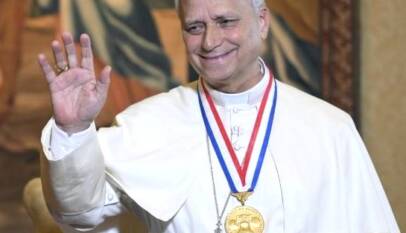
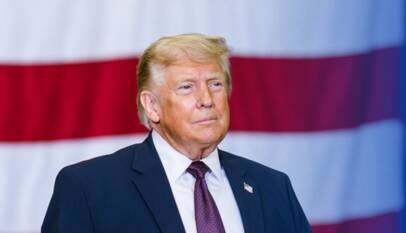



PM Modi Begins Three-Nation Tour to Indonesia, Australia and New Zealand, Focus on Indo-Pacific Cooperation
New Delhi, July 2026: Prime Minister Narendra Modi on Monday embarked on a significant thr…
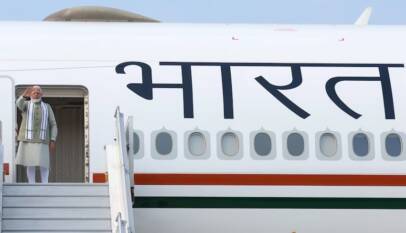
PM Modi Begins Three-Nation Tour to Indonesia, Australia and New Zealand, Focus on Indo-Pacific Cooperation
New Delhi, July 2026: Prime Minister Narendra Modi on Monday embarked on a significant …