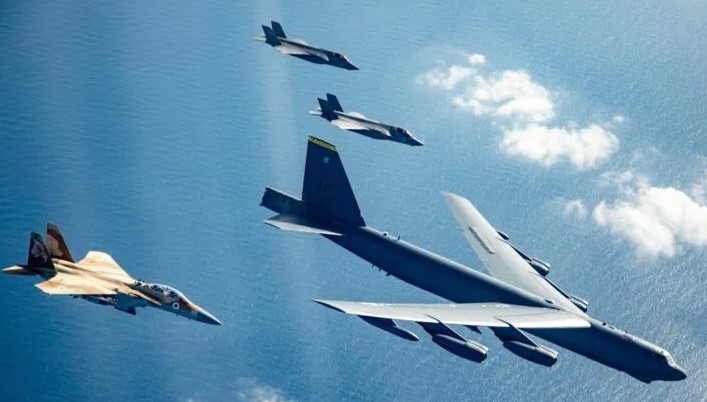
Israel’s Nuclear Weapons are been protected by the United States.

Sept 2025 : United States undismayed guardianship of Israel’s nuclear goals is nearly unentitled. It goes against any consideration of US security interests and continues despite an increasingly aggressive and frightening Israeli stance, as the Prime Minister Netanyahu recently attributed Israel as a “super-Sparta”. The US public is catching on to Netanyahu’s overreach, but the administration is still locked in a tight embrace with Israel.
It is not in the United States’ interest for Iran to get nuclear weapons, but it is more in the US security interest for Israel to continue to possess nuclear weapons, much less a powerful nuclear force that can potentially strike all of the Middle East, Europe, and beyond. That has become especially worrisome as political power in Israel has shifted to religiously inspired elements that favour uncompromising warfare to dominate the Middle East, even at the risk of catastrophe.
Since October 2023, Israel has pushed so far beyond the limits of what is acceptable in warfare, and so has antagonised the larger section of the world, that it could face a situation that threatens its exclusionist state. Given the current Israeli government and the pro-Israel Trump US administration, Israel’s nuclear program seems unlikely to change. But conditions do change, events happen, and opportunities arise unexpectedly. Consider, for example, the recent recognition of a Palestinian state by several Western capitals despite strong Israeli opposition, an event that would have been unimaginable a few years ago. The quintessential point is to clarify that it is the US, whose security interest lies in fewer countries possessing nuclear weapons and that those that do have nuclear weapons possess fewer of them. The same principle should prevail in the case of Israeli, whose nuclear weapons enrichment should not be an exception.
However unrealistic it may be for the US administration to captivate Israel’s nuclear arsenal; it is equally unrealistic to imagine that it will remain locked forever or that its existence will not provoke other states. Very recently, Pakistan quietly extended its nuclear deterrence to Saudi Arabia last week during a security summit in Riyadh, making it the second country in the Middle East to have access to nuclear weapons. And of course, Iran may be working actively toward weaponisation.
Despite much information about Israel’s nuclear weapons being available, and about the US silence about what it knows, the subject has barely reached out to the world. With few exceptions, the Media, and the watchdog agencies have consistently avoided reporting on the issue and seem to have taught themselves not to question officialdom. Reports offer lengthy discussions of how soon Iran could produce enough highly enriched uranium for a single warhead and how fast it could build one from its existing near-weapon-grade stockpile. But they rarely even mention Israel’s sizeable nuclear arsenal of warheads deliverable by land-based missiles, airplanes, and submarines. It is as if Israel has been granted a right to have nuclear weapons, one that is beyond question.
There is little for the US to accept the inconvenient fact that Israel has violated the 1963 Partial Test Ban Treaty in its 1979 test explosion, an event that should have triggered the 1977 Glenn Amendment and sanctions against Israel. Instead, Jimmy Carter and subsequent presidents pretended it didn’t happen. Meanwhile, Israel too is deliberate on this issue and has even bragged about its nuclear arsenal. Israel’s ultimate deterrent is its fleet of modern German submarines, which Israel outfits with long-range cruise missiles tipped with nuclear warheads. During the commissioning of the Rahav submarine in January 2016, Prime Minister Benjamin Netanyahu said, “Above all else, our submarine fleet acts as a deterrent to our enemies who want to destroy us. They need to know that Israel can attack, with great might, anyone who tries to harm it”.
However, Prime Minister Netanyahu didn’t mention nuclear weapons, but the whole world was learned to understand that a submarine can strike “with great military might” only with nuclear weapons. In view of Israel’s habit of launching preemptive attacks, it cannot be assumed that “deterrent to our enemies” means that it would use its nuclear weapons only in response to an attack, be it nuclear or conventional.
There was a time when the United States supported a Middle East free of weapons of mass destruction, which included nuclear weapons. It was a good idea, albeit not one easily implemented. But Israeli opposition negated even the most preliminary discussion of a nuclear-free zone. The issue came up in the critical 1995 Review Conference of the Non-Proliferation Treaty (NPT), 25 years after it went into effect. Treaty members were to vote on whether to extend the NPT indefinitely, to which Arab countries made clear that the indefinite extension the United States wanted could not be obtained without agreeing on starting discussions on a Middle East nuclear weapons-free zone. The United States agreed at the conference, but made sure nothing came of it.
The issue surfaced again in the 2010 Review Conference, and again the US representative voted for it to maintain unanimity on the final conference statement. But the next day, President Barack Obama buried the idea, saying it could only proceed if Israel agreed to it. Instead, he worked with Israel to sabotage Iran’s centrifuge plants, a project started by the previous Bush administration. This amounted to using a nuclear-weapon state that was an NPT outlaw and violation of the Partial Test Ban Treaty to punish an NPT member thought to have nuclear weapon ambitions, a practice that could only reduce respect for the NPT.
President Barrack Obama did go on to take the lead in negotiating a multi-country deal with Iran in a manner that responded to US and world interests rather than exclusively those of Israel, a notable and important exception to the long-held US policy. This was the 2015 Joint Comprehensive Plan of Action, an agreement that was a good start on a negotiated resolution of the Iran nuclear problem. But Israel never forgave Obama. Right-wing Israel does not negotiate or make concessions. It wages war. When he got the opportunity, Netanyahu convinced President Trump to pull out of the deal to remove obstacles to direct action.
A Middle East free of weapons of mass destruction is still a good goal that resonates internationally. Even Israel, although unalterably opposed to the idea, has found it politically easier to couch its opposition publicly in terms of the “volatile regional realities” rather than rejecting the idea out of hand. The proposal will have to wait for another time. A diplomatic solution is the only alternative to perpetual war. None of this discussion of Israel’s programs and policies reduces concern about the possibility of Iranian nuclear weapons. But the issue is not going to get resolved in a way that avoids perpetual warfare if the United States continues to ignore Israeli nuclear weapons in the Middle East strategic equation.
Will countries in the region forever accept being under the shadow of Israeli nuclear weapons? The Israeli government apparently thinks so. It has a name for dealing with boisterous neighbours, mowing the grass (periodic Israeli attacks on the Gaza Strip to manage the Israeli-Palestinian conflict), an occasional bit of violence to keep the “weeds” down in what it considers its backyard. Not only is it repugnant in concept. But it didn’t work in Gaza, and there is no chance that it would work in larger and more populated Iran.
The last US president who took a tough approach and did not want Israel to get nuclear weapons was probably President John F. Kennedy. The United States needs to reach back to Kennedy’s wisdom, to the business of examining Middle East nuclear weapon issues from the point of view of US interests and those of global peace. That means thinking in terms of negotiations and give and take on all sides. Certainly, Iran must make concessions. But it will only work if Israel makes concessions, too.
Israel is reportedly building a new facility near the Dimona reactor. This may be to replace the 60 year’s old reactor on which Israel now critically depends to produce the tritium needed in modern nuclear weapons. But tritium quickly decays in just a period over 12 years. Accordingly, half the tritium is gone, and hence it must be replaced. Should Dimona break down, Israeli nuclear weapons would lose their explosive power in years. Given the United States’ central role in Israeli security, Washington should have a say in such an extension project.
Before Israel attacks Iran again, the US administration could take a small, yet important step. When Israel tells the United States, as it will, what it expects it to contribute militarily to the next round of attacks on Iran’s nuclear facilities, the US answer should be that of an escapist, “we are not a part of any international dispute”.
Team Maverick








India Make Two Changes for Must-Win Fourth T20I as Shreyas Iyer Opts to Bat Against England
Bristol, July 2026 : India made two significant changes to their playing XI as captain Shr…

India Make Two Changes for Must-Win Fourth T20I as Shreyas Iyer Opts to Bat Against England
Bristol, July 2026 : India made two significant changes to their playing XI as …