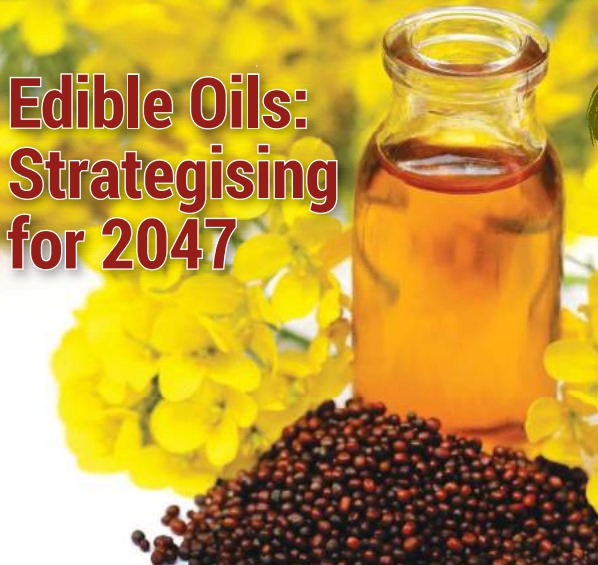
Revamping India’s Edible Oil Policy – From MSP Reform to Strategic Imports for 2047.

India’s edible oil policy has historically oscillated between protecting consumer prices and shielding farmer incomes, leaving systemic contradictions that exacerbate import dependence. As demand rises towards an estimated 46.5 million tons by 2047, policymakers must move beyond ad hoc tariff tinkering and build a coherent, long-term policy framework that reconciles trade, procurement and nutrition objectives.
Midway through its opening analysis, the Kisan-Vigyan Foundation’s white paper Edible Oil – Strategising for 2047 highlights how short-termism in policy has widened the gap between aspiration and outcome.
Frequent import duty adjustments and sudden tariff changes have, over time, distorted domestic markets. At times refined imported oils have been cheaper than domestic crude after duty changes, undermining refiners and disincentivising domestic processing investment. For policy to be effective, predictability must replace reactivity. A dynamic duty mechanism linked to global price indices and a standing price stabilisation fund would allow targeted interventions without undermining farmer price signals.
The Minimum Support Price schedule (MSP) for 2025–26 shows increases across a range of oilseed crops. The reproduced table below includes growth percentages to aid policy calibration:
| Crop | MSP 2024-25(Rs/quintal) | MSP 2025-26 (Rs/quintal) | Increase (Rs) | Growth (%) |
| Nigerseed | 8,717 | 9,537 | 820 | 9.41 |
| Sesamum | 9,267 | 9,846 | 579 | 6.25 |
| Soybean (Yellow) | 4,892 | 5,328 | 436 | 8.91 |
| Sunflower Seed | 7,280 | 7,721 | 441 | 6.06 |
| Groundnut | 6,783 | 7,263 | 480 | 7.08 |
These figures underline that price signals are being strengthened; what is lacking is conversion of price policy into reliable procurement. Policy measures should therefore prioritise expanding procurement access and creating institutional mechanisms to ensure the declared MSP translates into realised prices for farmers.
Even under an ambitious domestic expansion, projections show a residual import requirement. Imports, therefore, must be managed strategically rather than treated as a problem to be eliminated. A diversified sourcing strategy, public–private import consortia for long-term contracting, and a modest strategic buffer stock of 2–3 million tons will reduce exposure to single-country shocks and provide breathing space for domestic scaling.
Policy must also incorporate public health considerations. Cheap, heavily refined palm oil dominates processed food supply chains and contributes to suboptimal nutritional profiles for consumers. Strengthening labelling laws, incentivising industry reformulation toward healthier domestic oils, and channelising indigenous oils through government nutrition programmes will align trade and health goals.
Policy success will depend on institutional redesign and clear delivery mechanisms. Digital traceability, upgraded state procurement infrastructure, targeted R&D funding and time-bound performance indicators for oilseed yield improvements should be combined with statutory arrangements that ensure inter-ministerial coordination. The Kisan-Vigyan Foundation’s white paper provides concrete institutional options and timelines; what is now required is policy commitment and transparent implementation.
The Trajectory –
Over the decades, India’s edible oil landscape has undergone a marked transformation shaped by agro-climatic conditions, cultural preferences, and economic liberalisation. Traditional oils like mustard (North & East), groundnut (West), and coconut (South) dominated regional diets until the 1960s, when the Green Revolution introduced soybean into mainstream consumption. This was followed by a surge in palm oil imports during the 1990s due to its low cost and high shelf stability. Between 1951 (population: 361 million) and 2023 (population: 1.43 billion), India’s population grew nearly fourfold, while total edible oil consumption surged tenfold: from 2.5 million tons to 25 million tons.
Consequently, per capita edible oil intake rose from approximately 03 kilograms per year in the 1950s
to around 23–24 kilograms per year in 2023.
Looking ahead, India’s population is expected to reach 1.66 billion by 2047 (UN World Population Prospects, 2022). To project future demand, we assume a modest per capita intake of 28 kilogram per year. At this projected rate, India’s edible oil requirement in 2047 will cross 46.5 million tons annually. This demand surge underscores the dual burden of demographic expansion and nutritional transition calling for an urgent and comprehensive long-term strategy to ensure edible oil security for India@2047.
As per data available till the end of 2023, over 60% of India’s edible oil consumption is met through imports, with palm oil alone accounting for nearly 55% of total consumption, followed by soybean and
sunflower oil. In contrast, domestic oils like mustard (11%), groundnut (6%), coconut (3%) continue to cater to regional preferences but are insufficient to meet national demand. This heavy reliance on imported oils underscores the vulnerability of India’s edible oil economy to global supply disruptions and price volatility, making strategic planning all the more imperative.
In the journey towards India@2047, edible oil is not just a commodity, it is a strategic asset. Planning for it now is an investment in the nutritional security of our citizens, in strengthening the economy, and in ensuring India’s nutritional sovereignty.
Unless corrective measures are urgently implemented to boost domestic oilseeds productivity, diversify cropping systems towards oilseed production, and secure trade partnerships, India’s nutritional sovereignty, economic resilience and political aspirations will remain vulnerable. This reality makes a long-term edible oil strategy not only desirable but imperative in achieving India@2047 vision.
India imports more than 55% of its edible oil consumption requirements, making it the world’s largest edible oil importer. In FY 2022–23, imports crossed 15.3 million tonnes, resulting in a foreign exchange outgo of 1.4 lakh crore (~USD 17 billion). These imports are not only a reason for huge economic burden but also a geopolitical risk, making India’s food basket vulnerable to global price volatility, trade restrictions, supply disruptions as was seen during the COVID-19 pandemic, Ukraine-Russia war and more importantly during the terrorist attack by Pakistan, when Malaysia, one of the two leading oil
palm producing and exporting countries to India sided with the enemy country Pakistan making palm oil import difficult.
Moreover, frequent import duty adjustments used as price control mechanisms act as implicit subsidies for foreign producers, undermining the economic viability of Indian oilseed farmers and domestic processors. India ranks high in oilseed cultivation but still remains import-dependent due to low productivity, poor profitability, and inefficient value chains.
Agronomic & Technological Bottlenecks –
- 70%+ oilseed area is rainfed, limiting productivity due to erratic rainfall and poor irrigation.
- Grown mostly on marginal lands, unlike better-supported crops like paddy, wheat or sugarcane.
- Low R&D investment in oilseeds! lack of high-yield, pest-resistant varieties (except mustard hybrids covering 50%).
- Mechanisation and cropping system integration remain inadequate.
- Emerging tools like machine learning, diagnostic surveys offer potential but are underused.
Economic Viability & Farmer Incentives –
- MSPs exist, but procurement is <25%, leaving farmers vulnerable to price crashes and distress selling.
- High input costs and fragmented holdings resulting in low returns.
- Farmers prefer wheat, rice, maize due to better MSP coverage, and market access.
- Due to low profit, farmers do not cultivate oil seeds under irrigated land or where there is assured irrigation.
Processing & Infrastructure Gaps –
- Fragmented processing sector: modern solvent units limited to few states; outdated Ghani systems persist, resulting in low oil extraction and therefore low return.
- Underutilised opportunity: Rice bran oil from 51.4 M ha potential to scale from 1.1–1.4 MMT/year and Corn oil has emerging promise.
- 7–10% Post-harvest losses of oil seeds produced due to poor storage, grading, and infrastructure mismatch, has to be tapped to increase production.
Import Policy Paradoxes – Policy swings: duty cuts for consumers vs tariffs for farmers creates market
distortion. Refined palm oil cheaper than the crude post-duty cut hurts Indian refiners. This discourages investment, and affects farm gate prices.
Consumer awareness & Nutritional Mismatch –
- Traditional oils (mustard, sesame, groundnut) losing ground to cheap palm oil, preferred by industries.
- Weak labelling regulations: palm oil often hidden in unreadable fonts.
- Public unaware of health risks of palm oil and benefits of traditional oils.
- Lack of targeted awareness campaigns and regulatory enforcement
Team Maverick







ISRO Successfully Tests Indigenous Ship-Borne Tracking System for Gaganyaan Mission
New Delhi, July 2026 : The Indian Space Research Organisation (ISRO) has successfully vali…

ISRO Successfully Tests Indigenous Ship-Borne Tracking System for Gaganyaan Mission
New Delhi, July 2026 : The Indian Space Research Organisation (ISRO) has successfully validated …