South Korea and China Pledge Renewed Cooperation to Revive Korean Peninsula Dialogue at Gyeongju Summit

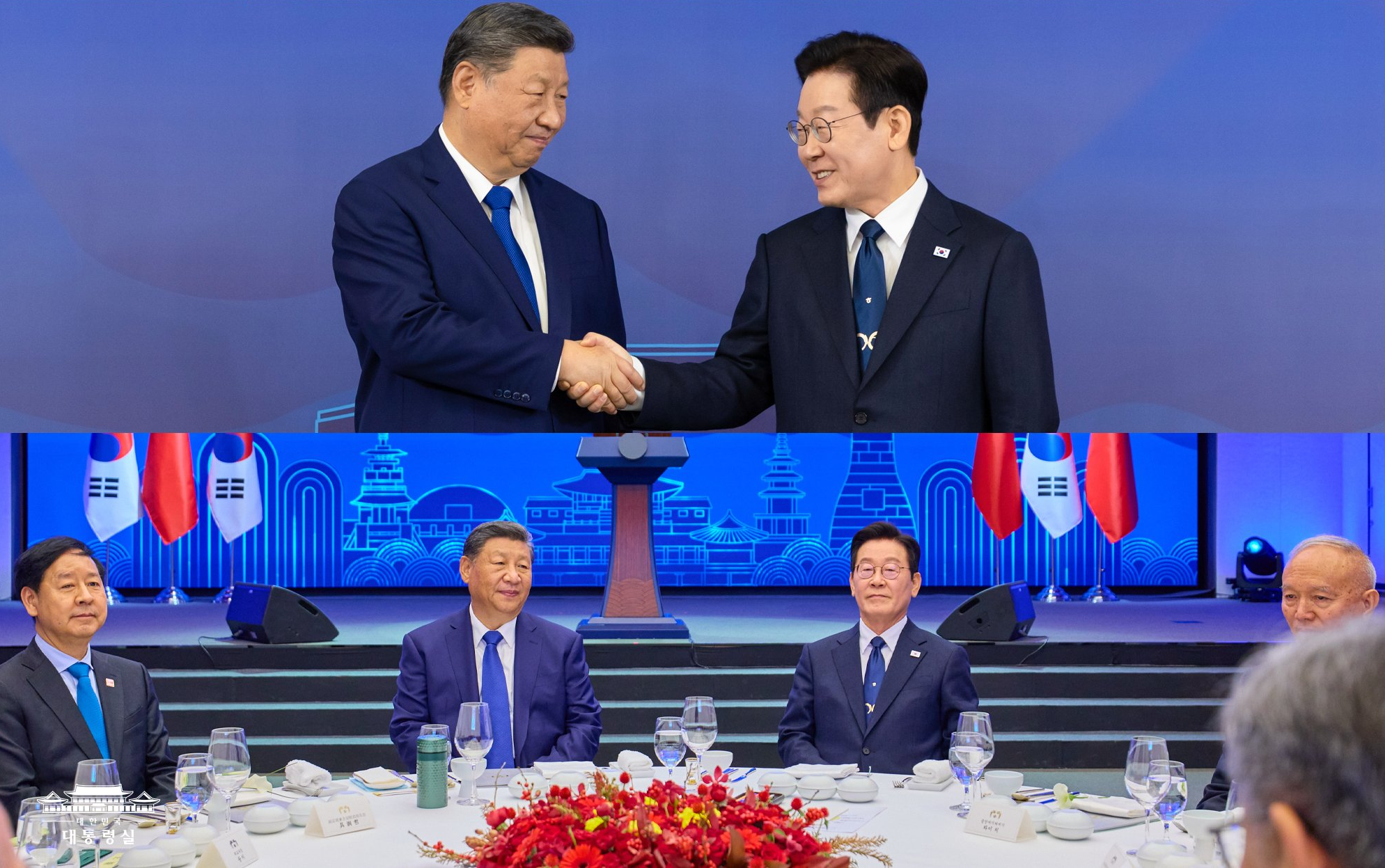
Gyeongju, Nov 2025 : South Korean President Lee Jae Myung and Chinese President Xi Jinping committed to renewed efforts to promote peace and stability on the Korean Peninsula, National Security Adviser Wi Sung-lac said on Saturday. The assurance comes as Seoul looks to Beijing to play a more active role in facilitating the long-stalled dialogue with Pyongyang.
President Xi’s visit — his first trip to South Korea in 11 years — was made to attend the Asia-Pacific Economic Cooperation (APEC) summit in Gyeongju. During the bilateral summit, President Lee emphasized the importance of China’s influence over North Korea and urged Beijing to act “constructively” in advancing peace and co-prosperity on the peninsula.
According to Wi, Lee conveyed Seoul’s expectation that deeper engagement between China and North Korea may help create favorable conditions for the resumption of talks with Pyongyang. His remarks came amid indications of increasingly frequent high-level exchanges between Beijing and Pyongyang, which he described as a “positive development.”
“I hope that the Republic of Korea and China will strengthen their strategic communication, make use of these conditions, and work toward resuming dialogue with North Korea,” Lee said in his opening remarks. “It can never be overstated how important regional security is.”
Economic Relations Shift Toward ‘Mutually Beneficial’ Partnership
President Lee also underscored that the economic relationship between South Korea and China has evolved over the years. What was once a “vertical structure,” he noted, has now transitioned into a “horizontal one,” reflecting increased parity and integration between the two economies. He stressed the need to build a “mutually beneficial” partnership grounded in stability and long-term growth.
President Xi echoed the sentiment, saying that China attaches great importance to its relationship with South Korea and intends to maintain policy stability and continuity. Through a translator, he expressed Beijing’s willingness to deepen communication with Seoul, jointly address shared challenges, and promote the “stable and long-term development” of bilateral ties.
Describing the two nations as “close neighbors who cannot move apart and inseparable partners in cooperation,” Xi highlighted the decades of sustained exchanges and collaboration that have led to co-prosperity. “Promoting the healthy and stable development of China–South Korea relations has always been in the interests of both peoples and is a choice in line with the spirit of the times,” he said.
Leaders Agree to Work ‘Unwaveringly’ Toward Peace
At a state dinner later in the evening, President Lee reiterated his optimism about the summit’s outcome. “President Xi and I have agreed to move forward unwaveringly together on the path toward peace,” he said. He expressed confidence that China would continue to play a constructive role in supporting Seoul’s efforts to open “a new era of peaceful coexistence and shared growth.”
National Security Adviser Wi said the summit represented the “full restoration” of Seoul–Beijing ties after years of friction, crediting the improvement to the Lee administration’s “pragmatic, national-interest-centered diplomacy.”
During the meeting, Lee laid out the South Korean government’s roadmap for achieving denuclearization on the Korean Peninsula. Xi responded by affirming China’s intention to continue supporting dialogue and contributing to peace and stability in the region. Both leaders reportedly acknowledged that the United States remains a crucial actor in any effort to revive talks with North Korea.
Seven Key MOUs Signed, Currency Swap Extended
On the sidelines of the summit, South Korea and China signed seven memorandums of understanding (MOUs) aimed at expanding cooperation across practical sectors.
One of the most significant outcomes was a bilateral agreement between the central banks to renew their currency swap deal — valued at 70 trillion won (US$48.9 billion) — for another five years. The extension is expected to strengthen financial stability and bolster economic ties.
Another MOU focused on enhancing services and trade as part of ongoing negotiations to upgrade the bilateral free trade agreement (FTA). Additionally, the two governments signed an accord enabling deeper cooperation between law enforcement agencies, particularly in combating rising cases of voice phishing and online fraud — crimes that increasingly involve cross-border operations.
Sensitive Issues Addressed: Hanwha Ocean, Yellow Sea Structures, Cultural Restrictions
The summit also addressed a number of sensitive bilateral issues. Among them were China’s recent sanctions on U.S. subsidiaries of the Korean shipbuilding firm Hanwha Ocean, which Beijing accused of aiding a U.S. investigation into China’s maritime and shipbuilding sectors. Wi said discussions on the matter were “productive” and hinted that progress may be possible if tensions between Washington and Beijing ease.
Other contentious issues included China’s installation of steel structures in overlapping maritime zones in the Yellow Sea, as well as Beijing’s restrictions on Korean cultural imports. Wi did not disclose details of these discussions but said both sides agreed that such matters “needed to be resolved through continued communication.”
A Summit Marking Renewed Momentum
The Gyeongju summit marks a notable moment in the recent trajectory of South Korea–China relations. After years of diplomatic strain driven by geopolitical tensions, trade disputes, and North Korea’s growing nuclear ambitions, the meeting between Lee and Xi signals a deliberate attempt to reestablish dialogue and rebuild trust.
Both leaders left the summit expressing shared goals: improving strategic communication, revitalizing the stalled peace process, expanding economic cooperation, and navigating regional challenges through sustained engagement.
Whether these commitments translate into tangible progress on the Korean Peninsula remains uncertain, but the summit has clearly generated new diplomatic momentum — and renewed expectations — for peace in Northeast Asia.


Final US Section 301 Measures on Forced Labour: India Placed in Lower Tariff Tier at 10%
The United States Trade Representative (USTR) announced on 23rd July 2026 the final measur…

Final US Section 301 Measures on Forced Labour: India Placed in Lower Tariff Tier at 10%
The United States Trade Representative (USTR) announced on 23rd July 2026 the final measures …