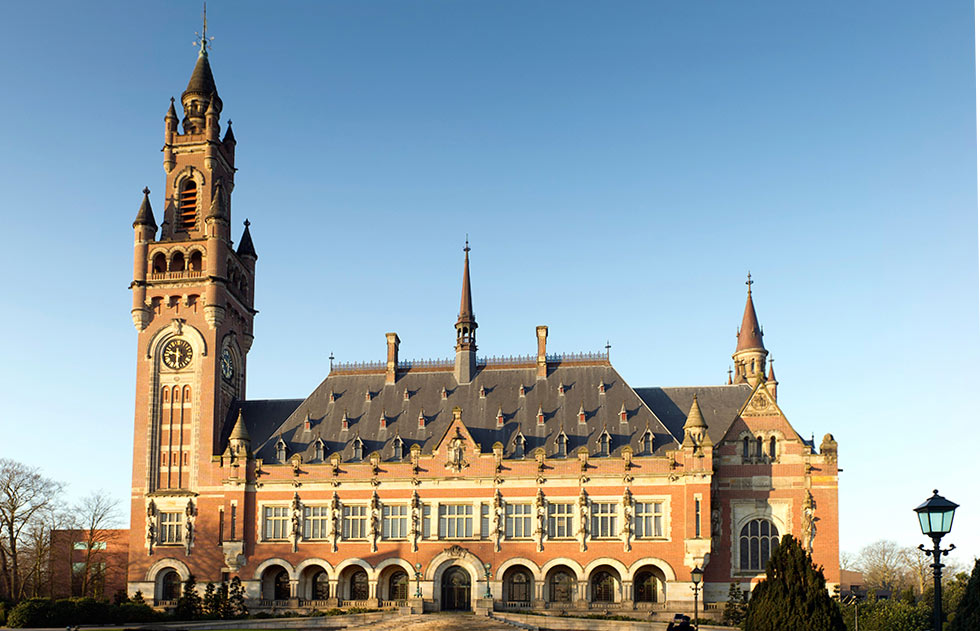
International Court Of Justice Heard Allegations of Genocide In The Case of Ukraine versus Russian Federation.

Hague; December 2025: By an Order dated 05th December 2025, the International Court of Justice has found that the counter-claims submitted by the Russian Federation in the case concerning Allegations of Genocide under the Convention on the Prevention and Punishment of the Crime of Genocide (Ukraine versus Russian Federation) are admissible as such and form part of the current proceedings. By that same Order, the Court has authorised Ukraine to submit a Reply and the Russian Federation to submit a Rejoinder. The Court has fixed 07th December 2026 and 07th December 2027 as the respective time-limits for the filing of those written pleadings.
As the Order explains, in its Judgment dated 02nd February 2024,
the Court found that it had jurisdiction, on the basis of Article IX of the Convention on the Prevention and Punishment of the Crime of Genocide (the “Genocide Convention”), to entertain submission
(b) in paragraph 178 of the Memorial of Ukraine, whereby the Applicant requests
the Court to “adjudge and declare that there is no credible evidence that Ukraine
is responsible for committing genocide in violation of the Genocide Convention
in the Donetsk and Luhansk oblasts of Ukraine”, and that
the submission in question was admissible.
However, the Court found that submissions (c) and (d) in paragraph 178 of Ukraine’s Memorial fell outside the scope of the compromissory clause in Article IX of the Genocide Convention and, consequently, that the Court lacked jurisdiction ratione materiae to entertain them.
The Order further recalls that in the Counter-Memorial that the Russian Federation filed on 18 November 2024, the latter, referring to Article 80 of the Rules of Court, presented counter-claims. Ukraine disputed the admissibility of those counter-claims as such.
Under Article 80, paragraph 1, of the Rules of Court, two requirements must be met for the Court to be able to entertain a counter-claim, namely that the counter-claim “comes within the jurisdiction of the Court” and that it “is directly connected with the subject-matter of the claim of the other party”.
In respect of the first requirement, the Court concludes that it has jurisdiction to entertain the counter-claims of the Russian Federation under Article IX of the Genocide Convention. The Learned International Court Of Justice.
As regards the question of connection in fact, the Court considers that the Parties’ respective claims relate to the same factual complex and that there is a direct connection in fact between Ukraine’s principal claim and the Russian Federation’s counter-claims. Moreover, the Court notes that the Russian Federation intends to rely, for the most part, on the same evidence in order both to refute Ukraine’s claim and to substantiate its own counter-claims. With respect to the question of connection in law, the Court notes that both Parties rely, in their respective claims, on the same instrument, the Genocide Convention, which is invoked both as the title of jurisdiction and as the basis of the Parties’ claims on the merits. The Court concludes that there is a direct legal connection between Ukraine’s principal claim and the Russian Federation’s counter-claims.
The Court therefore finds that the counter-claims of the Russian Federation satisfy the requirements of Article 80, paragraph 1, of the Rules of Court, and that they are admissible as such.
In its Order,
THE COURT,
(A) By eleven votes to four,
Finds that the counter-claims submitted by the Russian Federation are admissible as such and form part of the current proceedings;
IN FAVOUR: President Iwasawa; Vice‑President Sebutinde; Judges Tomka, Xue, Bhandari, Nolte, Charlesworth, Brant, Tladi, Hmoud; Judge ad hoc Tuzmukhamedov;
AGAINST: Judges Abraham, Gómez Robledo, Cleveland; Judge ad hoc Daudet;
(B) Unanimously,
Authorises Ukraine to submit a Reply and the Russian Federation to submit a Rejoinder relating to the claims of both Parties in the current proceedings and fixes the following time-limits for the filing of those pleadings:
For the Reply of Ukraine, 7 December 2026;
For the Rejoinder of the Russian Federation, 7 December 2027; and
Reserves the subsequent procedure for further decision.
Vice-President SEBUTINDE, Judges GÓMEZ ROBLEDO and CLEVELAND, and Judge ad hoc
DAUDET append a joint declaration to the Order of the Court;
Judges ABRAHAM, GÓMEZ ROBLEDO and CLEVELAND append dissenting opinions to the Order of the Court;
Judge TLADI appends a separate opinion to the Order of the Court;
Judge HMOUD appends a declaration to the Order of the Court;
Judge ad hoc DAUDET appends a dissenting opinion to the Order of the Court.
History of the proceedings:
On 26th February 2022, Ukraine filed in the Registry of the Court an Application instituting proceedings against the Russian Federation concerning “a dispute . . . relating to the interpretation, application and fulfilment of the 1948 Convention on the Prevention and Punishment of the Crime of Genocide” (the “Genocide Convention”).
Ukraine contends, inter alia, that
“the Russian Federation has falsely claimed that acts of genocide have occurred in the Luhansk and Donetsk oblasts of Ukraine, and on that basis recognized the so-called ‘Donetsk People’s Republic’ and ‘Luhansk People’s Republic’, and then declared and implemented a ‘special military operation’ against Ukraine.”
Ukraine “emphatically denies” that such acts of genocide have occurred and states that it submitted the Application “to establish that Russia has no lawful basis to take action in and against Ukraine for the purpose of preventing and punishing any purported genocide”.
As basis for the Court’s jurisdiction, Ukraine invokes Article 36, paragraph 1, of the Statute of the Court and Article IX of the Genocide Convention, to which both States are parties.
Together with the Application, Ukraine submitted a Request for the indication of provisional measures with reference to Article 41 of the Statute of the Court and to Articles 73, 74 and 75 of the Rules of Court. By an Order dated 16 March 2022, the Court indicated certain provisional measures.
On 03rd October 2022, the Russian Federation raised preliminary objections to the jurisdiction of the Court and to the admissibility of the Application. Consequently, in accordance with Article 79bis, paragraph 3, of the Rules of Court, the proceedings on the merits were suspended. By an Order dated 07th October 2022, the Court fixed 03rd February 2023 as the time-limit within which Ukraine could present a written statement of its observations and submissions on the preliminary objections raised by the Russian Federation. Ukraine filed its written statement within the time-limit thus fixed.
Between 21st July 2022 and 15th December 2022, 33 States filed declarations of intervention in the case, pursuant to Article 63, paragraph 2, of the Statute of the Court. By an Order dated 05th June 2023, the Court decided that the declarations submitted by 32 States were admissible at the preliminary objections stage of the proceedings. Public hearings on the preliminary objections raised by the Russian Federation were held between 18th and 27th September 2023. Thirty-two intervening States presented oral observations at the hearings.
On 02nd February 2024, the Court rendered its Judgment on the preliminary objections, in which it found that it had jurisdiction to examine the claim of Ukraine requesting the Court to “adjudge and declare that there is no credible evidence that Ukraine is responsible for committing genocide in violation of the Genocide Convention in the Donetsk and Luhansk oblasts of Ukraine”, and that the claim was admissible. The case could therefore proceed to the merits.
By an Order also dated 02nd February 2024, the Court fixed 02nd August 2024 as the time-limit for the filing of the Counter-Memorial of the Russian Federation. By Orders dated 30th July 2024 and 09th September 2024, this time-limit was extended to 16th September 2024 and then to 18th November 2024.
In a press release dated 06th August 2024, the Court announced that 23 States had filed new or adjusted declarations of intervention under Article 63 of the Statute for the purposes of the merits stage of the proceedings, or had indicated their intention to maintain their declarations of intervention filed at the preliminary objections stage, without adjustments. One such State, Poland, has also filed an application for permission to intervene under Article 62 of the Statute.
By an Order of 09th September 2024, the President of the Court extended to 18th November 2024 the time-limit for the filing of the Counter-Memorial of the Russian Federation. On 18th November 2024, the latter filed that pleading, which contained counter-claims. Ukraine subsequently objected to the admissibility of those claims.
In accordance with Article 80, paragraph 3, of the Rules of Court, the Court invited Ukraine and the Russian Federation to submit their views on the question no later than 20th May 2025 and 22nd September 2025, respectively.
Team Maverick.


Jaishankar, Rubio Push for Defence Pacts and Near-Final Trade Deal at Manila Meeting
Manila, July 2026 : India and the United States on Wednesday gave fresh momentum to their …
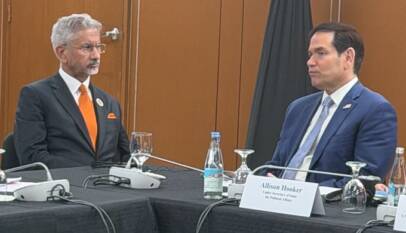
Jaishankar, Rubio Push for Defence Pacts and Near-Final Trade Deal at Manila Meeting
Manila, July 2026 : India and the United States on Wednesday gave fresh momentum …