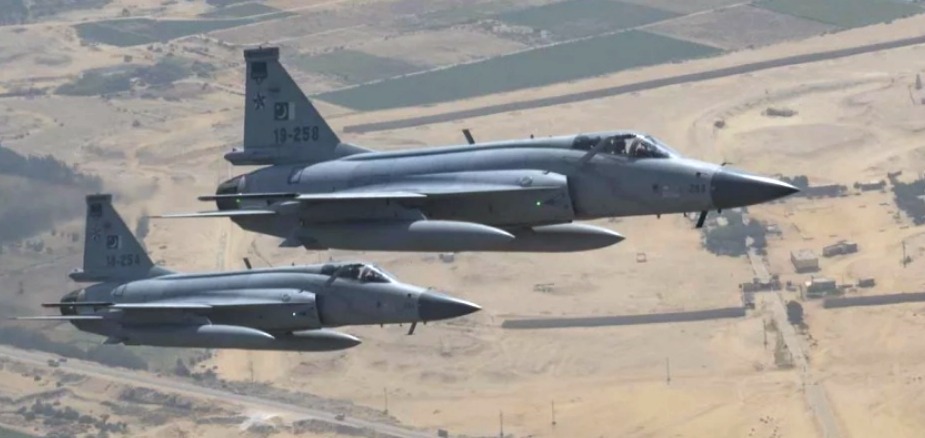
Iraq Formally Expressed Interest In Acquiring The JF-17 Thunder Fighter Jet From Pakistan.

Baghdad; January 2026: On January 10th, 2026, Pakistan’s Inter Services Public Relations (ISPR) said Iraq formally expressed interest in acquiring the JF-17 Thunder fighter jet during meetings between the Pakistan Air Force Chief of Air Staff and Iraqi Air Force Commander in Baghdad. The discussions linked any potential JF-17 acquisition to pilot training, maintenance support, and institutional cooperation as Iraq seeks to diversify its combat aircraft fleet beyond the F-16IQ.
Iraq formally expressed interest in acquiring Pakistan’s JF-17 Thunder fighter jet during senior-level air force talks held in Baghdad, following the footsteps of Libya, Bangladesh, and Saudi Arabia. The signal was delivered during an official visit by Pakistan Air Force Chief of Air Staff Air Chief Marshal Zaheer Ahmed Baber Sidhu, who met Lieutenant General Staff Pilot Mohanad Ghalib Mohammed Radi Al-Asadi, Commander of the Iraqi Air Force, at Iraqi Air Force Headquarters. The visit included a Guard of Honour and focused on operational cooperation, training, and capacity building, but the JF-17 emerged as the principal platform of interest.
During the meeting, the Pakistani delegation emphasised long-standing religious, cultural, and historical ties between Pakistan and Iraq as a foundation for expanded military cooperation, indicating that any future acquisition would be tied to sustained cooperation rather than a stand-alone purchase.
Air Chief Marshal Sidhu reaffirmed Pakistan’s readiness to support the Iraqi Air Force in training and institutional development, including pilot instruction and professional exchanges. Both commanders agreed to pursue joint exercises and structured training initiatives aimed at improving operational coordination and shared procedures. For its part, Lieutenant General Al-Asadi expressed an explicit interest in both the JF-17 Thunder multi-role fighter jet and the Super Mushshak basic trainer aircraft. He also conveyed interest in benefiting from Pakistan Air Force training systems and institutional experience.
Iraq currently relies primarily on a fleet of F-16IQ fighter jets, acquired to restore the Iraqi Air Force’s capacity following years of conflict and reconstruction priorities due to internal security and counterterrorism. While the F-16IQ provides Iraq with basic multirole capability, constraints related to sustainment, weapons integration, and operational availability have remained persistent challenges. Against this backdrop, Baghdad has explored options to diversify its combat aviation base, reduce reliance on a single supplier, and expand training capacity alongside fighter procurement, including the potential purchase of 14 French Rafale jets later in 2026. At a regional level, neighbouring air forces are recapitalizing fleets or adding new fighter jets, reinforcing Iraq’s efforts to quickly rebuild a coherent pilot pipeline and force structure rather than pursuing isolated acquisitions.
Therefore, Iraq’s attention toward the JF-17 Thunder is linked to a combination of cost, availability, and packaging factors rather than performance claims alone. Pakistan has positioned the JF-17 as a lightweight, single-engine multirole fighter that can be supplied without reliance on Western approval chains, while remaining compatible with a range of Chinese and non-Western weapons. Acquisition costs and operating expenses are consistently described as lower than those of heavier Western fighters, which is a decisive factor for air forces with constrained defence budgets, such as the Iraqi Air Force. Another driver is Pakistan’s willingness to bundle aircraft deliveries with pilot training, maintenance support, and institutional assistance, allowing customers to address capability gaps across personnel, aircraft, and sustainment simultaneously.
In recent months, multiple countries have either confirmed acquisitions or formally explored procurement of the JF-17 as part of wider defence cooperation agreements.
- In November 2025, Azerbaijan confirmed the delivery of five JF-17 Block IIIs following a $4.6 billion agreement covering 40 aircraft, training, and associated support.
- In December 2025, Libya finalised a multi-year package valued at more than $4 billion that includes JF-17 fighter jets and Super Mushshak trainers within a broader land, sea, and air cooperation arrangement.
- In January 2026 alone, Bangladesh held discussions regarding the potential acquisition of 20 to 32 JF-17s, alongside fast-tracked delivery of Super Mushshak trainers.
- In January 2026, again Pakistan has also engaged Saudi Arabia in talks described as converting $2 billion in existing loans into a JF-17-centered defence package, placing this fighter jet as the anchor of wider defence cooperation, training, and long-term military relationships.
Block III Variant Of JF-17:
The Block III is currently the most advanced variant of the JF-17, which was developed jointly by Pakistan and China in the 1990s, as the serial production of this variant started at Pakistan Aeronautical Complex Kamra by the end of 2020.
The Block III added a new avionics suite built around the KLJ-7A active electronically scanned array (AESA), an infrared search and track capability, a three-axis fly-by-wire flight control system, helmet-mounted displays and sights, and enhanced electronic warfare systems, with the Pakistan Air Force placing orders for around 50 aircraft that began induction in early 2023 and continued into 2024 as part of its force modernisation efforts.
This Block III variant was developed to pair increased sensor and weapons integration with improved training and sustainment pathways, maintaining production continuity while laying groundwork for future advancements within the JF-17 family, such as the JF-17 PFX.
The JF-17 Block III is a single-engine, lightweight multirole fighter powered by a Klimov RD-93MA afterburning turbofan (or potentially a Guizhou WS-13 engine in future configurations), producing a thrust of around 19,000 pounds.
The aircraft has an overall length of 14.3 meters, a wingspan of 9.5 meters, and a height close to 4.8 meters, with an empty weight of 7,965 kg and a maximum takeoff weight of 13,500 kg. The Block III retains a top speed of approximately Mach 1.6, equivalent to around 1,975 km/h, and a service ceiling nearing 55,000 feet with a thrust-to-weight ratio of about 1.07 under typical load conditions.
The JF-17 has 07 external hardpoints, allowing the carriage of a mix of air-to-air missiles, short-range infrared-guided missiles, precision-guided bombs, anti-ship weapons, and external fuel tanks, allowing it to undertake air defence, ground attack, and multirole missions.
Team Maverick.






India Arrive in New Chandigarh Ahead of One-Off Test Against Afghanistan at Mullanpur
New Chandigarh, June 2026 : The Indian cricket team arrived in New Chandigarh on Tuesday a…

India Arrive in New Chandigarh Ahead of One-Off Test Against Afghanistan at Mullanpur
New Chandigarh, June 2026 : The Indian cricket team arrived in New Chandigarh on …