Union Minister Ashwani Vaishnaw Steals The Show At WEF Davos.

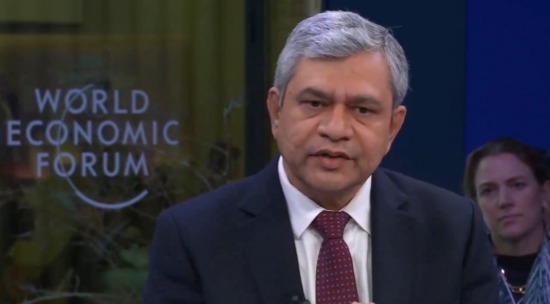
Davos; January 2026: Speaking at the session on ‘Bet on India – Bank on the Future’ organised by Confederation of Indian Industry (CII) in association with EY coinciding with the World Economic Forum (WEF) 2026 at Davos, Vaishnaw spoke of the government’s efforts towards ease of doing business.
“India will continue to grow 06% to 08% in real terms and 10% to 13% in nominal terms, supported by moderate inflation and strong growth”, he said. The Minister highlighted the importance of simplifying permissions and noted that the average time for obtaining telecom tower permission has decreased from 270 days to 07 days, with 89% of permissions issued in zero days. He further highlighted the need to bridge the gap between intent and functioning. Vaishnaw have also discussed the importance of communicating challenges among industry members, noting the need to standardise data localisation norms across the US and Europe.
Meanwhile, Rajiv Memani, President, CII and Regional Managing Partner, Africa-India Region, EY, called for increasing India’s per capita income by at least five times by 2047.
Union Minister Ashwini Vaishnaw described how India, after 60 years, has finally made a significant mark in the semiconductor industry. The Minister stated that one of the four semiconductor plants currently in pilot production is set to begin full operations by last week in February. Explaining the strategy behind these deals, Ashwini Vaishnaw said, “Regarding the four plants that started pilot production in the semiconductor sector, one of them will start commercial production by the last week of February”.
Taking a note of the 60 years span reiterated by the Union Minister, it is note worthy that semiconductor evolved in India in the mid 80’s (1985 precisely), when, according to N. Ravindra – Retired Senior DGM BEL, India was 02 years behind, but as of date India is 12 years behind.
He further added, Rare earths are a very complex value chain, involving contributions from many countries around the world. India has entered into several collaborations in this complex value chain. There are collaborations with the US, Europe, Germany, Japan, South Korea, and Singapore. These collaborations aim to create an ecosystem that ensures India’s continued growth”.
During addressing the media outlets, at the World Economic Forum 2026, Union Minister Vaishnaw outlined a trajectory where the nation is expected to maintain a real growth rate of 06% to 08%. He attributed this momentum to four strategic pillars: massive public investment in physical, digital, and social infrastructure; inclusive growth ensuring the “entire society grows alongwith the growth of the country”; a push for manufacturing and innovation; and a rigorous drive toward simplification. “India is being seen today as a trusted value chain partner all over the world. In this turbulent and very difficult environment, across the globe, where there is uncertainty, India is being seen as a very stable, good democracy, vibrant democracy, and an economy with sustainable growth.
Union Minister Ashwini Vaishnaw on Wednesday described the five distinct elements that form the backbone of India’s artificial intelligence mission. During the ongoing global summit, the Minister pointed out that the whole world, and especially the AI related industry, is appreciating that India is working methodically across all five layers. On the industry’s reaction to India’s progress, Vaishnaw commented, “The whole world today, and especially the AI related industry, is appreciating the fact that India is working methodically on all five layers”.
Breaking down the technical framework, the Minister said, looking into what AI is, AI has 05 elements.
The first element is the application layer, that is, how we use it.
The second is the model layer, the models that are created.
The third is the chip layer, the semiconductor layer.
The fourth is the infrastructure layer, the data centres.
The fifth layer is energy.
He further added, “In the world of AI, which is the fifth industrial revolution, energy is going to be a very big factor. In this kind of situation, from energy to applications, India’s methodical work has been highly appreciated by the world, and especially by the AI-related industry”.
Meanwhile, Ashwini Vaishnaw has detailed India’s comprehensive strategy to dominate the global artificial intelligence landscape, emphasising a shift from big-tech controlled resources to a public-private partnership model. He has revealed that India has successfully established a public private partnership with 38,000 GPUs as a common compute facility, accessible to students, researchers, and startups at roughly one-third the global cost, unlike many countries where big tech controls GPU access.
Addressing the critical issue of regulation, Vaishnaw advocated for a “techno-legal” approach rather than relying solely on standalone legislation. He argued that the complexities of modern technology require robust technical tools to address risks such as bias and deepfakes, including detection systems accurate enough to stand judicial scrutiny. He added that India is developing technologies to mitigate bias, enable reliable deepfake detection, and ensure proper “unlearning” before AI models are deployed.
The Minister also highlighted a strategic shift in the economics of the Fifth Industrial Revolution, suggesting that the massive Return On Investment (ROI) of the future will come from cost-effective, scalable solutions rather than just “brute-force” computing. He debunked the myth that all AI progress requires expensive hardware, noting that “nearly 95% of AI work can be done using the 20-50 billion parameter models”.
Team Maverick.





Habuild at 6: ‘We Are Not Just Teaching Yoga, We Are Helping Millions Build Lifelong Healthy Habits’
As Habuild celebrates six years of transforming lives through wellness, its founder reflec…

Habuild at 6: ‘We Are Not Just Teaching Yoga, We Are Helping Millions Build Lifelong Healthy Habits’
As Habuild celebrates six years of transforming lives through wellness, its founder reflects on …