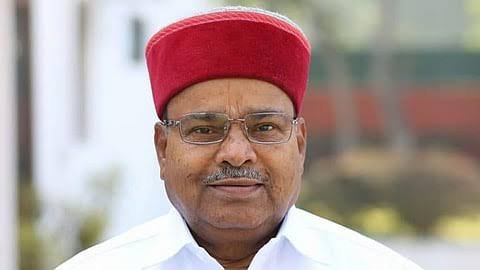
Thaawarchand Gehlot asks CM D.K. Shivakumar to reconsider September 8 directive amid High Court scrutiny
Bengaluru, September 2026 : Karnataka Governor Thaawarchand Gehlot has written a four-page letter to Chief Minister D.K. Shivakumar questioning the state government’s decision to restrict the rendition of the National Song Vande Mataram to its first two stanzas at official functions.
In his communication, Gehlot advised the state government to reconsider its September 8, 2026 order and follow the prevailing instructions issued by the Union government concerning the rendition of the National Song. He said the state’s decision could raise constitutional questions and create a conflict with the protocol prescribed by the Centre.
The Governor’s letter comes amid an ongoing political and legal controversy over the Karnataka government’s directive. A public interest litigation challenging the September 8 order has been filed before the Karnataka High Court, while the state government has defended its decision and maintained that the two-stanza format is applicable to most state government functions.
Under the state government’s order, the first two stanzas of Vande Mataram are to be sung or played at state government programmes and official functions. The order provides exceptions for functions attended by the President, Vice-President, Prime Minister or Governor, where the full version can be rendered. The state government has said the protocol was intended to maintain uniformity, dignity and proper etiquette depending on the nature of official programmes.
Governor Cites Central Protocol
In his letter, Gehlot referred to instructions issued by the Union Ministry of Home Affairs concerning the National Song and National Anthem. He said the Centre had prescribed an official version of Vande Mataram for rendition at official functions.
The Governor particularly referred to the instructions concerning mass singing, arguing that the prescribed protocol contemplated the rendition of the official version and did not provide for a state government to independently prescribe a truncated version for its official functions.
According to Gehlot, the issue therefore goes beyond an administrative decision about the duration of an official programme. He said it concerns conformity with the national protocol governing the use and rendition of a national symbol.
The matter has assumed additional significance following recent developments concerning statutory protection for the National Song. Gehlot referred to the Prevention of Insults to National Honour (Amendment) Act, 2026 and said Parliament had extended statutory protection under the Prevention of Insults to National Honour Act, 1971 to the National Song.
He argued that the expanded statutory framework made it important for executive action by states concerning Vande Mataram to be consistent with the applicable Central legal and administrative framework.
Constitutional Questions
Gehlot also referred to Articles 162, 256 and 257(1) of the Constitution while outlining his concerns about the respective executive powers of the Union and states.
Article 162 deals with the extent of the executive power of a state, while Articles 256 and 257 address the obligations of states in relation to parliamentary laws and the exercise of Union executive power.
The Governor said that, since the Union government had issued specific instructions concerning the National Song, the Karnataka government’s decision to prescribe a different version could raise questions about the respective spheres of Union and state executive authority.
Gehlot therefore advised the state government to examine whether the two-stanza restriction could be sustained consistently with the applicable statutory provisions, Ministry of Home Affairs instructions and constitutional principles governing the distribution of executive powers.
He also referred to judicial observations concerning national symbols and said the legal position should be examined in the context of statutory provisions and constitutional freedoms.
Issue Under Judicial Scrutiny
The Governor’s intervention comes as the Karnataka High Court examines challenges to the state government’s decision. A PIL has questioned the state’s authority to restrict the National Song to two stanzas at official functions and has argued that the state directive is inconsistent with the Union government’s protocol.
The controversy also surfaced in the Karnataka legislature this week. Opposition BJP and JD(S) legislators recited the full version of Vande Mataram after the official rendition ended after two stanzas, protesting the state government’s directive.
The state government, meanwhile, has maintained before the High Court that the singing of Vande Mataram is not mandatory in the same manner as the national anthem and has defended its decision to prescribe two stanzas at state functions.
Gehlot Seeks Reconsideration
In his letter, Gehlot urged Chief Minister Shivakumar to reconsider the September 8 government order and examine its compatibility with the Central government’s instructions and the statutory framework governing the National Song.
The Governor said reconsideration would help prevent an avoidable conflict between the state’s administrative instructions and the Union government’s protocol and could also reduce the possibility of further constitutional litigation concerning the distribution of executive powers.
The issue is now being examined simultaneously in the political, administrative and judicial spheres, with the Karnataka government’s directive facing questions over its legal basis and compatibility with Central instructions, while the state maintains that its protocol was adopted to ensure uniformity and proper conduct at official functions.