Minister Reviews Regional Water Scarcity Situation and Water Supply Schemes
Chhatrapati Sambhajinagar, September 2026 : With Marathwada receiving below-average rainfall this year, Water Supply and Sanitation Minister of State Meghna Sakore-Bordikar has directed officials to undertake strict, village-level planning of available water resources to prevent a possible water shortage in the region.
She instructed officials to begin detailed planning immediately to ensure a regular and uninterrupted supply of drinking water to citizens and to expedite the completion of pending water supply projects.
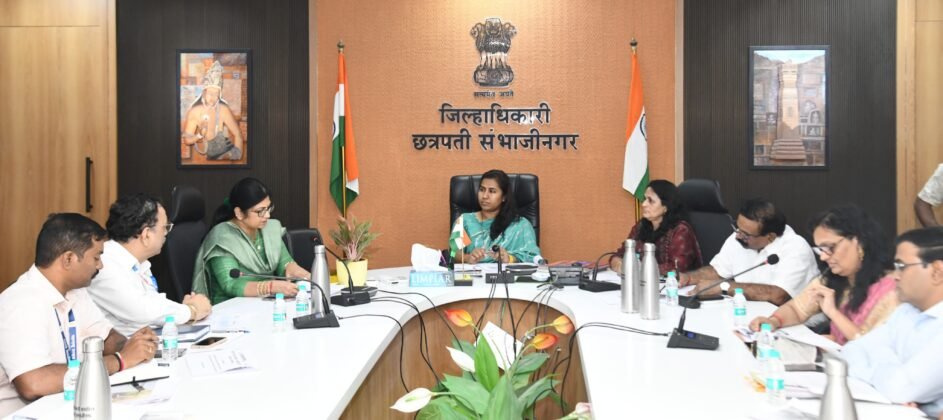
Minister Sakore-Bordikar reviewed the current water scarcity situation in Marathwada, rainfall, available water stocks, the possibility of water shortages and various water supply schemes at the District Collector’s Office.
Additional Collector Sambhaji Adkune, Resident Deputy Collector Janardan Vidhate, Additional Divisional Commissioner (Revenue) Rita Maitrewar, Maharashtra Jeevan Authority Chief Engineer Manisha Palande and officials from the concerned departments were present at the meeting.
At the beginning of the meeting, Water Supply and Sanitation Department Joint Secretary Geeta Kulkarni provided detailed information through video conferencing on the water scarcity action plan and the steps proposed to be taken in the coming period.
Marathwada Receives 63.40 Per Cent of Average Rainfall
Between June and September 2026, Marathwada’s average annual rainfall is 679.50 mm, while the region has received 430.80 mm so far. This is 63.40 per cent of the average annual rainfall.
During the period, the expected rainfall was 629.70 mm, while the actual rainfall received was 68.41 per cent of the expected figure.
District-wise, Chhatrapati Sambhajinagar received 422.30 mm of rainfall, equivalent to 72.60 per cent of its average. Jalna received 438.50 mm, or 72.71 per cent; Beed received 331.30 mm, or 58.52 per cent; Latur received 351.70 mm, or 49.82 per cent; Dharashiv received 337.90 mm, or 56.03 per cent; Nanded received 587.80 mm, or 72.18 per cent; Parbhani received 420.70 mm, or 55.26 per cent; and Hingoli received 543.40 mm, or 68.33 per cent of its average rainfall.
No Fodder Shortage Currently in Chhatrapati Sambhajinagar Division
The Chhatrapati Sambhajinagar division has a total livestock population of 53,59,462, comprising 6,50,282 small animals, 26,45,726 large animals and 20,63,455 goats and sheep.
The livestock requires around 20,125 metric tonnes of fodder every day. At present, the division has 44,81,136.851 metric tonnes of fodder available, and there is currently no need to establish fodder camps.
The available fodder is estimated to last for around 89 to 210 days across the districts. Jalna has the lowest availability, with stocks estimated to last for about 89 days.
Officials have been directed to start planning immediately in view of the possibility of fodder shortages emerging in the division from December 2026. A reduction in the area under Rabi crops could further delay the onset of fodder shortages in the districts.
The available fodder includes supplies from the Kharif and Rabi seasons, as well as fodder from field bunds, fallow land and forest areas.
Drinking Water to Get Highest Priority
Sakore-Bordikar directed officials to prepare village-wise action plans in anticipation of a possible water shortage, give the highest priority to drinking water, manage available water sources efficiently and keep alternative water sources ready wherever required.
She also directed officials to expedite pending works under water supply schemes and ensure the prompt resolution of citizens’ complaints related to water supply.
The Minister stressed that continuous monitoring should also be undertaken to ensure adequate fodder availability for livestock along with preparedness for water scarcity.
She directed all concerned agencies to coordinate closely and undertake advance preparations to deal with any potential water and fodder shortage in the region.