In A Bid To Mitigate The F-22 Raptor; China’s J-20A Stealth Fighter Finally Flies With WS-15 Engines.

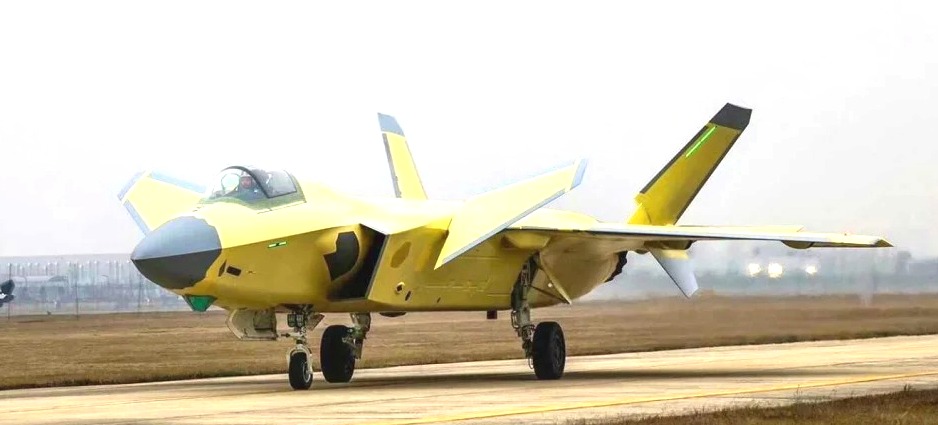
Beijing; January 2026: On January 24th, 2026, China’s Chengdu Aircraft Corporation have shared pictures showing a J-20A stealth fighter flying with the WS-15 turbofan engine. The aircraft was finished in yellow primer, a coating typically associated with production or acceptance flights. This will soon enable the J-20 and J-20A to approach their intended performance envelope while narrowing, though not eliminating completely, the propulsion gap with the U.S. F-22 Raptor.
Alongwith the pictures of a flight test program covering 05 locations and 10 aircraft types, 01 singular picture showed a J-20A stealth fighter flying in what appears to be a production and acceptance context rather than an experimental test. However, this particular aircraft was finished in yellow primer, a coating commonly associated with manufacturing and validation stages, and attention focused on the exhaust section, where nozzle geometry matched the WS-15 rather than earlier interim engines, which indicates that China’s J-20A is now flying with the long-awaited engine it was originally designed to use in operational service.
Earlier J-20s entered service within the Chinese Air Force with Russian AL-31 with the Russian WS-10 indigenous turbofan engines, which limited both supersonic performance and the exploitation of the fighter’s full potential. Therefore, this flight signifies that China moved away from interim turbofan engines, implying that the WS-15 has finally progressed beyond experimental integration.
Although, no numbers were provided on how many J-20As are currently involved, but the emphasis is clearly on scaling rather than experimentation. This change directly affects how the J-20 will be used in real missions, especially those requiring long-distance flights at high speeds, as Chengdu Aircraft Corporation will probably assess how consistently the WS-15 performs in everyday operations. The J-20A itself is an updated single-seat version of the J-20, with changes aimed at improving aerodynamic efficiency and internal volume. One visible modification is the raised section behind the canopy, which smooths airflow where the canopy meets the fuselage and reduces drag at high speed.
This reshaping also creates additional internal volume inside the aircraft. That space can be used for new systems and possibly extra fuel, which improves range and endurance during long missions. These adjustments show that the J-20A is optimised to benefit from a more powerful engine than earlier variants. Inside the airframe, adding systems and structural changes increases weight, which in turn raises the demand for higher thrust to maintain performance. Acceleration, climb rate, and sustained supersonic speed all depend on sufficient engine margins. This is why the J-20A and the WS-15 must be considered together rather than separately, as any airframe improvements only translate into operational advantages if the engine can support them reliably.
Developed specifically for fifth-generation fighter jets, the WS-15 is a low-bypass afterburning turbofan whose development began in the early 1990s and extended through a prolonged testing and maturation period before its serial production commenced in 2023.
Physically:
- the engine measures about 5.05 meters in length and 1.02 meters in diameter, with a dry mass of about 1,600 kilograms.
- It uses an axial-flow compressor, an annular nickel-alloy combustion chamber, and single-stage high- and low-pressure turbines.
- The bypass ratio is about 0.25, and the overall pressure ratio is stated in the 25 to 26 range.
These parameters reflect a design focused on high specific thrust rather than fuel efficiency. In performance terms, the WS-15 is rated between roughly 161 and 180 kilonewtons (kN) of thrust with afterburner, with turbine inlet temperatures around 1,850 K.
Its dry thrust level is intended to support sustained supersonic flight without afterburner use, commonly referred to as super cruise. The engine is also expected to improve the J-20A’s climb performance and provide more electrical power for onboard systems. However, peak thrust alone does not define operational value. At the same time, operational factors such as durability, maintenance intervals, and consistency across production engines will determine how often aircraft are available for missions. These factors remain decisive for evaluating the real impact of the WS-15 on the J-20A fleet.
For comparison:
its U.S. counterpart, the Lockheed Martin F-22 Raptor, is powered by 02 Pratt & Whitney F119 turbofan engines, which deliver more than 156 kilonewtons of thrust with afterburner and support sustained super cruise.
A key feature of the F119 is:
- thrust vectoring, allowing the exhaust to deflect up to ±20 degrees in pitch, which improves control during aggressive maneuvers.
- The F119 has a bypass ratio of about 0.30 and an overall pressure ratio close to 26, with very high operating temperatures. Now, with two WS-15 engines rated in the roughly 161–180 kN class each,
Meanwhile, the Chinese J-20A may achieve a total thrust that is comparable to, or higher, than that of the F-22, whose two F119 engines are each in the lower 156 kN class.
In practical terms, this can translate into better performance when flying long distances at high speed, especially in missions where range, persistence, and dash speed matter more than close-in manoeuvering. However, the current WS-15 engines appear to use non-vectoring nozzles, giving the F-22 a decisive edge in high-angle-of-attack control, post-stall maneuvering, and close-range agility.
Team Maverick.







Pope Leo XIV Calls for Peace, Says Suffering of Innocents “Hurts All Humanity”
Vatican, March 2026 : Pope Leo XIV on Sunday expressed deep anguish over ongoing conflicts…

Pope Leo XIV Calls for Peace, Says Suffering of Innocents “Hurts All Humanity”
Vatican, March 2026 : Pope Leo XIV on Sunday expressed deep anguish over ongoing …