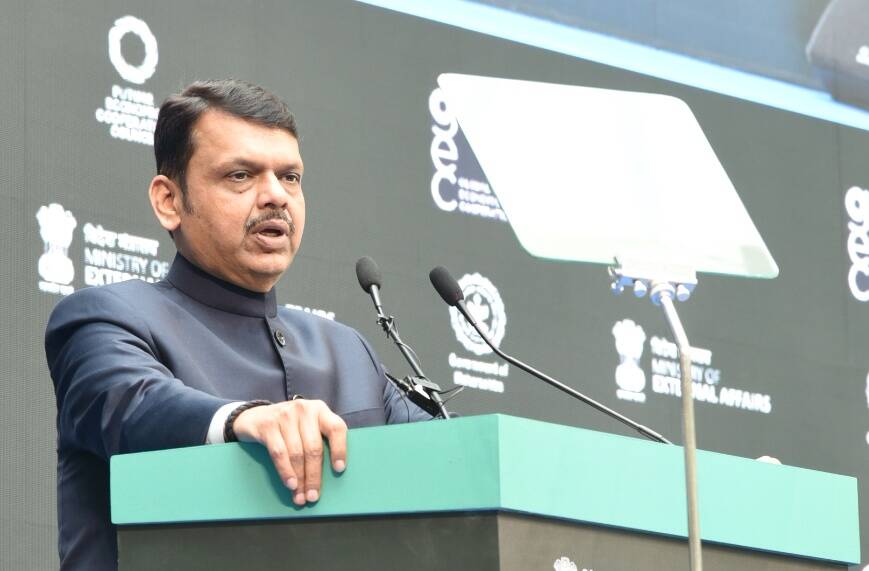
Mumbai to Become the Gateway for Global Capital – Chief Minister Devendra Fadnavis

‘Global Economic Cooperation 2026’ conference inaugurated in the presence of the Chief Minister
Mumbai, February 2026 : In the new phase of globalization, the concept of “trusted globalization” is gaining prominence, highlighting Maharashtra’s strategic importance, said Devendra Fadnavis. Maharashtra contributes 14–15 percent to India’s GDP, leads the country in foreign direct investment, accounts for 20 percent of industrial output, and handles over 60 percent of container traffic through India’s western ports. In the coming years, Mumbai will emerge as the gateway for global capital, and both Mumbai and Maharashtra will play a crucial role in shaping global economic stability, the Chief Minister said, expressing confidence that in a multipolar world, trusted partnerships will determine success.
The three-day Global Economic Cooperation Conference was jointly organized by the Ministry of External Affairs, the Future Economic Cooperation Council (FECC), and the Government of Maharashtra. The conference was inaugurated by Chief Minister Fadnavis in the presence of External Affairs Minister S. Jaishankar. The event was attended by FECC Executive Director Vijay Chauthaiwale, advisory board members Baba Kalyani, Adil Zainulbhai and Cyril Shroff, along with representatives from industry, the diplomatic community, and global partners in large numbers.
Prime Minister Narendra Modi’s Message
India: A Ray of Hope for the World
In his message, Narendra Modi said that the inaugural Global Economic Cooperation Conference is a significant step toward deepening international economic dialogue amid rapid global changes. Serving as a high-level platform for broad international cooperation, the conference brings together ministers from various sectors, senior policymakers, leading economists, global industry leaders, investors, and strategic representatives at the intersection of policy innovation and economic opportunity.
At a time when the world is searching for stable leadership amid uncertainty, India has emerged as a ray of hope. By maintaining a rare balance of high economic growth and low inflation, India is offering practical and scalable solutions to global challenges. One major challenge—ensuring that welfare schemes reach the maximum number of people without leaving anyone behind—has been effectively addressed through world-class digital public infrastructure. With transparency and accountability, welfare benefits are now being delivered to citizens at the click of a button.
India is among the world’s fastest-growing major economies, with sustainability at the core of its progress. More than 50 percent of the country’s total installed energy capacity now comes from non-fossil fuel sources, placing India among the leading nations to achieve this milestone. India has also emerged as a confident and credible voice of the Global South, shaping a more balanced and inclusive global order through inclusive engagement and a forward-looking agenda. The Prime Minister expressed hope that the conference would successfully foster dialogue and cooperation, laying a strong foundation for a more interconnected global economic future by linking ideas, capital, and innovation.
Transparency, Regulation, and Inclusiveness: Mumbai in the Lead
Chief Minister Fadnavis emphasized that economic sovereignty does not mean isolation or self-reliance alone; rather, it is a balanced combination of diversified trade, manufacturing capacity, energy security, and technological capability—along with strategic autonomy and cooperative engagement. This, he said, is the approach Maharashtra has adopted. The future global order will be corridor-based, and Maharashtra will play a decisive role. Economic resilience will be key, and Mumbai will lead in transparency, regulation, and inclusiveness.
Mumbai, he noted, has a long tradition of maritime trade, entrepreneurship, and global engagement. From here, a stable, inclusive, and strategically capable economic system will be built. A multipolar world is not a risk but an opportunity—provided it is structured well—and Maharashtra is ready to help shape that opportunity. He added that the combination of artificial intelligence, data governance, semiconductor supply chains, and skilled human capital will define future power. Maharashtra is developing AI parks, data center clusters, and skill universities. Climate change, he said, is no longer just an environmental issue but a geopolitical one, and the state is making large investments in green hydrogen, solar and wind energy, green mobility, and sustainable urban infrastructure.
A Reshaping Global Order
The Chief Minister noted that the global system is being reshaped, with world trade undergoing major disruptions and supply chains being restructured. Strategic sectors such as semiconductors, energy, food security, critical minerals, and artificial intelligence are now integral to national security strategies. Capital flows are increasingly guided not only by returns but also by geopolitical alignment—marking the era of economic statecraft. India’s progress, he said, is structural, and at this decisive juncture of global economic rebalancing, India’s clarity and confidence have been strengthened under Prime Minister Modi’s leadership. Initiatives such as India’s G20 presidency, the India–Middle East–Europe Economic Corridor (IMEC), the expansion of digital public infrastructure, and India’s role as the voice of the Global South are shaping the new global economic order. Diplomacy and economics have become inseparable, and under External Affairs Minister Jaishankar’s leadership, India has strengthened trusted global partnerships while preserving strategic autonomy. India has also successfully concluded high-quality free trade agreements that go beyond trade to encompass supply chains, capital flows, technology transfer, and skills exchange.
Maharashtra: The Gateway for Global Capital
Reiterating that Mumbai is India’s financial capital, Chief Minister Fadnavis said connectivity—from roads to the Suez Canal, from Atlantic trade routes to Pacific supply chains—is the source of strength. With the rise of the Indo-Pacific maritime framework and restructured supply chains, Maharashtra is emerging as a central hub on the western seaboard. The Jawaharlal Nehru Port Authority, the Navi Mumbai International Airport, and the proposed Vadhavan Port position Maharashtra at the heart of western maritime trade, with Mumbai poised to become the western anchor of IMEC.
Maharashtra is leading in electronics, electric vehicle manufacturing, green hydrogen, battery production, semiconductors, pharmaceuticals, biotechnology, and defence-aerospace. The state competes not just on cost, but on reliability, the rule of law, and scale. Economic stability, he said, is the real strength of our times. Capital markets are expanding, with growing participation through municipal bonds, green bonds, infrastructure investment trusts, and sovereign fund partnerships. Infrastructure, logistics, renewable energy, and the digital economy are long-term assets. Strengthening partnerships across Africa, the Gulf, and Asia, Mumbai is elevating its historic trade links to new heights, the Chief Minister added.
De-risking and Diversification Are Essential: External Affairs Minister S. Jaishankar
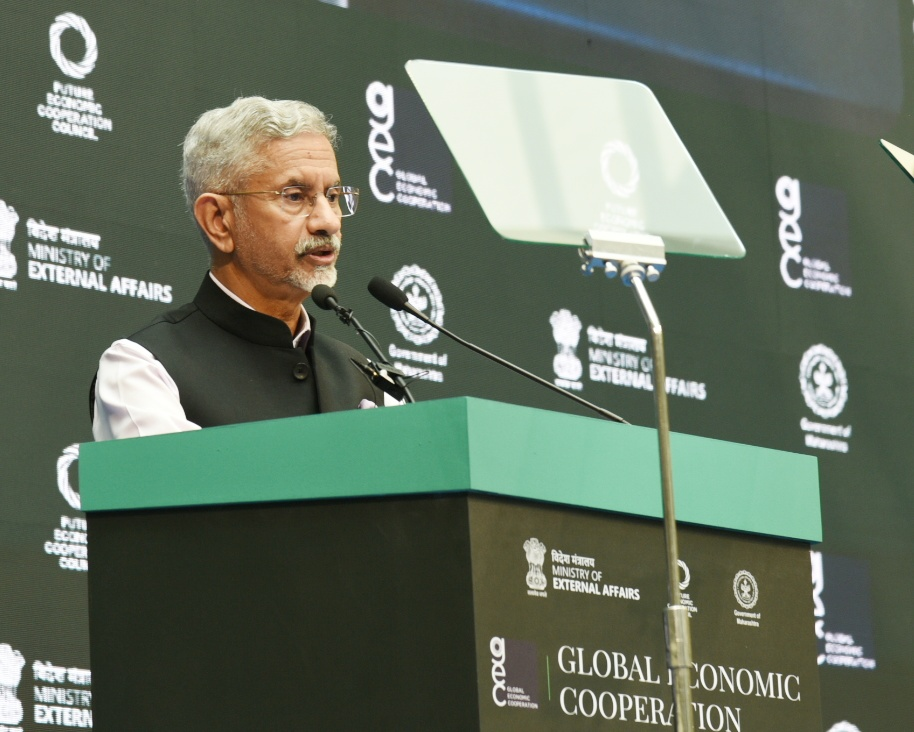
External Affairs Minister S. Jaishankar spoke in detail about the global situation, India’s role, and the vision of “Viksit Bharat 2047.” He said the world is passing through a phase of extreme volatility and uncertainty, with simultaneous shifts in strategic, political, economic, and technological domains challenging old assumptions. In this context, adopting de-risking and diversification is essential, as vulnerabilities in global supply chains were exposed by the COVID-19 pandemic and conflicts in Ukraine and West Asia.
“Viksit Bharat 2047,” announced by Prime Minister Modi, is a national goal that requires parallel progress across industry, services, agriculture, advanced technology, infrastructure, and innovation. The Make in India initiative has been expanded to include research, design, and co-creation. Over the past decade, large investments in highways, railways, airports, ports, energy, and digital public infrastructure have significantly improved the ease of doing business and ease of living.
Minister Jaishankar added that India has recently concluded trade agreements with the European Union and the United States, in addition to earlier agreements with the United Kingdom, EFTA, New Zealand, Oman, the UAE, Australia, and Mauritius. These agreements are enhancing global market access for Indian products and positioning India as a key partner in the global de-risking process. As the world moves toward a technology- and skill-based economy, India’s young population and skilled workforce are major strengths. Initiatives such as 5G technology, the Chandrayaan mission, Vande Bharat trains, and UPI have shaped the identity of a “New India.”
In an unstable global environment, India is emerging as a credible and capable partner, Minister Jaishankar said, expressing confidence in the country’s growing global role.
Netanyahu Meets Trump at White House for Eighth Bilateral Talks Amid Regional Tensions
Jerusalem/Washington, July 2026 : Israeli Prime Minister Benjamin Netanyahu arrived at the…
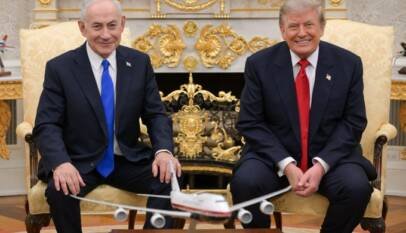
Netanyahu Meets Trump at White House for Eighth Bilateral Talks Amid Regional Tensions
Jerusalem/Washington, July 2026 : Israeli Prime Minister Benjamin Netanyahu arrived at the White House …