Iran Repositions S-300 Air Defences Around Tehran Ahead Of Potential US Strikes.

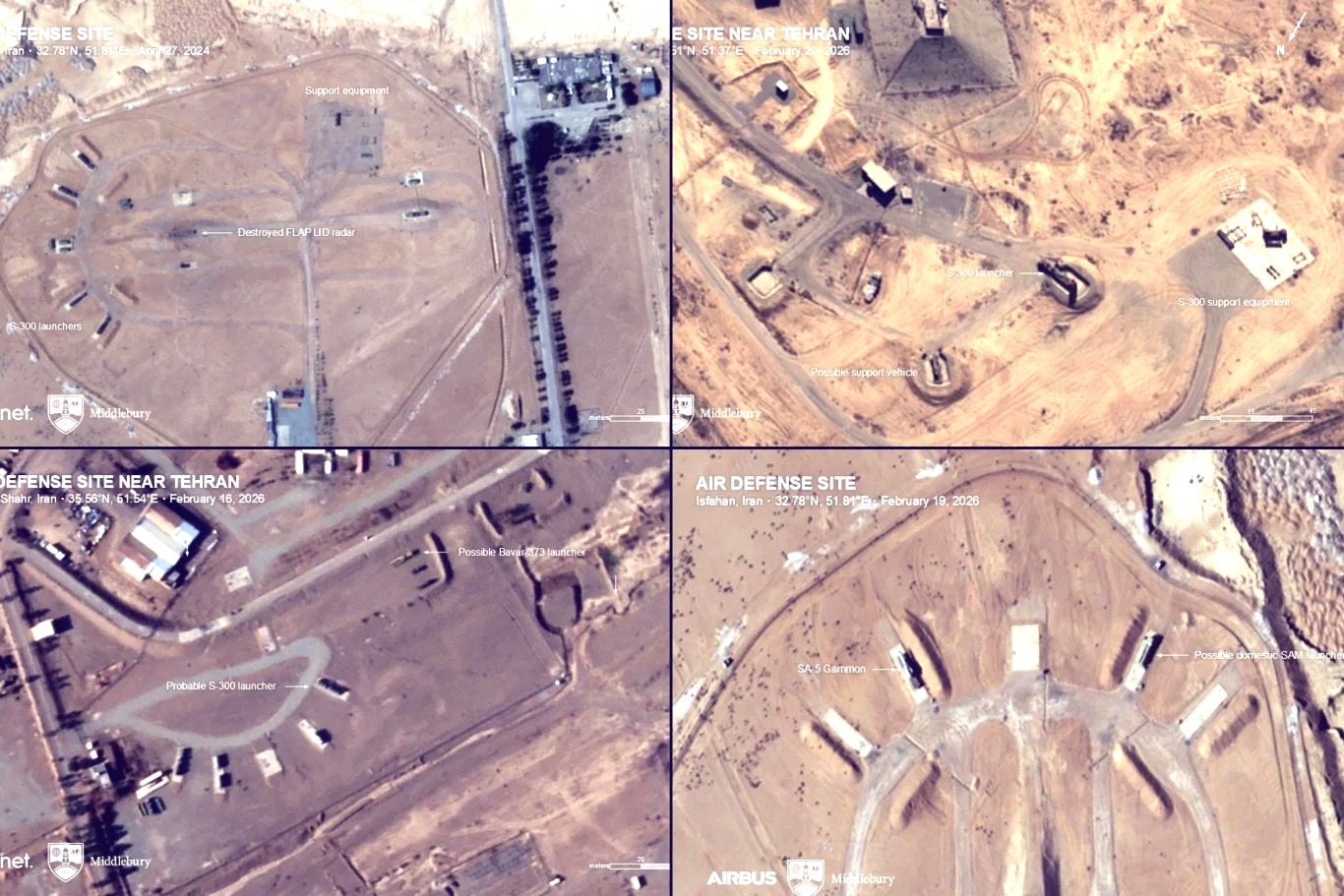
Tehran; February 2026: Commercial satellite imagery collected in February 2026 by Planet Labs and Airbus shows what appear to be Iranian S-300 surface-to-air missile launchers repositioned at multiple air defence sites around Tehran and Isfahan, even as the fire control radars typically paired with those systems are not visible in their customary locations.
The images, reviewed against the backdrop of renewed friction between the United States and Iran, indicate that portions of Iran’s long-range air defence inventory have resurfaced after months of limited visibility following Israeli strikes in 2024. While the absence of engagement radars raises questions about operational status, the launcher redeployments point to at least a partial effort to restore layered defences around key political and nuclear infrastructure.
The S-300 PM, accepted for operational service around 1990 as a modified production standard, belongs to the third generation of the S-300P family designed to counter aircraft, cruise missiles, and certain classes of ballistic threats under heavy electronic countermeasures. Export variants such as the S-300PMU-2 supplied to Iran are derived from this lineage. A typical S-300PM battery can field up to 04 83P6 fire units, comprising 12 5P85S and 5P85D transporter erector launchers, each carrying 04 missiles in sealed cylindrical canisters. In firing position, the paired missile containers are raised vertically from the rear of a semi-trailer, usually towed by a 6×6 KRAZ-260 truck in the PM configuration.
The missiles most closely associated with the PM and PMU series are the Fakel 48N6 and 48N6E. Measuring approximately 7.25 metres in length and weighing around 1,804 kilograms, the interceptor carries a 143 kilogram high explosive fragmentation warhead. The 48N6 series introduced Track Via Missile guidance, in which the missile relays target data back to the ground based engagement radar, typically the 30N6E1, improving accuracy compared to earlier command guidance modes. A new rocket motor increased engagement ranges, with Russian sources citing up to 150 kilometres in some configurations, although commonly referenced envelopes for earlier variants range between 75 and 90 kilometres against aerodynamic targets. Missile speed peaks at roughly 2,100 metres/second, close to Mach 6, and launch intervals can be as short as 03 seconds.
A standard S-300PM battery integrates the 30N6E1 engagement radar, supported by acquisition sensors such as the 64N6E long range radar and, in some configurations, the 76N6 low altitude detector. At battalion level, up to 06 batteries can be coordinated through a 54K6E command post, forming a layered defensive network. Later upgrades include the LEMZ 96L6 Cheese Board early warning radar, a planar array system with electronic beam steering in elevation and mechanical steering in azimuth, deployable in towed, mast-mounted, or fully mobile 8×8 configurations. These radars are central to the system’s effectiveness, as the 48N6 relies on continuous target illumination and data link connectivity for terminal guidance.
Recent imagery from Tehran shows a launcher measuring roughly 15 to 16 metres, consistent with the 5P85 series dimensions previously documented at Iranian S-300 sites. At least 01 launcher is erected, accompanied by vehicles resembling support and logistics elements typical of operational batteries. Yet no 30N6E1 engagement radar or 64N6E acquisition radar is visible in open source imagery at these locations. This absence is operationally consequential. Without the dedicated engagement radar, the Track Via Missile architecture cannot function as designed, and engagement ranges, tracking precision, and resistance to jamming would be reduced.
At Isfahan, a launcher resembling the indigenous Bavar-373 appears collocated with other air defence assets. The Bavar-373 employs the Sayyad-4 missile, reportedly capable of reaching targets at distances approaching 200 kilometres and altitudes around 27 kilometres, guided by the Meraj-4 active electronically scanned array radar. The Khordad-15 system, associated with the Sayyad-3 interceptor and credited with engagement ranges near 120 kilometres, is also present at certain sites. The juxtaposition of Russian supplied S-300 components with domestic systems suggests an attempt to integrate surviving launchers into a hybrid command and control framework.
From a tactical and operational standpoint, a fully equipped S-300PM battalion provides area defence against multiple simultaneous targets, including high performance aircraft and certain tactical ballistic missiles. The combination of high missile velocity, rapid firing intervals, and layered radar coverage enables saturation resistance under complex threat conditions. However, the system’s dependence on ground based radars exposes it to anti-radiation missiles and electronic attack. If Iran is substituting domestic radars for damaged or destroyed Russian sensors, interoperability constraints and potential gaps in data link compatibility could narrow the defended footprint and reduce engagement effectiveness, particularly against low observable or stand-off threats.
These developments unfold in a regional environment marked by persistent Israeli strike capabilities and an expanded U.S. military presence across the Gulf. The reappearance of S-300 launchers indicates that Iran retains at least part of its long-range missile inventory and is willing to redeploy it despite previous losses. At the same time, the apparent absence of core engagement radars and the visible mixing of Russian and indigenous systems point to an air defence network under reconstruction rather than at full strength. For regional security, this evolving posture adds uncertainty. Even a partially restored S-300 layer complicates operational planning, yet its degraded configuration, if confirmed, underscores the continuing vulnerability of Iran’s strategic infrastructure in the event of renewed conflict.
Team Maverick.






Shashank Singh’s Heroics Guide Punjab Kings to Thrilling Six-Wicket Win Over SRH
April 2026 : In a nail-biting encounter, Punjab Kings registered a brilliant six-wicket vi…

Shashank Singh’s Heroics Guide Punjab Kings to Thrilling Six-Wicket Win Over SRH
April 2026 : In a nail-biting encounter, Punjab Kings registered a brilliant six-wicket victory …