Private and Charitable Hospitals Must Implement Government Health Schemes – Chief Minister Devendra Fadnavis

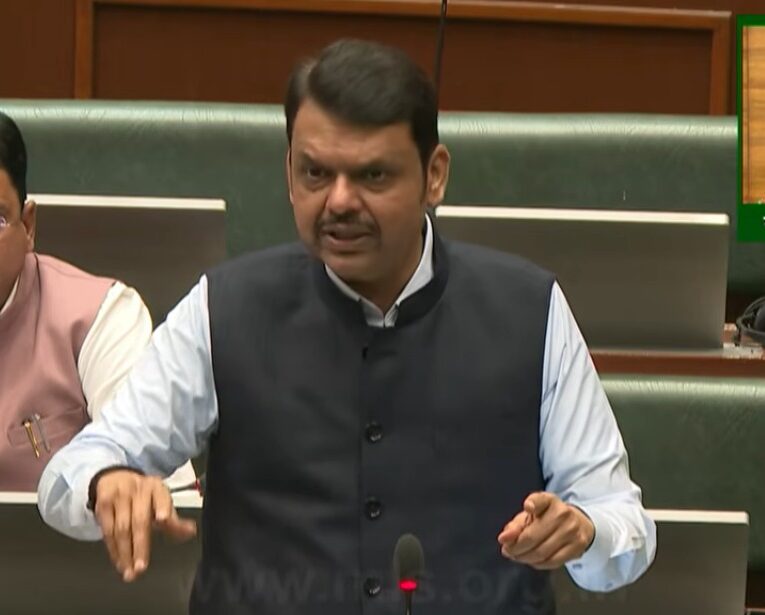
Mumbai, Feb 2026 : Chief Minister Devendra Fadnavis informed the Legislative Assembly that it is mandatory for private and charitable hospitals in the state to implement health schemes of both the Central and State governments.
He was responding to a question raised by MLA Bhimrao Tapkir.
The Chief Minister said the government has framed a new “definition of concessions” for charitable hospitals, under which many hospitals now fall into the charitable category. These hospitals are required to maintain transparency regarding reserved beds and funds meant for poor and needy patients. To ensure accurate information on available beds and expenditure on patients, the government has developed a dynamic dashboard. Through this system, details of beds in each hospital, treatment costs, and utilization of charitable funds can be viewed at any time.
Earlier, hospitals only reported expenses, with no certainty whether actual services were provided. Now, the government has revised and increased fixed treatment rates, and hospitals are required to provide services strictly as per these rates. It will be mandatory for every hospital to publicly display its bed charges. Additionally, hospitals must allocate 2 percent of their total funds for charitable services. However, until now, the actual utilization of this fund was not clearly visible. Amendments to the law during this session will ensure that this 2 percent fund is reflected on the dashboard, clearly showing how much was spent on which patient.
Some related matters are currently pending before the High Court. The court has directed the Law and Judiciary Department to hear the hospitals’ side before taking a decision. However, the state government’s stand is clear that all charitable hospitals must transparently implement Central and State health schemes, along with reserved beds and funds.
For the first time, the state government now has real-time information on beds available in every hospital. After further amendments, the system will become even more robust and transparent, the Chief Minister added.
Minister of State Adv. Ashish Jaiswal and MLAs Vijay Wadettiwar, Amin Patel, and Prashant Bamb participated in the discussion.
Law to Be Amended for Strict Action Against Repeat-Offender Orchestra Bars – Chief Minister
Mumbai, Feb 24: Chief Minister Devendra Fadnavis announced in the Assembly that the law will soon be amended to take strict action against orchestra and bar establishments that repeatedly violate rules.
Responding to a question raised by MLA Subhash Deshmukh during Question Hour, the Chief Minister said that in some places, dance bars are being run under the guise of orchestra bars. Even after action is taken, such establishments often resume operations in the same manner. Therefore, the state government has decided to include a provision in the law to permanently cancel licenses if violations occur three times. The necessary amendment will be proposed in the current or the next Assembly session.
He further noted that the Supreme Court has delivered several judgments on this issue. Although some provisions framed earlier were struck down as unconstitutional, the state has since introduced fresh rules, including conditions related to space requirements, partitions, and restrictions on alcohol. He also said the Panvel case would be examined.
MLA Bhaskar Jadhav participated in the discussion.
“Digital Arrest Is a Hoax”; Contact 1930 Immediately in Case of Suspected Fraud – Chief Minister
Mumbai, Feb 24: Chief Minister Devendra Fadnavis clarified that “digital arrest” does not exist and is entirely fraudulent. If anyone receives such calls, messages, or video calls, they should immediately contact the cyber helpline number 1930. He said extensive awareness campaigns are being run by both the State and Central governments to educate citizens about such frauds.
MLA Abu Azmi raised concerns in the Assembly about cases of looting through “digital arrest” and online fraud, particularly in Mumbai and Ahilyanagar.
The Chief Minister explained that fraudsters often impersonate police or customs officials and claim that drugs have been found in parcels addressed to the victim. They then falsely declare that the person has been placed under “digital arrest” and instruct them not to move from the screen. By instilling fear, they force victims to transfer large sums of money online. Such frauds have affected not only common citizens but also retired senior officials, including a former IAS officer and a senior naval officer. These fraud networks are operated from abroad, while individuals in India act merely as handlers.
He said a comprehensive mechanism has been set up to control cybercrime in the state. If money is mistakenly transferred and the incident is immediately reported on 1930, it is possible to freeze the amount through coordination with banks.
Awareness campaigns are being conducted through television advertisements, caller tunes, and various media platforms to warn citizens about “digital arrest” frauds. Despite this, people continue to fall victim daily. The Chief Minister urged citizens to remain extremely vigilant.
MLA Abhijit Patil participated in the discussion.

President Of India Reviews Passing Out Parade at Indian Military Academy, Dehradun.
Dehradun; June 2026: The Supreme Commander of the Armed Forces and President of India, Dro…
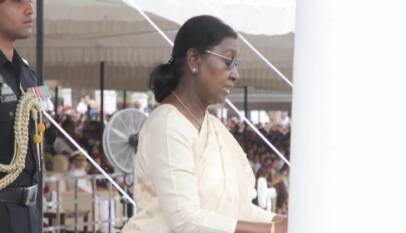
President Of India Reviews Passing Out Parade at Indian Military Academy, Dehradun.
Dehradun; June 2026: The Supreme Commander of the Armed Forces and President of India, …