Central Cabinet Approves Three Multi-Tracking Railway Projects Across 8 Districts Including Maharashtra Gondia–Jabalpur Route to Be Doubled

New Delhi, Feb 2026 : The Cabinet Committee on Economic Affairs, chaired by Prime Minister Narendra Modi, has approved three major railway line expansion (multi-tracking) projects of the Ministry of Railways, involving an investment of approximately ₹9,072 crore. A key component of these projects is the doubling of the Gondia–Jabalpur railway route.
These projects will be implemented across eight districts in four states—Maharashtra, Madhya Pradesh, Bihar, and Jharkhand—and will add about 307 km to the existing Indian Railways network. In addition to the Gondia–Jabalpur doubling, the projects include the construction of third and fourth lines on the Rewari–Kiul and Gamharia–Chandil routes.
The proposed multi-tracking projects are expected to significantly improve rail connectivity for around 5,407 villages, benefiting nearly 9.8 million people. Enhanced route capacity will lead to substantial improvements in the transportation system, increasing the efficiency and service reliability of Indian Railways. The decision will facilitate smoother railway operations and help reduce congestion in both passenger and freight traffic.
Aligned with the Prime Minister’s vision of a “New India,” these projects emphasize balanced regional development. They are expected to generate employment and self-employment opportunities at the local level, contributing to greater economic self-reliance among citizens.
The projects have been planned under the PM Gati Shakti National Master Plan, which focuses on integrated planning, inter-ministerial coordination, and enhanced multi-modal connectivity. The primary objective is to improve transportation efficiency and ensure seamless movement of people, goods, and services across the country.
The capacity augmentation will also strengthen rail connectivity to several prominent tourist destinations, including the Kachnar Shiv Temple in Jabalpur, Kanha National Park, Pench National Park, Dhuandhar Falls, and the Dalma Wildlife Sanctuary.
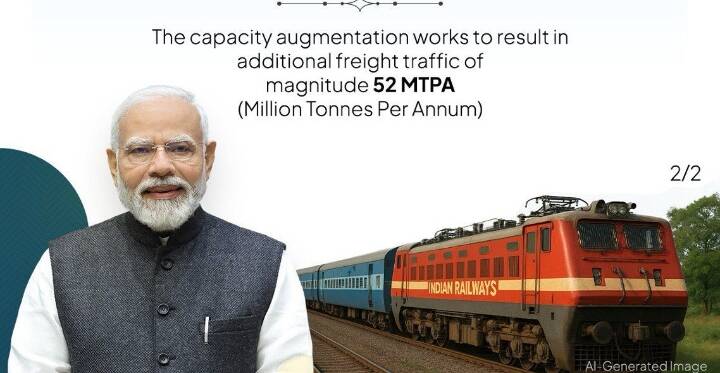
These railway corridors will play a vital role in the transportation of essential commodities such as coal, steel, iron ore, cement, food grains, and fertilizers. With the expansion of these routes, an additional freight capacity of 52 million tonnes per annum (MTPA) will be created.
As rail transport is an environmentally friendly and energy-efficient mode, the projects will contribute positively to India’s climate goals. They are expected to save nearly 60 million litres of oil imports annually and reduce carbon emissions by about 300 million kilograms—an environmental impact equivalent to planting around 10 million trees.

President Of India Reviews Passing Out Parade at Indian Military Academy, Dehradun.
Dehradun; June 2026: The Supreme Commander of the Armed Forces and President of India, Dro…

President Of India Reviews Passing Out Parade at Indian Military Academy, Dehradun.
Dehradun; June 2026: The Supreme Commander of the Armed Forces and President of India, …