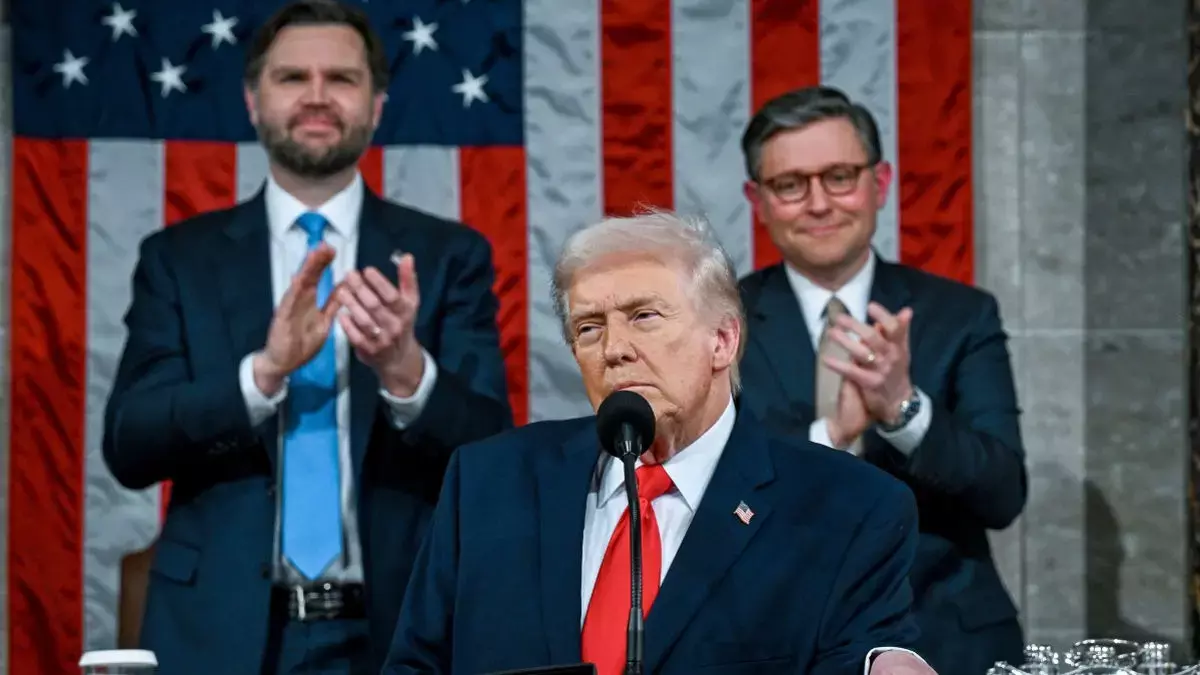
Trump Pitches Power-Plant Mandate for Big Tech, Defends Tariffs in Combative State of the Union

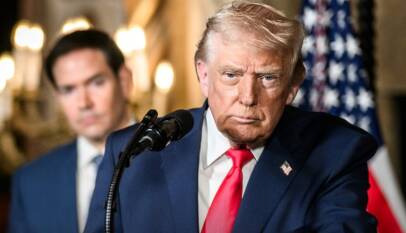
Washington, Feb 2026 : US President Donald Trump used his State of the Union address on Tuesday to unveil a controversial proposal aimed at reshaping the country’s fast-growing digital infrastructure and defending his aggressive trade agenda. At the heart of the speech was a new directive telling major technology companies that they must build their own power plants to run energy-hungry data centres—an effort, he said, to shield ordinary Americans from rising electricity bills and protect an ageing national grid.
Speaking to a joint session of Congress, Trump said his administration had negotiated what he called a “new ratepayer protection commitment” with large technology firms. Under the proposal, companies developing massive data centres would be responsible for generating their own electricity instead of relying on public utilities. “We have an old grid,” Trump said. “It was never designed to handle the scale of power demand we’re seeing now. So I’m telling them: build your own plants, make your own power. That guarantees energy for the company and lower prices for you, the customer.”
The announcement comes amid mounting local opposition across the United States to large data-centre projects, which critics blame for driving up power prices and straining transmission systems. While Trump did not name specific companies or provide details on how the policy would be enforced, two sources familiar with the plan said the White House could host major technology firms in early March to formalise the initiative.
The administration has strongly backed the expansion of artificial intelligence infrastructure as part of its strategic competition with China. However, with midterm elections approaching in November, the rapid proliferation of AI-driven data centres—and their impact on household energy costs—has emerged as a potential political vulnerability for Republicans.
Concerns over grid capacity have already prompted action within the energy sector. PJM Interconnection, the largest power grid operator in the United States, recently proposed a framework requiring new large power users either to bring their own generation capacity online or to limit consumption during periods of system stress. Meanwhile, companies such as Microsoft and Anthropic have announced voluntary measures to reduce the impact of their data centres on consumer energy prices, signalling growing industry awareness of the issue.
Beyond energy policy, Trump devoted a significant portion of his address to defending his use of tariffs as a tool of economic and national security strategy. Just days after a major legal setback, the president criticised a recent ruling by the Supreme Court of the United States, which struck down his global tariff system. Calling the decision “very bad,” Trump argued that his approach had finally forced countries that had “ripped us off for decades” to pay hundreds of billions of dollars to the United States.
“Everything was going great,” he said. “The Democrats knew it too.” Trump insisted that tariffs had strengthened America’s negotiating hand and delivered what he described as “big deals” that benefited the economy and national security.
Pushing the argument further, the president floated a sweeping and highly controversial idea: that revenue from foreign tariffs could eventually replace the modern income tax system. “As time goes by,” Trump said, “I believe tariffs paid by other countries will replace the income tax, like it used to be, lifting a massive financial burden from my beloved people.”
The Supreme Court ruling that derailed Trump’s tariff regime was decided by a 6–3 majority, which found that the International Emergency Economic Powers Act (IEEPA) does not grant the president authority to impose broad import duties. While the law allows the executive to regulate certain economic transactions during a national emergency, the court ruled that sweeping tariff powers rest with Congress under the Constitution.
Chief Justice John Roberts authored the majority opinion, joined by Justices Neil Gorsuch, Amy Coney Barrett, and the court’s three liberal members—Elena Kagan, Sonia Sotomayor and Ketanji Brown Jackson. In dissent, Justices Clarence Thomas, Samuel Alito and Brett Kavanaugh argued for a broader interpretation of presidential emergency powers.
The White House reacted swiftly and defiantly. Within hours of the ruling, it turned to X, posting a terse message that read: “Stay calm and impose tariffs.” Press Secretary Karoline Leavitt later said that while the administration respected the court, the president would continue exploring lawful avenues to advance his trade agenda.
Leavitt had earlier indicated that the overarching theme of the State of the Union would be the approaching 250th anniversary of the United States, a milestone Trump referenced as a reminder of American resilience and reinvention. Yet much of the speech underscored the political and economic battles shaping his presidency—from managing the costs of technological transformation to redefining the balance of power between Congress and the executive on trade policy.
Taken together, Trump’s proposals reflect an effort to reframe complex structural challenges—energy transition, AI expansion, and global trade—through a populist lens that emphasises consumer protection and national strength. Whether compelling Big Tech to generate its own power is feasible, or whether tariffs can realistically substitute for income taxes, remains deeply contested. What is clear is that the president is doubling down on bold, disruptive ideas as he seeks to rally supporters, blunt criticism, and set the agenda ahead of a high-stakes election season.
(The content of this article is sourced from a news agency and has not been edited by the Mavericknews30 team.)



Trump Declares Strait of Hormuz Reopened Under US Protection, Imposes Full Blockade on Iranian Shipping
Washington, July 2026 : US President Donald Trump on Tuesday announced that the Strait of …
Trump Declares Strait of Hormuz Reopened Under US Protection, Imposes Full Blockade on Iranian Shipping
Washington, July 2026 : US President Donald Trump on Tuesday announced that the Strait …