Trump Hails ‘America’s Golden Age’ in State of the Union Amid Mounting Political and Economic Pressures

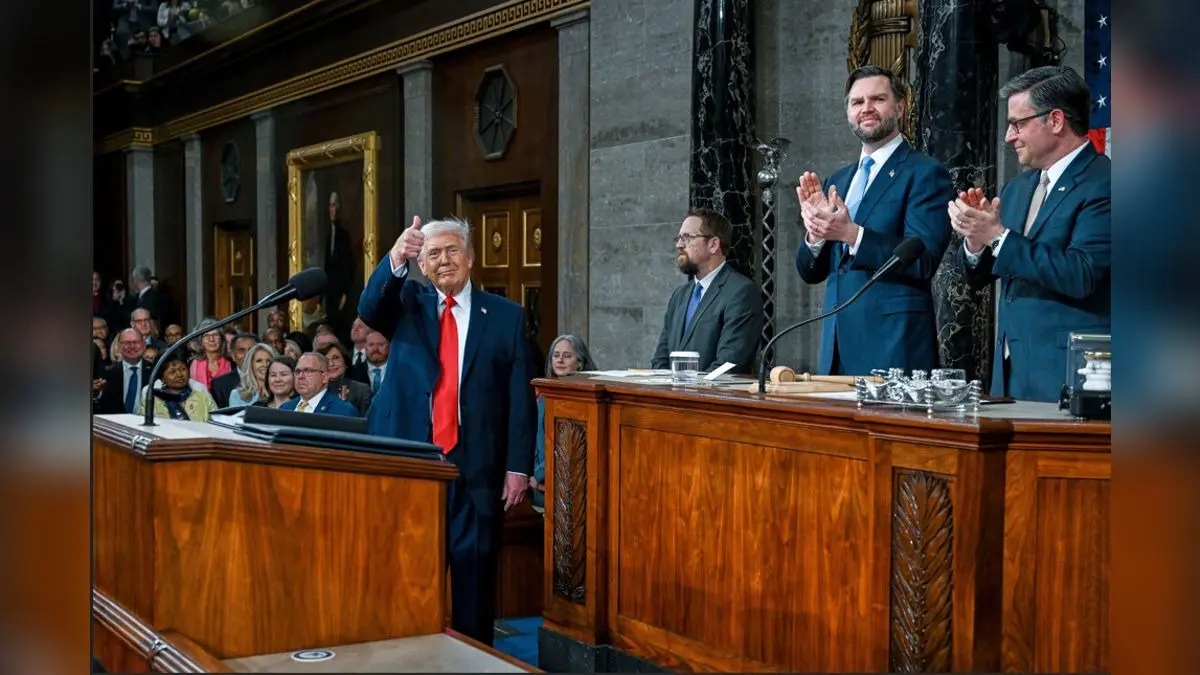
Washington, Feb 2026 : Opening his State of the Union address on Tuesday with a sweeping declaration that “this is America’s Golden Age,” US President Donald Trump sought to project confidence and momentum for his presidency and the Republican Party at a time of growing political turbulence at home and abroad.
Entering the chamber to loud chants of “USA, USA” from Republican lawmakers, Trump told Congress and a national television audience that “our country is back—bigger, better, richer and stronger than ever before.” The line set the tone for a speech aimed at reassuring voters, rallying party loyalists, and reframing a presidency facing declining approval ratings, economic anxiety, and intensifying geopolitical challenges.
This year’s address carried unusually high stakes. With midterm elections scheduled for November, Americans grappling with the rising cost of living, and concerns mounting over Iran and global instability, the prime-time speech offered Trump a crucial opportunity to persuade voters to keep Republicans in power. It was his second address to Congress since returning to the White House 13 months ago, but one delivered under far more difficult circumstances.
In the days leading up to the speech, the administration had suffered a major setback when the Supreme Court of the United States struck down Trump’s signature global tariff system. Fresh economic data also showed that growth had slowed more than expected while inflation had ticked upward, undermining the president’s repeated claims of an economic resurgence. At the same time, the Department of Homeland Security was largely shut down amid sharp disagreements between Republicans and Democrats over the administration’s aggressive immigration policies, following a deadly shooting of two American citizens in Minneapolis.
Adding to the pressure, Trump has been struggling to distance himself from renewed controversy linked to convicted sex offender Jeffrey Epstein. Opposition Democrats invited several individuals to attend the speech who have accused Epstein of misconduct involving Trump, keeping the issue firmly in the public spotlight.
Public opinion polls paint a challenging picture. A recent Reuters/Ipsos survey found that six in ten Americans—including 30 per cent of Republicans—believe the 79-year-old president has become increasingly erratic with age. Only 40 per cent of respondents approved of his job performance, while 58 per cent disapproved. These numbers underscore the uphill battle Trump faces as he seeks to reassert control over the political narrative.
Foreign policy loomed large over the address. Trump, who has openly expressed his desire to win a Nobel Peace Prize and has created what he calls a “board of peace,” appears increasingly close to a potential military confrontation with Iran over its nuclear programme. Tuesday’s speech marked his first major opportunity to make a public case for military intervention, should he choose that path. White House officials, speaking on condition of anonymity, said Trump would outline his approach while highlighting what he describes as his record of brokering peace deals, though they offered few details.
The timing was also symbolic. Tuesday marked the fourth anniversary of Russia’s invasion of Ukraine, a conflict Trump once claimed he could resolve within 24 hours. That promise remains unfulfilled, a reminder of the limits of US influence and the complexity of global crises. The ongoing war has continued to strain transatlantic relations and global markets, further complicating Trump’s foreign policy agenda.
Domestically, expectations were high that Trump would address the Supreme Court’s tariff ruling directly. Allies anticipated that he would argue the court had erred and signal alternative legal pathways to reimpose many of the levies. His angry reaction to the decision last week, which included personal attacks on several judges, had already stirred controversy. Repeating such rhetoric on Tuesday risked creating awkward moments, especially with four of the court’s nine justices present in the chamber.
Behind the scenes, White House aides and Republican campaign strategists—acutely aware of the looming midterms—had urged the president to focus squarely on Americans’ economic concerns. Trump’s 2024 election victory rested heavily on promises to reduce household costs and restore affordability. Yet opinion polls suggest many voters remain unconvinced that his policies have delivered tangible relief.
Staying on message has been a persistent challenge for Trump. While he frequently touts economic success, his public remarks often drift into lengthy grievances before circling back to claims that problems have already been solved. A senior White House official said the president would “declare victory on the economy,” pointing to stock market gains, increased private-sector investment, and his tax-cut legislation as evidence that his policies have strengthened growth.
Trump also reiterated his hardline stance on immigration, promoting strict border controls and an expansive deportation campaign. This comes despite polling that indicates a majority of Americans believe his administration has gone too far in targeting undocumented immigrants. Nonetheless, the president appears determined to make border security a central pillar of his re-election messaging, betting that firmness will resonate with his base.
Throughout the address, Trump sought to strike a balance between celebration and defiance—celebrating what he called a national revival while pushing back against critics, courts, and political opponents. Whether his declaration of a “Golden Age” will convince a sceptical electorate remains uncertain. With economic pressures persisting, foreign policy crises unresolved, and political divisions deepening, the speech underscored both Trump’s confidence and the formidable challenges that lie ahead for his presidency and his party.
(The content of this article is sourced from a news agency and has not been edited by the Mavericknews30 team.)





Tripura: Government Implements People Centric Governance ‘Mukhyamantri Samipeshu’.
Agartala; June 2026: The Tripura government’s flagship public outreach initiative, &…

Tripura: Government Implements People Centric Governance ‘Mukhyamantri Samipeshu’.
Agartala; June 2026: The Tripura government’s flagship public outreach initiative, “Mukhyamantri Samipeshu”, has emerged …