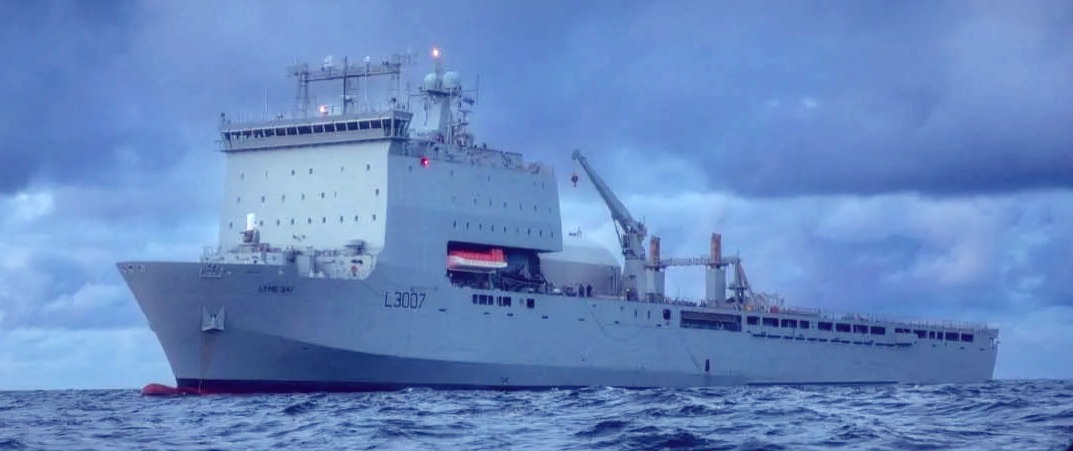
UK Prepares Mine-Clearing Vessel For Possible Strait Of Hormuz Deployment.

London; March 2026: Britain is preparing to deploy a Royal Navy evacuation vessel to the Strait of Hormuz, equipped with a fleet of autonomous drones designed for mine detection and clearance, according to official sources.
Last week, ministers said RFA Lyme Bay, an amphibious landing vessel currently undergoing routine maintenance in Gibraltar, would be sent to the Mediterranean for training exercises. However, sources indicated that John Healey, the UK’s defence secretary, has authorised contingency plans for the 580-foot Bay-class ship to be sent to the Strait of Hormuz to support mine-clearance efforts.
According to the report, RFA Lyme Bay will be equipped in Gibraltar with autonomous mine-clearance systems, including underwater drones and mine-hunting boats, allowing it to serve as a mothership for seabed scanning and mine disposal operations.
A defence source told that “no decision” had yet been taken on deployment to the Strait of Hormuz, adding: “This preventative step gives ministers options should they be needed to help resume the normal flow of merchant shipping”.
It was previously informed that the Royal Navy Mine and Threat Exploitation Group drones already in the region were being considered for deployment, with the unit expected to support resources aboard RFA Lyme Bay, which can carry up to 500 troops and includes onboard medical and weapons systems.
Trump said this month he was “not happy” with the UK’s response to the Middle East crisis, adding that Britain “should be involved enthusiastically” in efforts to reopen the Strait of Hormuz.
A US amphibious assault vessel carrying thousands of expeditionary forces has arrived in the Middle East, US Central Command said yesterday (local time). “US Sailors and Marines aboard USS Tripoli (LHA 7) arrived in the US Central Command area of responsibility, March 27”, CENTCOM said in a statement.
The RFA Lyme Bay is capable of putting troops, vehicles, stores and ammunition ashore using landing craft or Mexeflote powered rafts from her floodable loading dock, or helicopters using the flight deck, RFA Lyme Bay is one of the most versatile vessels in the Fleet.
She can carry up to 200 tons of equipment/supplies/vehicles, as large as a Challenger 2 tank, while there is space on board to accommodate more than 350 troops, and as many as 700 on a short-term basis.
The ship is able to sustain Royal Marines amphibious operations and exercises, support NATO missions, deliver humanitarian aid and provide wide-ranging support and assistance following disasters when needed around the globe.
Captain Mark Colley, the Commanding Officer of Lyme Bay has today informed that: “the RFA is a crucial support arm of the Royal Navy and being able to act as an MCM mothership once again shows how we can adapt to the operational demand where needed”.
The Royal Navy is stepping up its mine hunting capabilities with new cutting-edge uncrewed equipment being added to RFA Lyme Bay in the coming days. The high-tech equipment will be able to detect, identify and neutralise threats and is part of the Royal Navy’s transition to a ‘hybrid navy’. The move comes after RFA Lyme Bay was brought to heightened readiness several weeks ago.
After being fitted with the technology, Lyme Bay will be able to store, prepare, deploy and recover a variety of autonomous and crewless technology, from underwater drones to mine hunting boats, acting as a crewed ‘mothership’ for drone tech.
First Sea Lord, General Sir Gwyn Jenkins, said: “RFA Lyme Bay preparing for a possible mine hunting mothership role is a perfect example of how we are building a Hybrid Navy, one where crewed ships and cutting-edge uncrewed systems work together seamlessly to keep our people safe and our seas secure.
“Mine countermeasures have always been vital work, and by harnessing autonomous technology we are ensuring the Royal Navy remains at the forefront of underwater defence. I am proud of everyone involved in making this capability a reality”.
With a plug-and-play Command and Control system, the technology can be deployed where needed and the RFA ship makes an ideal base for future MCM operations.
While at the Rock, Lyme Bay will also undergo inspections to ensure she is ready for more time at sea.
Captain Mark Colley, the Commanding Officer of Lyme Bay, added: “The RFA is a crucial support arm of the Royal Navy and being able to act as an MCM mothership once again shows how we can adapt to the operational demand where needed. I am proud of the work my ship’s company has done to prepare RFA Lyme Bay, and be ready to embark this kit. Having recently returned to high readiness, we have been put through our paces but I know we are ready to support this autonomous uncrewed kit so as to play an important role in its use”.
The Royal Navy’s use of autonomous and uncrewed mine hunting kit comes as it continues to forge ahead with its bold ambitions of a Hybrid Navy, where crewed and uncrewed systems operate seamlessly together on the front line.
The Strait of Hormuz has been effectively disrupted since early March. Around 20 million barrels of oil normally pass through it daily, and the disruption has driven up shipping costs and pushed global oil prices higher.
Team Maverick.






Trump Says Netanyahu May Visit White House Soon as US Pushes to Reset Middle East Strategy
Washington, July 2026 : US President Donald Trump has indicated that Israeli Prime Ministe…

Trump Says Netanyahu May Visit White House Soon as US Pushes to Reset Middle East Strategy
Washington, July 2026 : US President Donald Trump has indicated that Israeli Prime Minister …