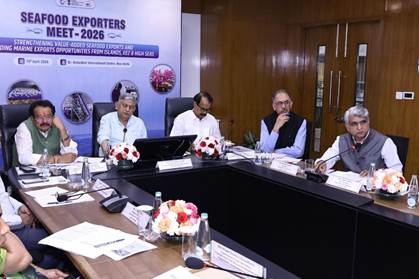
Rajiv Ranjan Singh Chairs Seafood Exporters Meet 2026 in New Delhi; Chart Strategy to Expand Global Market Reach

“India to Scale Up Value‑Added Seafood Exports and Tap Marine Potential from EEZ and High Seas”
“India’s seafood exports have crossed a new milestone, growing from ₹62,000 crore last year to approximately ₹68,000 crore this year, reflecting a net increase of about ₹6,000 crore”
The Department of Fisheries under the Ministry of Fisheries, Animal Husbandry & Dairying organized a Seafood Exporters Meet 2026 at Ambedkar Bhawan, New Delhi. The meet was graced by Union Minister, Ministry of Fisheries, Animal Husbandry & Dairying (MoFAH&D) and Ministry of Panchayati Raj (MoPR), Shri Rajiv Ranjan Singh along with Minister of State, MoFAH&D and MoPR Prof. S.P. Singh Baghel and Minister of State, Shri George Kurian, MoFAH&D and Ministry of Minority Affairs. The meet was organised to provide a structured platform for interaction between the Government and industry stakeholders and to obtain feedback from exporters on current challenges related to market access, pricing pressures and compliance requirements, and to deliberate on measures required for enhancing value addition, market diversification and marine export expansion from islands, EEZ and high seas.
Union Minister Shri Rajiv Ranjan Singh appreciated and congratulated exporters for their efforts in enhancing seafood exports. Despite global uncertainties, he highlighted that India’s seafood exports have recorded robust growth, driven largely by strong performance in non‑US markets. Emphasising the need for sustained market and product diversification, Union Minister stressed the importance of strict regulatory compliance, including adherence to antibiotic bans and strengthened traceability systems. Referring to the EEZ Rules, he stated that the framework is being operationalised through Access Passes, with priority being accorded to cooperative societies to promote inclusive growth. He underscored the export potential of high‑value species such as tuna from the Andaman & Nicobar Islands, the EEZ and the high seas, and called for improved onboard handling, robust cold‑chain infrastructure, better packaging, value addition and the exploration of alternative markets to reduce post‑harvest losses and strengthen the export ecosystem. Exporters were also urged to work towards achieving the ₹1 lakh crore export target and adopt an open‑market approach, assuring support from institutions such as EIC, NCDC, NABARD and the Ministry of Food Processing Industries. He also referred to the Investors meet held in the Andaman & Nicobar Islands, which has led to investments aimed at strengthening the fisheries sector, particularly in areas such as sea‑cage culture, pearl farming and deep‑sea fishing vessels.
Hon’ble Minister of State for Fisheries, Animal Husbandry and Dairying & Minority Affairs, Shri George Kurian, stated that in line with the post‑Budget webinar 2026, concerted efforts are being made to position fisheries as a high‑value, high‑demand sector. Noting the encouraging growth in seafood exports, he appreciated exporters for their sustained efforts and emphasised that strict regulatory compliance, including traceability and certifications, along with strengthened logistics and value‑chain development, is essential to sustain export growth.
Dr. Abhilaksh Likhi, Union Secretary, Department of Fisheries, stated that focused market diversification strategy has been formulated in coordination with MPEDA, EIC, and the Department of Commerce. He highlighted that diplomatic engagement with Ambassadors from nearly forty countries has yielded encouraging responses, underscoring the need to complement market diversification with targeted products, particularly in ready‑to‑eat, ready‑to‑cook and value‑added seafood segments. The Department would facilitate direct linkages between exporters and Indian Missions abroad to promote seafood exports. MPEDA was urged to strengthen capacity‑building initiatives to support exporters and enhance compliance, competitiveness, and export readiness.
Stakeholders appreciated the proactive support from the government of India at the meeting and highlighted key challenges and opportunities in boosting seafood exports, including the need to streamline procedures for issuance of Catch Certificates, facilitation of permits for seaweed cultivation (Kappaphycus) in the Andaman & Nicobar Islands, and targeted support for fish‑meal manufacturers to scientifically develop and upscale production of high-quality fish feed meal. They also noted there is a need to explore and strengthen export potential of inland fisheries and mariculture in western Coast. Stakeholders also drew attention to several overarching challenges affecting seafood exports, including limited market access due to tariff and non‑tariff barriers, high compliance costs, gaps in value‑added processing capacity, cold‑chain and logistics constraints, and the need for stronger traceability and quality assurance systems.
The meeting was attended by officials from Marine Products Export Development Authority (MPEDA), National Fisheries Development Board (NFDB), Export Inspection Council (EIC), National Bank for Agriculture and Rural Development (NABARD), National Cooperative Development Corporation (NCDC), National Cooperative Exports Limited (NCEL), Ministry of Food Processing Industries (MoFPI), and other line Ministries. Representatives from export associations including the Seafood Exporters Association of India, Indian Marine Ingredients Association and Seaweed Association of India, along with industry representatives like Sea6 Energy Pvt. Ltd., Sashimi Foods Pvt. Ltd., Aquagri Processing Pvt. Ltd., Anemco Pvt. Ltd., Oceanic Horizon, cooperatives and exporters, also participated. The event saw participation of senior officials from the Department of Fisheries, Government of India, as well as Fisheries Departments of Odisha, Gujarat, Dadra & Nagar Haveli and Daman & Diu, Goa, Andaman & Nicobar Islands and Lakshadweep.
Background
India’s seafood exports have recorded strong and sustained growth, expanding at an average annual rate of 7% over the past 11 years. Marine product exports have more than doubled during the period, rising from ₹30,213 crore in 2013‑14 to ₹62,408 crore in 2024‑25, driven largely by shrimp exports valued at ₹43,334 crore.
India’s seafood exports span a wide and diversified basket, with over 350 varieties of products shipped to nearly 130 global markets. The United States remains the largest destination, accounting for 36.42% of total export value in 2024‑25, followed by China, the European Union, Southeast Asia, Japan and the Middle East, while other markets together account for about 9%. To reduce over‑dependence on a few commodities and deepen India’s presence in global seafood markets, the Government is actively pursuing diversification of the export basket. Under the Pradhan Mantri Matsya Sampada Yojana (PMMSY), the Department of Fisheries supports a wide range of interventions across the value chain, including quality fish seed production, expansion and diversification of brackish‑water aquaculture, promotion of export‑oriented species, technology adoption, disease management, traceability systems, and capacity building. Investments are also being made to strengthen post‑harvest infrastructure, seamless cold‑chain networks, modern fishing harbours and fish landing centres.


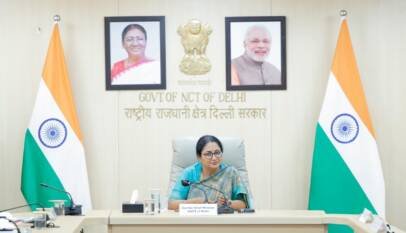

Chief Minister Rekha Gupta inaugurates ‘Arpan Kendra’ at Punjabi Bagh West Metro Station
‘Arpan Kendras’ being set up at 10 major Delhi Metro stations in collaboration with Delhi …
Chief Minister Rekha Gupta inaugurates ‘Arpan Kendra’ at Punjabi Bagh West Metro Station
‘Arpan Kendras’ being set up at 10 major Delhi Metro stations in collaboration with …