Iran Threatens Wider Blockade.

Tehran; April 2026: Iran escalated its rhetoric yesterday (15th April 2026) with the commander of its joint military command threatening to extend disruption far beyond the Strait of Hormuz unless Washington lifts its naval blockade of Iranian ports.
According to Iranian state media, Ali Abdollahi warned that Tehran would “act with strength to defend its national sovereignty and its interests”, threatening to completely block exports and imports across the Persian Gulf, the Sea of Oman, and the Red Sea, where it has allies in the form of the Houthis from Yemen. Abdollahi also declared the US blockade a “prelude to violating the ceasefire”.
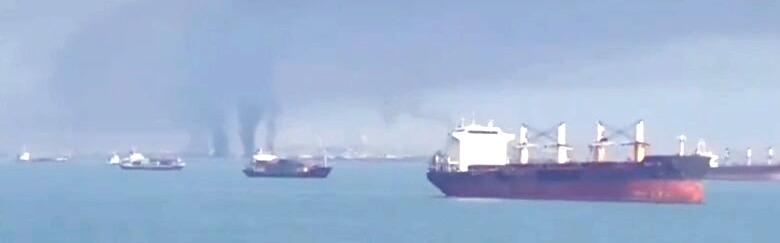
On the water, the picture remains murky on day 48 of one of the most disruptive shipping crises in modern history. Maritime intelligence firm Windward, tracking vessel behaviour through the strait, paints a picture of partial compliance and persistent evasion.
Vessel behaviour reflects hesitation, rerouting, and selective continuation. “Transit through the Strait remains limited and concentrated among sanctioned, falsely flagged, and high-risk vessels”, Windward noted, adding that “vessel behaviour reflects hesitation, rerouting, and selective continuation rather than full compliance. The operating environment is now defined by Windward as “active enforcement, partial compliance, and ongoing evasion”.
For the global bunkering industry, the crisis is forcing a structural reckoning. Adrian Tolson, newly appointed chair of the International Bunker Industry Association, acknowledged the gravity of the moment in his first statement in the role. “It is hard to conceive of a more challenging time in the marine fuel industry to take on the role of chair of IBIA”, he wrote, before arguing that what separates this crisis from previous geopolitical shocks is its structural character. “The potential for prolonged disruption, coupled with the vulnerability of the Straits of Hormuz, points to a shift in the landscape. More than any recent event, this conflict has exposed weaknesses within the global energy structure and, more specifically, within our own supply chain”.
Tolson was candid about the pressures that remain. “Prices are high and remain volatile,” he said, warning that some pricing and margins seen during the initial disruption stages were difficult to justify.
In Washington, the Treasury Department intensified its so-called Operation Economic Fury, sanctioning more than two dozen individuals, companies, and vessels linked to the network of Iranian oil shipping magnate Mohammad Hossein Shamkhani.
Treasury secretary Scott Bessent said the administration was “moving aggressively with Economic Fury by targeting regime elites like the Shamkhani family”. The action targeted a web of UAE-based front companies – including Oriel Group, House of Shipping Investment FZCO, and Meritron DMCC, alongside multiple tankers transporting Iranian and Russian petroleum products.
Team Maverick.




India Aims to Build a World-Class Drone Ecosystem as Defence Reforms Accelerate Innovation
New Delhi, July 2026 : Defence Secretary Rajesh Kumar Singh has said that building a globa…
India Aims to Build a World-Class Drone Ecosystem as Defence Reforms Accelerate Innovation
New Delhi, July 2026 : Defence Secretary Rajesh Kumar Singh has said that building …