Delhi Schools Shift Online Amid GRAP-IV Restrictions

In a decisive response to worsening air pollution in Delhi, Chief Minister Atishi announced on Sunday evening that all physical classes, barring those for students in Classes 10 and 12, would be discontinued from November 18. The directive, necessitated by the imposition of Stage IV of the Graded Response Action Plan (GRAP), mandates schools to transition to online learning until further notice.
“With GRAP-4 taking effect tomorrow, physical classes for all students, except those in Classes 10 and 12, will be suspended. Schools will conduct online classes as a precautionary measure,” the Chief Minister stated in a post on X. This announcement came after the Commission for Air Quality Management (CAQM) activated the stringent Stage-IV measures under GRAP due to the rapid deterioration of air quality in Delhi-NCR.
Alarming AQI Levels in Delhi
The decision followed an emergency meeting convened by the Sub-Committee for operationalizing GRAP. Delhi’s daily Air Quality Index (AQI) recorded alarming levels of 441 at 4 p.m. on Sunday, climbing to 457 by 7 p.m., according to the Central Pollution Control Board (CPCB). The rise was attributed to unfavorable meteorological conditions, which exacerbated pollution levels.
During the meeting, experts from the India Meteorological Department (IMD) and Indian Institute of Tropical Meteorology (IITM) provided forecasts highlighting continued deterioration in air quality. Observing the escalating AQI, the Sub-Committee decided to enforce Stage-IV restrictions starting 8 a.m. on November 18 to prevent further aggravation of the pollution crisis.
Stage-IV GRAP Measures Enforced
Stage-IV GRAP, referred to as the ‘Severe+’ air quality stage, is implemented when AQI levels exceed 450. This stage includes an eight-point action plan aimed at curbing pollution across Delhi-NCR. Key measures include:
- Truck Entry Restrictions: Only trucks carrying essential goods or using clean fuels (LNG, CNG, BS-VI diesel, or electric) are permitted to enter Delhi.
- Vehicle Bans: Diesel-operated medium and heavy goods vehicles (MGVs and HGVs) registered under BS-IV or earlier standards are prohibited, except for those engaged in essential services.
- Construction and Demolition (C&D) Ban: Linear public projects such as highways, roads, flyovers, and power transmission are halted, extending the restrictions under Stage-III GRAP.
- Workforce Management: NCR state governments and the GNCTD are advised to reduce workforce attendance in public, municipal, and private offices to 50%, with the remainder working remotely.
- Additional Measures: Central and state governments are encouraged to consider emergency actions, including closing educational institutions, halting non-essential commercial activities, and implementing odd-even vehicle rationing schemes.
Impact on Daily Life
The restrictions also come with an appeal to citizens to follow GRAP guidelines, emphasizing the Citizen Charter, which promotes responsible practices to mitigate pollution. Vulnerable groups, including children, the elderly, and those with chronic illnesses, are advised to minimize outdoor activities and stay indoors as much as possible.
Delhi’s air quality crisis has disrupted regular life, with the city choking under hazardous pollution levels for the fifth consecutive day. The suspension of physical classes marks a significant step in safeguarding students’ health. While online classes for all grades, except Classes 10 and 12, are mandated, authorities have left room for state governments in NCR to decide on further suspensions for grades 6-9 and 11.
Broader Implications of GRAP
The GRAP framework, initially developed as a response to Delhi’s recurrent air quality challenges, involves tiered measures corresponding to specific AQI levels. Stages I through IV are implemented progressively, with Stage-IV representing the most severe response.
Beyond educational institutions, the restrictions aim to curb pollution through coordinated efforts involving multiple stakeholders, including pollution control boards and state governments. By limiting vehicular emissions, halting construction activities, and managing workforce density, GRAP-IV seeks to address the immediate triggers of pollution while setting a precedent for stringent environmental action.
Collective Responsibility
As Delhi grapples with the ongoing air quality crisis, CAQM underscores the importance of community participation. Citizens are urged to comply with the prescribed measures, such as reducing personal vehicle use, opting for public transport, and avoiding activities that contribute to pollution. These collective efforts are crucial to mitigating the health risks associated with prolonged exposure to toxic air.
The escalating pollution levels underscore the urgent need for sustainable solutions to Delhi’s air quality issues. While emergency measures under GRAP-IV offer short-term relief, the crisis highlights the need for long-term strategies to combat pollution, including transitioning to cleaner energy sources, promoting public transportation, and implementing stricter emission norms.
Delhi’s proactive measures, including the suspension of physical classes and implementation of stringent restrictions, reflect the city’s commitment to protecting public health in the face of an environmental emergency. However, achieving lasting change will require collaborative efforts from governments, industries, and citizens alike.



Actor-Politician Vijay Files Nomination from Perambur Amid Massive Show of Support
Chennai, March 2026 : Actor-turned-politician Vijay on Monday filed his nomination papers …
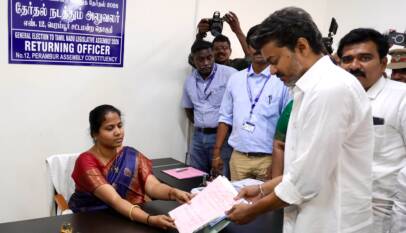
Actor-Politician Vijay Files Nomination from Perambur Amid Massive Show of Support
Chennai, March 2026 : Actor-turned-politician Vijay on Monday filed his nomination papers from the …