
Trump-Led Tariffs Shake Global Medical Device Market: Exports Decline, Imports Surge, and Costs Spiral

By Vijayraj Amin | Business Editor, MaverickNews30
Bengaluru : The global medical device industry is entering choppy waters as revived tariff actions under Donald Trump’s leadership drive up costs, unsettle supply chains, and deepen trade imbalances across key markets. The sector, critical to global healthcare systems, now finds itself at the center of a geopolitical tug-of-war.
At the heart of the disruption: tariffs on Chinese medical imports have climbed as high as 125%, targeting a wide range of components essential for manufacturing devices like imaging systems, surgical tools, and diagnostic kits.
India, one of the fastest-growing medical device markets, is already feeling the pinch. Between April 2023 and January 2024, medical device exports fell 5.3%, sliding from ₹21,428 crore to ₹20,287 crore, while imports surged by 8.8% to ₹52,346 crore, according to official commerce ministry data. Industry players warn that this growing gap is threatening India’s aspirations for self-reliant manufacturing in the sector.
Global multinationals are facing parallel challenges. Thermo Fisher Scientific has flagged a potential $400 million revenue hit from declining Chinese sales—previously accounting for 8% of its business. Boston Scientific anticipates a $200 million shortfall amid supply chain stress. Meanwhile, shares of key players including Medtronic, Bausch & Lomb, and Siemens Healthineers have dipped, with analysts projecting up to a 13.8% decline in EPS for some companies if the tariffs hold.
Industry associations, including AdvaMed, are lobbying for critical exemptions, arguing that humanitarian sectors should be shielded from the brunt of trade retaliation. Despite precedent for such exclusions, the current approach appears to be sweeping, leaving little room for nuance.
In response, several companies are exploring new production hubs in Vietnam, Malaysia, and Mexico, while also assessing reshoring opportunities. However, shifting manufacturing footprints comes with added costs and time-consuming regulatory recalibrations.
With global demand for medical innovation rising and healthcare systems under pressure, the device sector now finds itself navigating a high-stakes trade environment—one where political agendas may end up driving the cost of patient care.








PM Modi, Australian Opposition Leader Angus Taylor Reaffirm Bipartisan Commitment to Stronger India-Australia Ties
Melbourne, July 2026 : Prime Minister Narendra Modi on Friday met Australian Opposition Le…
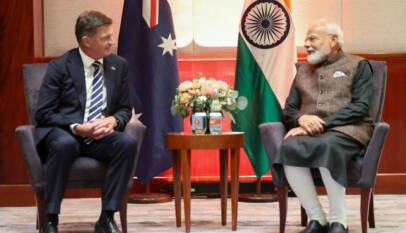
PM Modi, Australian Opposition Leader Angus Taylor Reaffirm Bipartisan Commitment to Stronger India-Australia Ties
Melbourne, July 2026 : Prime Minister Narendra Modi on Friday met Australian Opposition Leader …