Showcasing India’s Ancient Glory, History, and Culture through the Book ‘Khajinyachi Shodhyatra’ – CM Devendra Fadnavis

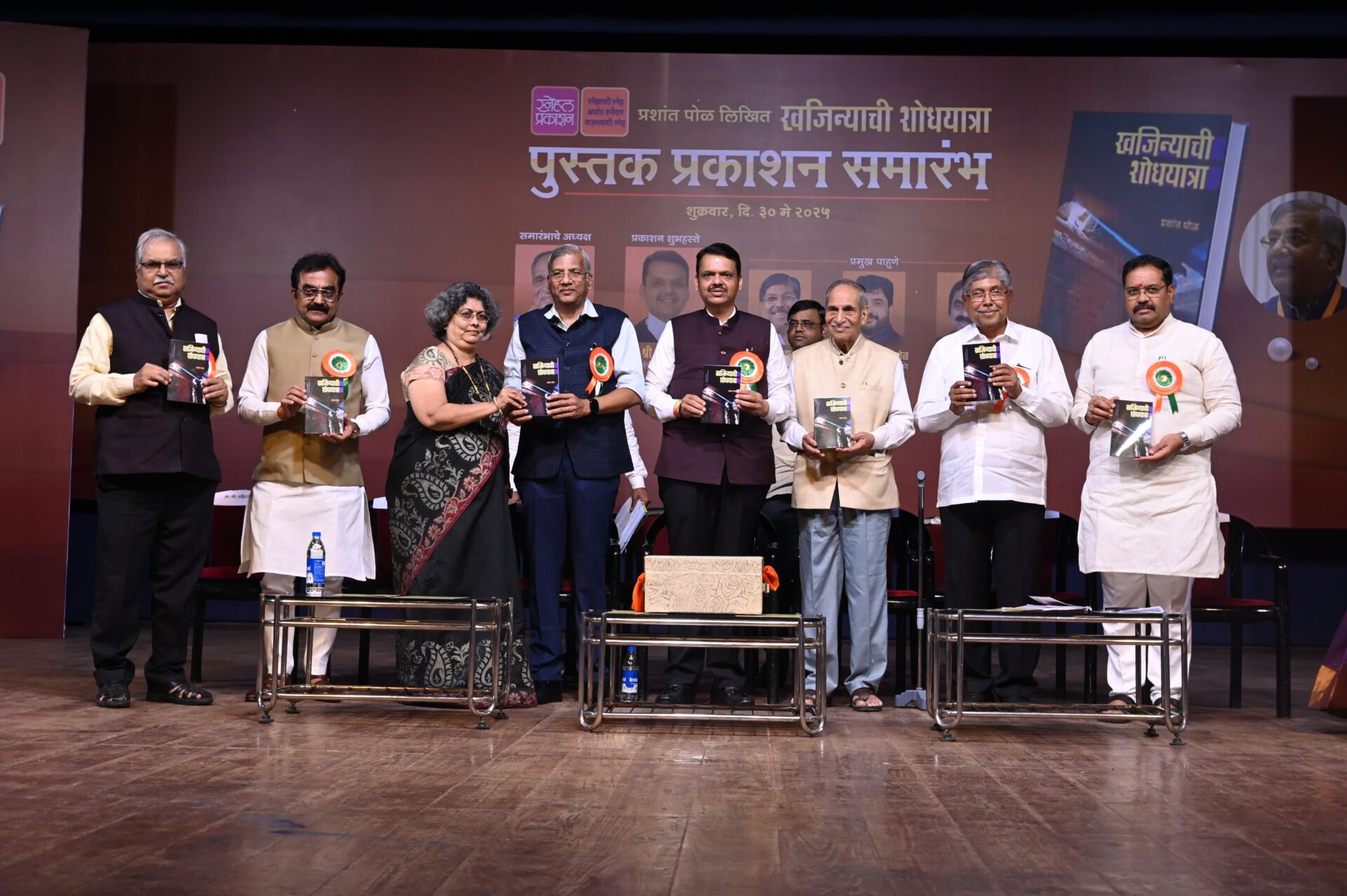
Pune : Chief Minister Devendra Fadnavis stated that ‘Khajinyachi Shodhyatra’ (The Treasure Hunt), authored by Prashant Pol, is a result of extensive research and study. The book presents India’s ancient grandeur, history, and culture in a compelling manner. He assured that the government would strive to ensure the book reaches a wide readership. “Through this book, a vast treasure of knowledge will be made available to the people,” he remarked.
CM Fadnavis was speaking at the launch event of ‘Khajinyachi Shodhyatra’, held at Bal Gandharva Rang Mandir. The event was graced by Higher and Technical Education Minister Chandrakant (Dada) Patil, Madhya Pradesh Public Works Minister Rakesh Singh, temple architecture and iconography scholar Dr. Go. Bn. Deglurkar, Snehal Publications’ Ravindra Ghatpande, and Rajesh Pandey, Director of National Book Trust and chief organizer of the Pune Book Festival.
Congratulating Prashant Pol on his work, Fadnavis said, “Preserving our history, traditions, and culture is our responsibility. Foreign invaders tried to destroy our pride and identity, leading to centuries of subjugation. India was once a prosperous land; its riches and knowledge were looted and suppressed. For over 700 years, systematic efforts were made to destroy centers of knowledge, demolish symbols of our heritage, and impose foreign traditions upon us. As a result, generations grew up unaware of their glorious past, which contributed to India’s downfall into colonial rule.”
He added that various researchers have shown how Indian culture influenced other parts of the world, while other ancient civilizations faded away. India remains the only continuously living civilization. The book describes sites like Dholavira and Lothal, which showcase architectural concepts known even 6,000 years ago—long before such ideas emerged in Europe.
“At a time when Europe lacked a clear concept of culture, ours was already flourishing. We had a sophisticated language like Sanskrit and a rich tradition of learning. This is not only the Indus Valley Civilization but also the Saraswati Civilization—both materially and spiritually rich. In the first century, India held 33% of the global trade share. Our youth must know this history,” Fadnavis emphasized.
The book also highlights India’s mathematical achievements and other milestones. “We’ve failed to properly study the Hindavi Swarajya and the Maratha Empire. Our cultural and intellectual heritage must be passed on. Even ancient Ayurvedic texts require renewed research. This book will guide readers and continue the journey of rediscovering knowledge,” he added.
Minister Chandrakant Patil said that to restore India’s position as a ‘Vishwaguru’ (global teacher), the importance of India’s knowledge traditions must be recognized. That is why the new education policy emphasizes integrating Indian knowledge systems. He also noted that the book describes India’s historic trade prosperity and introduces readers to many new insights.
Madhya Pradesh Minister Rakesh Singh remarked that as Indian culture is being revived, books like this bring the nation’s history closer to the people. “This book is a call to reconnect with India’s cultural greatness. Thanks to writers like Prashant Pol, we can experience this heritage. His writing reflects both sincerity and deep respect for Indian traditions. I am confident the book will be published in multiple Indian languages and reach readers across the country,” he said.
Dr. Deglurkar stated, “Indian culture is the world’s first culture, and it evolves with society. It is fluid and ever-flowing. We’ve presented the wisdom of the Vedas, Upanishads, and Bhagavad Gita to the world. Yet we often fail to recognize the richness of our thought. Reviving this ancient knowledge will undoubtedly lead to India’s renaissance.”
Prashant Pol noted that his earlier book ‘Bharatiya Dnyanacha Khajina’ (The Treasure of Indian Knowledge), published in 2017, received overwhelming response in government libraries. “Indian thinkers once led many fields of knowledge. Unfortunately, many discoveries attributed to foreign researchers had already been made in India, but were never credited. As we work towards becoming a ‘Vishwaguru,’ we must be aware and proud of our rich heritage and traditions,” he said.
Rajesh Pandey also spoke on the occasion, stating that the book ‘Khajinyachi Shodhyatra’ is based on India’s glorious past and will be well-received in Pune, a city known for its love of books.
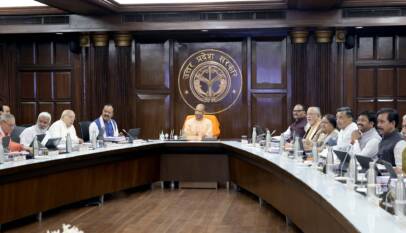
Wheat procurement to begin from March 30; CM Yogi sets a target of 5 million metric tonnes
Wheat will be procured at an MSP of ₹2585 per quintal, an increase of ₹160 per quintal com…
Wheat procurement to begin from March 30; CM Yogi sets a target of 5 million metric tonnes
Wheat will be procured at an MSP of ₹2585 per quintal, an increase of …