China penetrates deep into South Korean waters.

Satellite photos reveal China is using the cover of global turmoil to push its boundaries deeper into neighbouring territory. When the world’s eyes are focused on Ukraine, Gaza and Iran. South Korea has been contending with the fallout of a failed presidential coup. Meanwhile, Beijing has anchored an enormous deep-sea platform in the disputed waters of the Yellow Sea. And it won’t let Seoul get a close look.
China insists it is a service centre for surrounding caged aqua farms, while South Korea, has its doubts.
“We are treating this issue with utmost seriousness from the standpoint of protecting our maritime territory”, Korean Minister of Oceans and Fisheries Kang Do-hyung told reporters.
The whole of the International security analysts has delved into it to understand the reason & objectives with which China has penetrated into Korean waters. “While available information suggests that the platforms are genuinely focused on aquaculture, concerns that the platforms may be dual-use are not unfounded, given China’s track record in the South China Sea”, a new report by the Asia Maritime Transparency Initiative (AMTI) states.
Beijing insisted in 2015 that its massive building campaign in the Spratly Islands was to establish weather stations and air-sea rescue facilities to serve commercial shipping in the area. Why these humanitarian roles require missile launchers, anti-aircraft guns, military-grade piers and runways, hardened hangars, ammunition bunkers, and barracks remains unexplained. The new structure is in waters previously agreed to be shared until arbitration under the United Nations Convention on the Law of the Sea (UNCLOS) decided who owned what. That agreement, however, now appears surplus to Beijing’s needs.
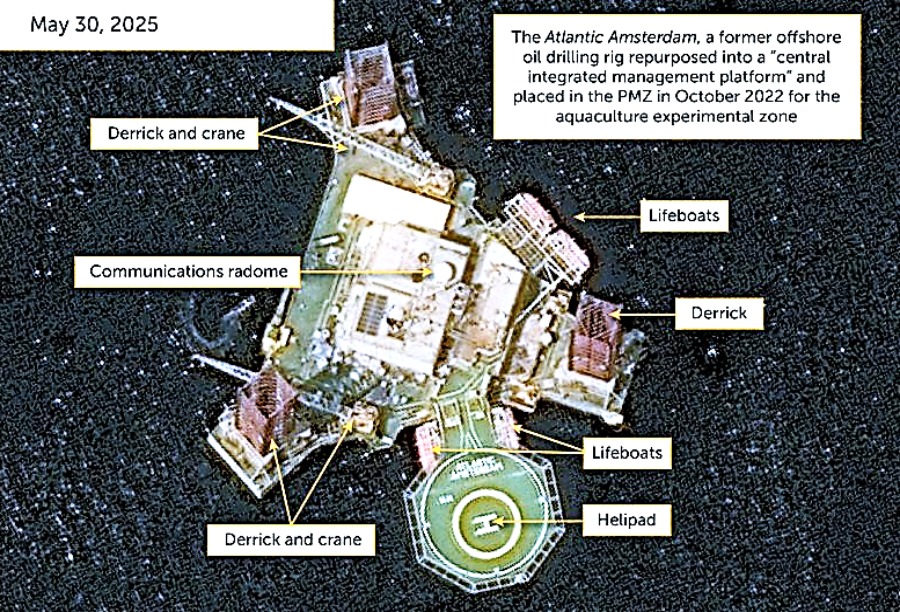
The hulking steel rig is called Atlantic Amsterdam. It was built for the offshore oil industry. It’s now supposed to be the front office of a Chinese fish farm complex. But it’s not the only structure Beijing has deployed in the supposedly shared Provisional Measures Zone (PMZ). Two giant steel aquaculture cages are fattening and harvesting fish.
“Even without further expansion, the platforms are likely already collecting data that could have value for undersea navigation and detection”, Centre for Strategic and International Studies (CSIS) analysts Jennifer Jun and Victor Cha assess in the AMSTI report.
The 85m wide, six-storey high structure can accommodate more than 100 people. That’s far beyond what’s needed for its stated “central integrated management” role – if limited to aquaculture.
Chinese state-controlled media touts the facility as including a marine science laboratory, research centre, production management facilities, and tourist accommodations. With the platform as the landing point, more cages can be built around it, the scale of deep-sea aquaculture can be continuously expanded.
However, Seoul isn’t convinced. “China’s method of installing the (Atlantic Amsterdam) structure is similar to its tactic of creating artificial islands in the South China Sea”, People Power Party MP Kweon Seong-dong told Korea Herald.
A Stanford University’s SeaLight maritime security research project satellite photo assessment found the Atlantic Amsterdam was anchored in the disputed territory in October 2022. It replaced a much smaller rig placed there two years earlier. South Korea has, until recently, kept its concerns about China’s expanding infrastructure to itself. News of the increasing tensions only emerged in last April.
That was when details of a February high seas clash between South Korean and Chinese Coast Guard vessels became public.
The South Korean fisheries research vessel Onnuri was sent into the PMZ to verify Chinese accounts of its new fish farm. But it sits within a treaty “grey zone”. “While ships from both sides are allowed to fish within the PMZ, aquaculture is entirely unmentioned by the 2001 fisheries agreement”, AMTI states. “This leaves an ambiguity that will make it difficult for Seoul to convince Beijing to remove the platforms”
It appears Beijing believes the structure falls outside the scope of Exclusive Economic Zone (EEZ) definitions, and its PMZ compromise with Seoul. China’s Chairman, Xi Jinping, wants South Korea to “inject more certainty into the chaotic regional and international situation. Respecting each other’s core interests and major concerns will help maintain the right course of bilateral relations and ensure steady progress”, he said in a statement.
“A healthy, stable, and continuously deepening China-South Korea relationship aligns with the trends of the times, serves the fundamental interests of both peoples, and contributes to regional and global peace, stability, and prosperity”. South Korea President Lee Jae-Myung has indicated compliance, stating he sought “pragmatic diplomacy” after years of Seoul “unnecessarily antagonising” Beijing.
Team Maverick







End of an Era: Cristiano Ronaldo Bids Farewell to the FIFA World Cup After a Record-Breaking International Career
Dallas, July 2026 : One of football’s greatest chapters came to a close on Tuesday a…

End of an Era: Cristiano Ronaldo Bids Farewell to the FIFA World Cup After a Record-Breaking International Career
Dallas, July 2026 : One of football’s greatest chapters came to a close on …