Scientific Marvels beyond Limits.

Within the infinite canvas of existence, consciousness reigns supreme. This mysterious force exhibits a dynamic quantum power that transcends the ordinary human understanding. Like a cosmic conductor, consciousness orchestrates the symphony of reality, vibrating the quantum fabric of time and space, shaping our experiences and perceptions in ways unimaginable. Embarking upon a riveting journey into the boundless realms of consciousness, examining its unmatched power, humans today have successfully taken a giant leap into the outer space, along with delving into the bottom most part of the oceans.
Today, when super powers exhibits their supremacy by threating to eradicate the opponent’s ultra-tech ammunitions within seconds, scientists are also relentlessly engaged in the development of indigenous tools for the magnitudal development of humanity.
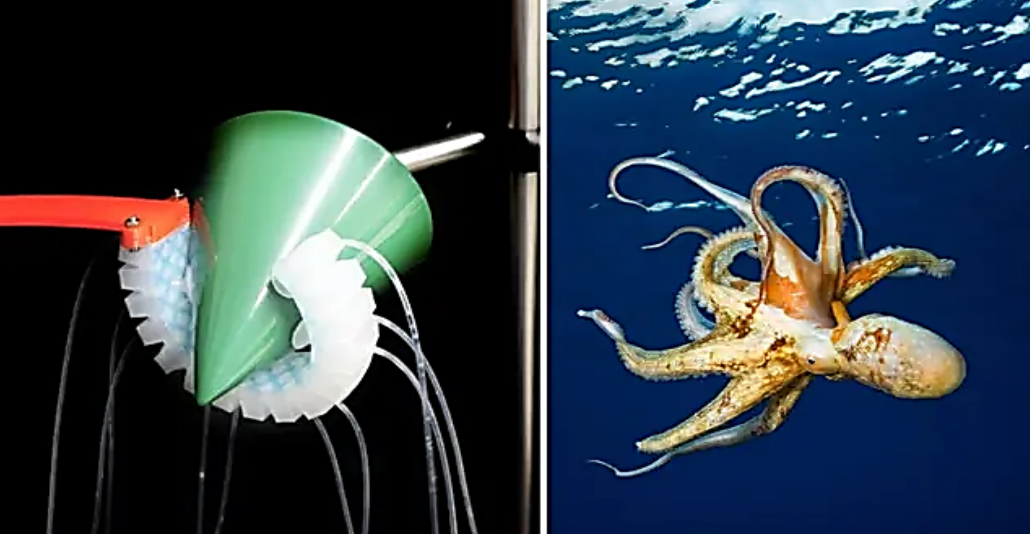
Scientists have developed a robot that can decide how to move or grip objects by sensing its environment. The device is inspired by octopus’ nervous system to grab items by sensing them.
Developed by researchers from the University of Bristol’s Faculty of Science and Engineering, the soft robot can use suction flow not just to stick to things, but also to sense its environment and control its own actions—just like an octopus. Researchers revealed that a single suction system enables the robot to grab delicate items, sense whether it’s touching air, water, or a rough surface, and even predict how hard something is pulling on it—all at once, without needing a central computer.
Octopuses exploit an efficient neuromuscular hierarchy to achieve complex dexterous body manipulation, integrating sensor-rich suckers, in-arm embodied computation, and centralized higher-level reasoning. Here, we take inspiration from the hierarchical intelligence of the octopus and demonstrate how, by exploiting the fluidic energy and information capacity of simple suction cups, soft computational elements, and soft actuators, we can mimic key aspects of the neuromuscular structure of the octopus in soft robotic systems. The presented suction intelligence works at two levels: By coupling suction flow with local fluidic circuitry, soft robots can achieve octopus-like low-level embodied intelligence, including gently grasping delicate objects, adaptive curling, and encapsulating objects of unknown geometries, and by decoding the pressure response from a suction cup, robots can achieve multimodal high-level perception, including contact detection, classification of an environmental medium and surface roughness, and prediction of an interactive pulling force. As in octopuses, suction intelligence executes most of its computation within lower-level local fluidic circuitries, and minimum information is transmitted to the high-level decision-making of the “brain.” This development provides insights into octopus-inspired machine intelligence through low-cost, simple, and easy-to-integrate methods. The presented suction intelligence can be readily integrated into fluidic-driven soft robots to enhance their intelligence and reduce their computational requirement and can be applied widely, from industrial object handling and robotic manufacturing to robot-assisted harvesting and interventional health care.
Researchers have unveiled a cutting-edge facial expression synthesis technology that uses “waveform movements” to replicate natural gestures, including breathing, blinking, and yawning, as distinct wave patterns. “We can mimic key aspects of the neuromuscular structure of the octopus in soft robotic systems”, said researchers in the study.
“Last year, we had developed an artificial suction cup that mimicked how octopuses stick to rocks using soft materials and water sealing. This research brings that work on, from using a suction cup like an octopus sucker to connect to objects to using ‘embodied suction intelligence’ – mimicking key aspects of the neuromuscular structure of the octopus in soft robotic systems”, explained lead author Tianqi Yue.
Researchers highlighted that the presented suction intelligence works at two levels: By coupling suction flow with local fluidic circuitry, soft robots can achieve octopus-like low-level embodied intelligence, including gently grasping delicate objects, adaptive curling, and encapsulating objects of unknown geometries.
The study also revealed that by decoding the pressure response from a suction cup, robots can achieve multimodal high-level perception, including contact detection, classification of an environmental medium and surface roughness, and prediction of an interactive pulling force.
This simple and low-cost suction intelligence could lead to a new generation of soft robots that are safer, smarter and more energy-efficient. Potential uses include picking fruit gently in agriculture, handling fragile items in factories, anchoring medical tools inside the human body, or creating soft toys and wearable tools that can interact safely with people, according to a press release.
Team Maverick








India Make Two Changes for Must-Win Fourth T20I as Shreyas Iyer Opts to Bat Against England
Bristol, July 2026 : India made two significant changes to their playing XI as captain Shr…

India Make Two Changes for Must-Win Fourth T20I as Shreyas Iyer Opts to Bat Against England
Bristol, July 2026 : India made two significant changes to their playing XI as …