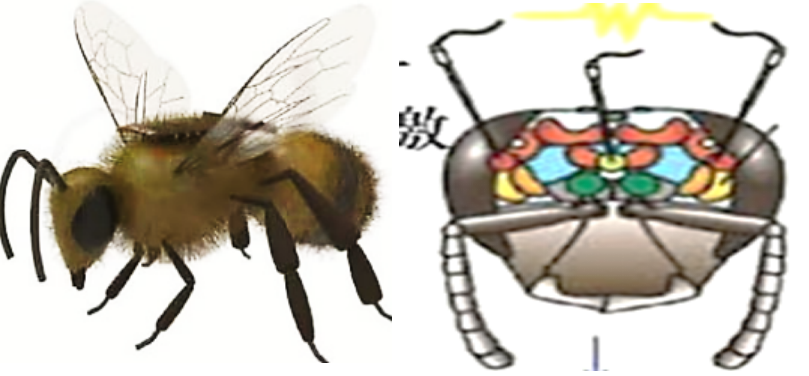
‘Ultra-Light’ Chinese Chip Turns Real Bees Into Flying Spy Robots.

Chinese scientists have developed a cyborg bee using a “brain controller” that weighs just 74 milligrams, lighter than the nectar bees typically carry. Engineered by Zhao Jieliang’s team at the Beijing Institute of Technology, the device mounts to the insect’s back and connects to its brain via three tiny needles, steering movement through electrical pulses.
It is printed on a flexible polymer film as thin as insect wings, yet houses full control modules, an all-including infrared remote. In lab tests, the bees with the microchip reportedly responded to flight commands like turning and forward movement with 90% accuracy. It has also outperformed a similar controller made in Singapore but over three times heavier, which had been tested on beetles and roaches but left them quickly fatigued.
Bees can fly up to 5 kilometres (3 miles) nonstop and cut drag mid-air by tucking their legs, making them ideal for longer missions. “Insect-based robots inherit the superior mobility, camouflage capabilities, and environmental adaptability of their biological hosts”, Zhao’s team wrote in a paper published in the Chinese Journal of Mechanical Engineering.
Built for Search and Surveillance –
The researchers tested nine pulse patterns on both bees and cockroaches. Roaches followed pre-programmed paths with little deviation, while bees responded accurately to directional commands.
But limitations remain. Bees still rely on wired power, and batteries light enough for flight are still too heavy for practical use. On the other hand, roaches tire after about 10 pulses. Signal consistency is another challenge, as stimulation can trigger different reactions across species, with bees’ legs and bellies proving less responsive.
Despite the technical hurdles, the team said the system could aid military operations such as urban surveillance, counterterrorism, and drug interdiction, while also offering potential for use in disaster zones. “Compared to synthetic alternatives, they demonstrate enhanced stealth and extended operational endurance”, the research paper stated.
To improve reliability, the research team plans to refine stimulation signals and add modules for navigation and environmental sensing. The cyborg bee could serve as military scouts or search for survivors in the ruins of an earthquake, according to a peer-reviewed paper. “Compared to synthetic alternatives, they demonstrate enhanced stealth and extended operational endurance, making them invaluable for covert reconnaissance in scenarios such as urban combat, counterterrorism and narcotics interdiction, as well as critical disaster relief operations”.
Team Maverick








End of an Era: Cristiano Ronaldo Bids Farewell to the FIFA World Cup After a Record-Breaking International Career
Dallas, July 2026 : One of football’s greatest chapters came to a close on Tuesday a…

End of an Era: Cristiano Ronaldo Bids Farewell to the FIFA World Cup After a Record-Breaking International Career
Dallas, July 2026 : One of football’s greatest chapters came to a close on …