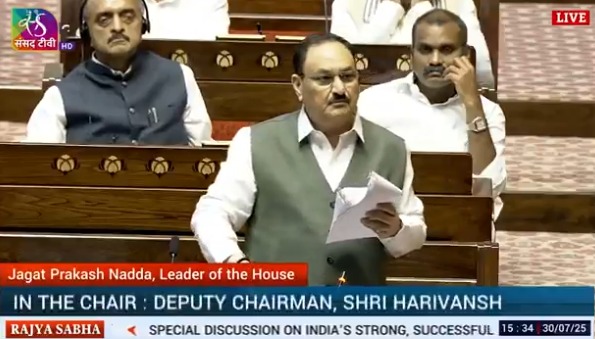
India’s National Security Transformed: Nadda Showcases ‘Sindoor Spirit’ in Rajya Sabha

New Delhi : Union Minister and Leader of the House Jagat Prakash Nadda delivered a powerful address in the Rajya Sabha on Wednesday during the debate on Operation Sindoor, drawing a stark contrast between the Congress-led governments from 2004–2014 and the Modi government from 2014–2025. He underscored how India’s approach to terrorism, national security, and military retaliation has undergone a “robust transformation” over the past decade.
“Operation Sindoor was carried out with unmatched precision and power,” Nadda said, informing the House that nine terrorist camps, including those in Bahawalpur, Sialkot, and Muzaffarabad, were destroyed in just 22 minutes. He added that the masterminds of the Pahalgam terror attack were eliminated in combined actions under Operation Mahadev and Operation Sindoor, dealing a decisive blow to major terror outfits such as Lashkar-e-Taiba, Jaish-e-Mohammed, and Hizbul Mujahideen.
For the first time, Nadda asserted, India has shown the world that “terrorism and dialogue cannot go hand in hand.” He praised the Indian Armed Forces and stressed that the key difference was the political will under Prime Minister Narendra Modi’s leadership.
Congress Governments Failed to Act
Nadda did not mince words in criticising the Congress governments of 2004–2014. “Between 2004 and 2014, 7,217 terrorist incidents occurred. From 2015 to 2025, that number fell sharply to 2,150, an 85% reduction,” he said. Civilian deaths also dropped by 70% (from 1,770 to 357), while terrorist casualties increased by 123%, he added.
He reminded the House of attacks during the Congress era: Jaunpur (2005), Varanasi (2006), serial bombings in Mumbai, Delhi, and Ahmedabad, culminating in the 26/11 Mumbai attacks. Despite mass casualties, Nadda alleged, Congress governments continued trade and cultural exchanges with Pakistan instead of retaliating.
“Sweets were piled while bullets streamed. Trade soared. They served biryani, we bled,” Nadda said, accusing the Opposition of appeasement and Muslim vote-bank politics. Stone-pelting incidents in Kashmir, he noted, had reduced from 2,654 annually before 2014 to zero, and shutdowns in the valley had fallen from over 130 days a year to none.
Decisive Retaliation Under Modi
Nadda highlighted India’s bold responses under the Modi government:
- 2016: Surgical strikes destroyed terror launch pads within three days of the Uri attack.
- 2019: The Balakot air strikes hit deep inside Pakistan just 11 days after Pulwama.
- 2025: Operation Sindoor, launched 13 days after the Pahalgam massacre, struck multiple airbases and terrorist camps with zero civilian casualties.
India achieved these operations using indigenously developed systems such as BrahMos, Pinaka rockets, radars, and advanced artillery. Defence self-reliance, Nadda said, has risen from 32% in 2014 to 88% today, demonstrating India’s leap in domestic military manufacturing.
“Not a single terrorist survived. No civilian was harmed. This is full-moon India—decisive and transparent leadership,” Nadda declared.
Global Support and the Indus Water Treaty
Nadda noted that India’s actions received unprecedented global backing. “After the Pahalgam attack, 61 global leaders, including foreign ministers and heads of state, condemned the attack. We had support from the UNSC, QUAD, BRICS, the EU, France, Germany, and others,” he said.
He also revisited the Indus Water Treaty, calling it a “historical mistake” signed in 1960 that granted excessive concessions to Pakistan. “This government has corrected that error by putting the treaty in abeyance. Blood and water cannot flow together,” Nadda stated.
Political Will as the Defining Difference
Nadda repeatedly emphasised that India’s enhanced security record stemmed not from changes in the army, police, or paramilitary forces, but from the political leadership’s will to act decisively.
He accused Congress governments of weakening terrorism laws and failing to hold Pakistan accountable. He reminded members of instances where Opposition leaders “honoured” terror mastermind Hafiz Saeed, ignored cross-border aggression, and prioritised electoral gains over national security.
“If you demand a debate on Pahalgam, first ask what the previous political leadership accomplished,” Nadda challenged the Opposition.
The ‘Sindoor Spirit’
Nadda urged all parliamentarians to adopt what he called the ‘Sindoor Spirit’, which symbolises Indian resolve, unity, and pride. He appealed for bipartisan support to build a stronger India:
“The nation is bigger than any party. Lend your support and together we will build a secure and resilient Bharat.”
His address concluded with a call for the Opposition to set aside political differences and take pride in the country’s achievements, whether in Parliament or on the battlefield.
“India has shown that the era of appeasement is over. This is a new India, decisive and self-reliant, where national interest reigns supreme,” Nadda said, drawing sustained applause from the treasury benches.


Spain Stun France 2-0 to Storm into World Cup Final; Oyarzabal, Porro Sink Les Bleus
Score: Spain 2 (Mikel Oyarzabal 20′ pen, Pedro Porro 58′) beat France 0 Arling…

Spain Stun France 2-0 to Storm into World Cup Final; Oyarzabal, Porro Sink Les Bleus
Score: Spain 2 (Mikel Oyarzabal 20′ pen, Pedro Porro 58′) beat France 0 Arlington …