India and CTBTO need each other.

Sept 2025 : A record participation at the hallowed halls of the Hofburg Palace unfolded at the CTBTO’s Science & Technology conference last week, where global experts transcended all boundaries to engage with each other. But India, which is estimated to have the third-largest scientific and technical manpower in the world, was conspicuously absent. Question is, why?
It appears that decades later, the conversation of nuclear test ban and transparency, which in many ways began in the capital city of India New Delhi, has changed course over time. And a lot has contributed to these shifting winds.
Global call-to-action transforms into a National call –
In 1954, the U.S. conducted a high-yield thermonuclear test called ‘Castle Bravo’; it’s resulted yield nearly three times the expected amount. Shortly after, thousands of miles away, free India’s first Prime Minister Jawaharlal Nehru delivered a thundering address at the Parliament’s Lower House, or Lok Sabha.
Nehru became the world’s first statesman to call for a nuclear test ban. He urged that nuclear powers of the world create a ‘standstill agreement’ – a critical step towards the long journey of nuclear disarmament. Much has changed in the next 20 years, and India’s stance has shifted. Rather, it was forced to shift under a strong geopolitical compass, often moved by the West.
Fresh out of its colonial identity and finding its footing in the world, New Delhi moved against it. In 1974, India conducted its first nuclear test. Codenamed ‘Operation Smiling Buddha’s the test triggered a hypocritical frown from the West. It marked a significant moment; making India the sixth country to possess nuclear weapons. More importantly, it was the first outside the permanent members of the UN Security Council to conduct such a test.
India did not stop its nuclear ambitions there. In 1998, the country conducted Pokhran-II, a second series of nuclear tests. For India’s leadership, the tests were an assertion of strategic autonomy.
India & CTBT: A relationship stuck in time –
Two years before India’s second nuclear test, the Comprehensive Nuclear Test Ban Treaty came into existence. In the year 1996, the CTBT was adopted by the United Nations General Assembly on 10th. September. But for the treaty to enter into force, it was decided on various factors that 44 countries are necessary to sign and ratify it.
Of those 44, there are 9 countries that have not ratified the treaty. Of these, there are 3, which have not even signed it. India, Pakistan & North Korea. The Pariahs. Of the three, North Korea is no surprise. Pakistan has chosen to be an observer state. But India, excluding itself, has long been a surprise for many stakeholders globally and domestically, too. One, an adversarial neighbour with a deeply connected past but a complicated co-existence ever since. The second is a country that has chosen to keep the world at arm’s length.
But India, with its global positioning and the growing bilateral relationships with countries around the world, it has segued away from this multi-lateral relationship of the CTBTO. There are several reasons:
- India has repeatedly called the Comprehensive Nuclear Test Ban Treaty an unequal one, biased towards the five recognised nuclear states, which do not include India. The country has also contested ambiguous language in several of the Treaty’s provisions. For one, the lack of clarity on sub-critical nuclear tests remains a strong point of contention even today. More recently, it appears to have only deepened, especially after the U.S. conducted subcritical nuclear tests in May last year.
- Another provision of the Treaty that India contests is the ‘On-Site Inspection’. The country has long maintained that it finds OSI intrusive, and in contradiction to national security, which cannot be compromised. Nor should it.
- India’s issues with the Treaty have been analysed, and were found to be valid. But the issue that bother the most is the closed door that has hindered any and all possible conversation, at a table where 187 state signatories have a seat. India has repeatedly been offered a proposal to accept an observer status and access the data from the CTBTO’s International Monitoring System. But India has refused, as recently as 2019.
- India does not stand to lose much by accepting an observer status. It absolves the country of any obligation towards the Treaty, but grants access that any country positioning itself as an upcoming global superpower does need. Geopolitically, India should take a seat at any and every table its regional neighbours sit on. Especially Pakistan and China.
- Beyond the obvious strategic positioning, India’s diplomatic stakeholders need to take its scientific and academic community into confidence. Now more than ever, there is a pressing need for multi-lateral conversations, but they are incomplete without India, and India is incomplete without them.
Team Maverick
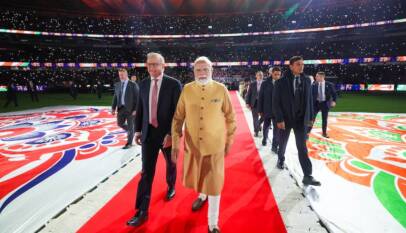

PM Modi, Australian Opposition Leader Angus Taylor Reaffirm Bipartisan Commitment to Stronger India-Australia Ties
Melbourne, July 2026 : Prime Minister Narendra Modi on Friday met Australian Opposition Le…
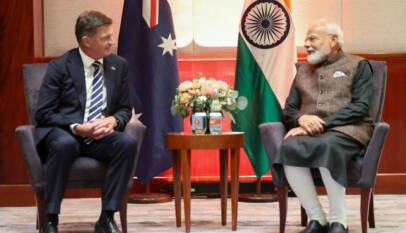
PM Modi, Australian Opposition Leader Angus Taylor Reaffirm Bipartisan Commitment to Stronger India-Australia Ties
Melbourne, July 2026 : Prime Minister Narendra Modi on Friday met Australian Opposition Leader …