How US Tomahawk Missiles in the Caribbean have demonstrated Supremacy.

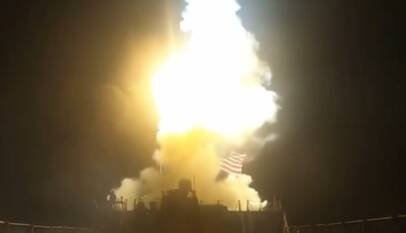
The U.S. Navy has expanded its presence in the Caribbean, deploying multiple warships and hundreds of Tomahawk missiles near Venezuela. U.S. officials asserted that the buildup is aimed at targeting drug trafficking operations linked to President Nicolás Maduro’s government. The number of missiles, approaching 200, matches the scale of U.S. deployments in past limited military campaigns, while highlighting Washington’s present military capabilities in the region amid heightened political and security tensions.
The U.S. Navy’s buildup in the Caribbean reflects an intensified focus on counter‑narcotics operations near Venezuela. For Washington, the deployment signals readiness to address alleged cartel activity linked to the country. U.S. forces have already carried out limited vessel strikes in the region as part of these operations.
On the otherside, for Venezuela, it represents a direct challenge to national sovereignty, prompting Maduro to activate emergency powers and mobilise the military. With Tomahawk missile numbers nearing levels seen in past conflicts, the situation highlights the broader strategic stakes in the region and carries potential global implications, signalling U.S. military reach and influencing international perceptions of power and stability in Latin America.

United States forces in the Caribbean currently carry an estimated 115 Tomahawk cruise missiles, with the arrival of three destroyers escorting the USS Gerald R. Ford aircraft carrier expected to add roughly 70 more. These missiles could strike drug cartel facilities or targets associated with the Maduro regime.
The total stock approaches levels used in prior limited campaigns, the 1999 bombing of Yugoslavia, had employed 218 Tomahawks, and in the 2011 intervention in Libya, 150 missiles were used.
The Tomahawk has been a central tool in U.S. precision strikes for decades. It was first deployed in 1991 during Operation Desert Storm, with 288 missiles hitting Iraqi defences in the opening days. It has since been used in Afghanistan, Yemen, Syria, and Iraq, as well as in targeted strikes against Iranian nuclear sites in June. The missile has consistently provided a high-explosive, long-range option for operations of limited duration and scope.
Upgrades and Capabilities –
The latest Tomahawk variant, introduced in 2021, features improved electronics and extended range, capable of striking targets between 1,600 and 2,500 kilometres (1,000 to 1,600 miles). Traveling at high subsonic speeds of roughly 550 mph, the missile remains precise, reliable, and relatively cost-effective at $2 million per unit, with a significantly larger payload than most other long-range strike options.
On 02nd November, 2025, President Donald Trump has outrightly rejected the possibility of the U.S. aggression against Venezuela, but at the same time has also suggested that Maduro’s time as the country’s leader may soon be coming to an end. When asked during an interview with CBS’s 60 Minutes whether Washington was preparing for military action against Venezuela, Trump said: “I doubt it. I don’t think so. But they’ve been treating us very badly“.
U.S. forces in the Caribbean remain positioned for targeted strikes, but the window for action may be limited. As the USS Gerald R. Ford and its escorting destroyers arrive, military planners will need to decide whether to use the amassed Tomahawks quickly or risk losing operational momentum.
While the buildup demonstrates U.S. capability for a precision air campaign, analysts note that a broader ground operation would require significant additional resources. The coming days will clarify whether this deployment remains a show of force, a limited strike campaign, or a precursor to more-sustained military action.
Team Maverick


Viren Rasquinha Questions India Hockey Team’s New Saffron Jersey
New Delhi, July 2026 : Former India hockey captain Viren Rasquinha has criticised Hockey I…

Viren Rasquinha Questions India Hockey Team’s New Saffron Jersey
New Delhi, July 2026 : Former India hockey captain Viren Rasquinha has criticised Hockey …