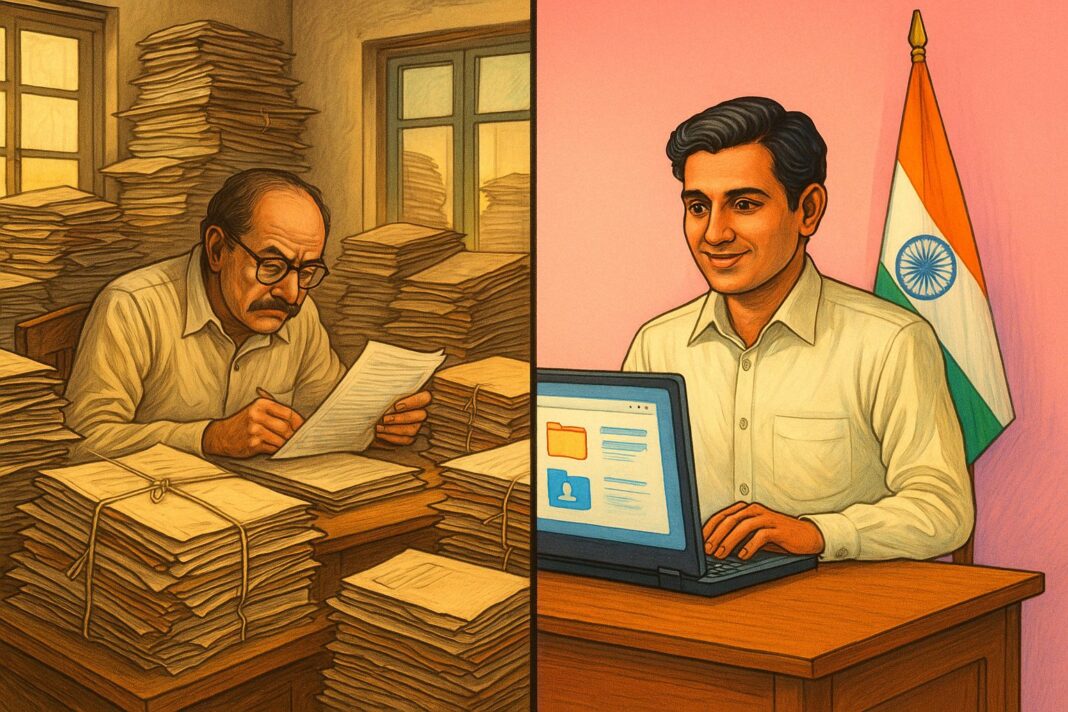
A New Model of Dynamic Governance: The E-Office Revolution

Oct 2025 : Once upon a time, stepping into a government office meant being greeted by towering piles of dusty files stacked on wooden tables — loose papers, faded pages, and lost applications buried in chaos. For decades, such scenes defined Indian bureaucracy. Citizens grew accustomed to hearing phrases like “The file hasn’t arrived yet,” “The signature is pending,” or “The case is with the ministry.” People had to visit offices repeatedly — not just to claim their rights, but to ensure their files didn’t “get stuck.” The reason was simple: the entire administrative system ran on paper. Files moved from hand to hand; tracing a missing one was like searching for a needle in a haystack.
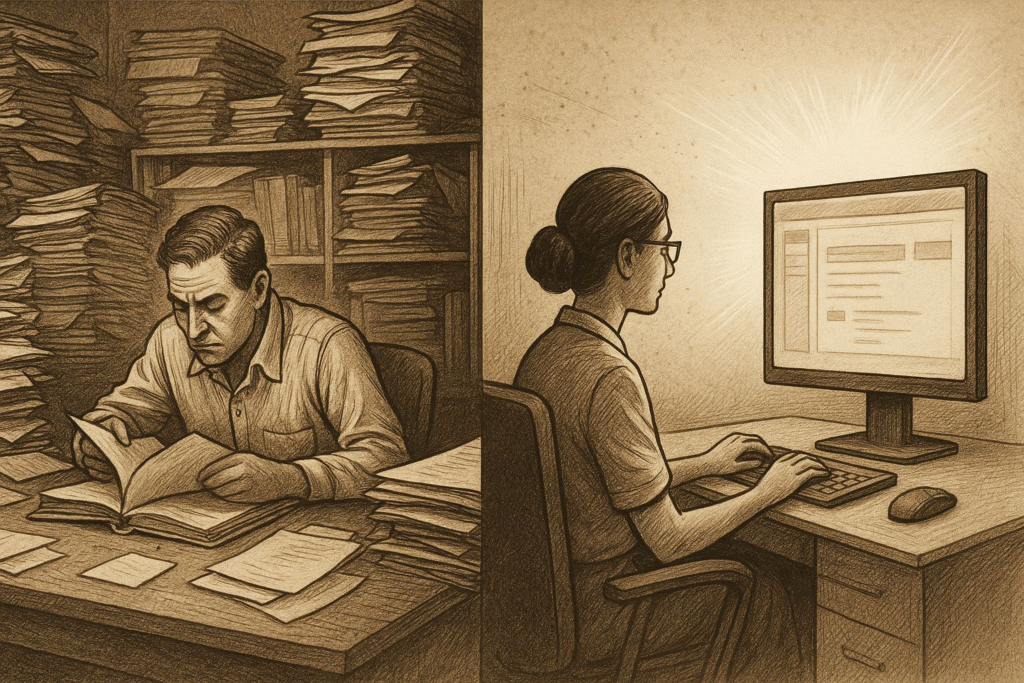
Chief Minister Devendra Fadnavis, recognizing this inefficiency, made a decisive move. As part of his 150-day administrative reform agenda, every department and office was mandated to adopt the e-Office system. The transformation began swiftly — and today, in the tribal district of Nandurbar, as many as 34 offices operate fully through e-Office.
Birth of the E-Office
In the early 2000s, the government realized that change was essential. As India entered the information technology era, the concept of e-Governance took shape — introducing digital tools into administrative work. The National Informatics Centre (NIC) developed the e-Office platform to make this vision real.
The concept was simple yet revolutionary: computers instead of paper, digital signatures instead of handwritten ones, and online file management instead of physical folders. Every application, letter, or proposal was created digitally; remarks, orders, and approvals were recorded online. The question “Where is my file?” became obsolete.
The First Steps Toward Change
The journey was not easy at first. Many employees were unfamiliar with computers and found typing difficult. The habit of working on paper was deeply ingrained. But as experience grew, attitudes changed. Early successes — faster approvals and timely decisions — built confidence. People realized that e-Office was not just a technical upgrade but a cultural shift in governance. Dependence on paper decreased, costs fell, and the decision-making process accelerated. Officials gained better control, and citizens began receiving timely responses.
Nandurbar’s Digital Transformation
Nandurbar, a remote tribal district surrounded by hills, had long struggled with access to administration. Once, citizens had no way of knowing where their applications were or when they would be approved. Then, under the leadership of District Collector Dr. Mitali Sethi, e-Office was introduced. Training sessions were held, network connectivity was improved, and departments were linked to the new system.
Now, every incoming application is logged digitally. Its scanned copy is uploaded to the portal, sent to the relevant officer, and its status can be tracked in real time. Applicants receive a tracking number, allowing them to monitor progress online.
A Farmer’s Experience
For Ramesh Pawra, a small farmer from Akkalkuwa, applying for land registration used to mean endless visits to the tehsil office and hearing the same excuses — “The file is missing,” “The signature is pending,” “It hasn’t moved forward.” This year, his application was submitted via e-Office. Within two days, he checked the status at the local Common Service Centre — the file had reached the tehsildar. A few days later, approval came through. Smiling, Ramesh said, “Earlier, my file was stuck in a mountain of red tape; now it moves like a bullet train.” His story is one of many that symbolize Nandurbar’s new era of fast and responsive administration.
Tangible Changes in Key Departments
E-Office has transformed the Revenue, Health, and Education departments. Land mutation and inheritance applications now conclude within days instead of months. The district hospital processes medicine procurement, doctor appointments, and correspondence digitally — cutting approval times by half. In the education sector, proposals for school repairs, teacher transfers, and student scholarships are handled online, ensuring funds and stipends reach on time.
Transparency and Accountability
The greatest success of e-Office is transparency. Every file’s location, handler, and pending duration are visible on the system, establishing accountability and curbing corruption. Lost files are no longer blamed on clerical lapses — the system itself maintains digital records. The administration has effectively realized the concept of a paperless office — reducing paper usage, printing costs, and benefiting the environment.
A New Dawn in Remote Areas
Nandurbar’s rugged terrain often suffers from poor electricity and internet connectivity. Yet, through planning and persistence, offices were connected to e-Office, staff trained, and digital infrastructure strengthened. For a farmer living at the foot of a hill, seeing his application move digitally to the Collector’s office is not just technological progress — it’s a new experience of democracy.
Challenges and Lessons
The transition was not without hurdles. Technical glitches, power outages, and employee apprehensions slowed progress initially. However, with repeated training, patience, and teamwork, these obstacles were overcome. The journey proved that with strong willpower and citizen trust, lasting reform is achievable.
The Next Chapter
The e-Office journey extends beyond Nandurbar — it mirrors Maharashtra’s digital governance revolution. The state aims for a “Paperless Secretariat,” and progress across districts is encouraging. In coming years, artificial intelligence and data analytics will enhance e-Office, making files smart — capable of tracking progress, assisting decisions, and sending automatic alerts for delays.
E-Office is more than software — it represents a new work culture rooted in responsibility, transparency, and respect for time. When an elderly pensioner receives timely approval, it’s not just an administrative action — it’s a reflection of governance with a human touch.
Today, the phrase “The file is lost” belongs to history. The new reality is “The file is one click away.” Perhaps, years from now, we will look back and realize — e-Office was not merely a computer system; it was the first page of a new chapter in India’s democracy.




Govt. to formulate policy to provide relief in encroachment cases involving poor and landless families: CM
Chief Minister Thakur Sukhvinder Singh Sukhu today laid the foundation stone of the new Mu…
Govt. to formulate policy to provide relief in encroachment cases involving poor and landless families: CM
Chief Minister Thakur Sukhvinder Singh Sukhu today laid the foundation stone of the new …