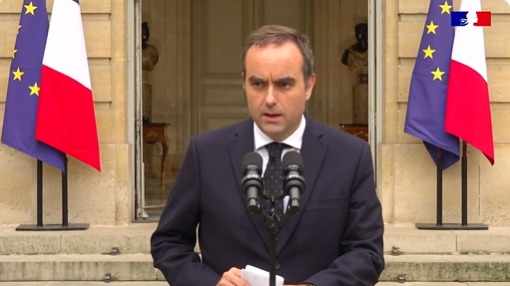
France’s Political Crisis Deepens as PM Lecornu Seeks Cross-Party Backing Amid Government Deadlock

Paris, Oct 2025 : France’s outgoing Prime Minister Sébastien Lecornu on Tuesday launched a final attempt to secure cross-party support for a new cabinet that could steer the nation out of its deepening political deadlock.
President Emmanuel Macron, who appointed the 39-year-old Lecornu in early September after parliament toppled his predecessor over a controversial austerity budget, now faces mounting pressure to resolve the impasse that has paralysed governance for over a year.
Lecornu unveiled his proposed cabinet on Sunday, but the announcement quickly drew criticism for recycling many ministers from the previous administration. The backlash was immediate and intense, prompting Lecornu to tender his resignation on Monday morning.
However, in a dramatic twist later that evening, Lecornu agreed to Macron’s request to remain in office for two more days to explore the possibility of saving his government. A presidential aide said Lecornu had been tasked with “conducting final negotiations by Wednesday evening to define a platform of action and stability for the country.”
The aide, who requested anonymity, added that Macron was “ready to assume his responsibilities” if Lecornu’s mission failed — a statement widely interpreted as a hint that the president might dissolve parliament and call fresh legislative elections.
Lecornu began his marathon round of talks at 9:00 am (0700 GMT) Tuesday, meeting leaders of various political parties at the Hôtel de Matignon, the prime minister’s residence, in a bid to broker an agreement.
France has been trapped in political turmoil since Macron’s decision to call snap parliamentary elections in mid-2024, which resulted in a hung parliament. The instability has severely weakened Macron’s centrist bloc ahead of the 2027 presidential election, seen as a defining moment in French politics.
The far-right, led by Marine Le Pen, now senses its strongest opportunity yet to take power. Le Pen on Monday called it “wise” for Macron to resign and demanded immediate legislative elections, calling them “absolutely necessary.” Her party’s leader, Jordan Bardella, declared that the National Rally (RN) was “ready to govern.”
Amid growing dissent, voices within Macron’s own camp are showing signs of fatigue. Gabriel Attal, Macron’s former prime minister and current leader of the president’s centrist Renaissance Party, said he no longer understood the president’s strategy. “After a succession of prime ministers, it is time to try something else,” he remarked.
Former Prime Minister Édouard Philippe, a centre-right figure and possible 2027 contender, criticized what he described as a “distressing political game,” urging Macron to hold early presidential elections once the 2026 budget is passed.
Lecornu, meanwhile, faces a formidable challenge in reconciling France’s fractured political landscape. Socialist Party chief Olivier Faure has demanded “a change of course” through the formation of a left-leaning government, while Bruno Retailleau, leader of the conservative Republicans and outgoing interior minister, signaled openness to cooperation — provided his party’s influence is not diminished.
Both Lecornu’s immediate predecessors, François Bayrou and Michel Barnier, were ousted after parliamentary defeats on the same austerity budget issue. The recurring confrontations reflect deep resistance across the political spectrum to Macron’s fiscal tightening measures.
Any future premier will inherit the daunting task of passing the spending bill in a chamber where the pro-Macron bloc lacks a majority. The challenge is compounded by France’s ballooning public debt, which has climbed to one of the highest debt-to-GDP ratios in the EU, trailing only Greece and Italy — nearly twice the 60% limit set by EU rules.
Despite mounting calls for change, Macron has ruled out resigning before his term ends in 2027. If Lecornu’s efforts fail, the president may opt to appoint yet another prime minister — the eighth under his tenure — but without a major political shift, any new government may face the same fate as its predecessors.
As Lecornu works against the clock, France’s political uncertainty continues to deepen, with its leadership gridlocked and the country’s economic stability hanging in the balance.





Ukraine Signs Agreement With Sweden For The Procurement Of 16 Gripen Fighter Jets.
Stockholm; July 2026: President of Ukraine Volodymyr Zelenskyy held a meeting with Ministe…
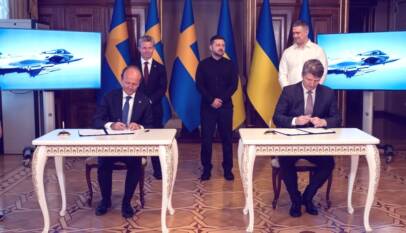
Ukraine Signs Agreement With Sweden For The Procurement Of 16 Gripen Fighter Jets.
Stockholm; July 2026: President of Ukraine Volodymyr Zelenskyy held a meeting with Minister for …